
-
Fortnite Cheats — Aimbot, ESP, Wallhack & DMA Hacks
Undetected Fortnite Cheats : Pacific Break. Updated within hours of every patch. Aimbot, ESP, triggerbot, radar, and DMA hardware.
-
Featured Products
-
650 Million Accounts and the Widest Skill Gap in Battle Royale
Fortnite is the only battle royale where shooting someone isn't enough. You land a clean shot, and your opponent instantly throws up a wall, ramps over you, edits a window, and hits you with an Iron Pump Shotgun before you can process what happened. That building mechanic — the thing that made Fortnite famous — is also the thing that makes it nearly impossible for casual players to compete in 2026. Every other BR rewards aim and positioning. Warzone lobbies are decided by who sees who first. Apex rewards movement and ability timing. Fortnite rewards aim, positioning, building speed, editing speed, piece control, material management, and the ability to do all of those simultaneously under pressure.
The numbers tell the story of a game that refuses to slow down. Over 650 million registered accounts exist worldwide, with roughly 30 million players logging in daily across PC, PlayStation, Xbox, Switch, and mobile — putting it alongside Counter-Strike 2 as one of the most populated competitive shooters on the planet. Chapter 7 Season 1 — Pacific Break — launched November 29, 2025, bringing a Hollywood-inspired map with new POIs like Battlewood Boulevard, Sandy Strip, Classified Canyon, and Bumpy Bay. The Remix: The Finale concert event in November 2024 pulled 14.3 million concurrent players, the largest in-game concert audience in gaming history. Fortnite generated over $5.8 billion in revenue in 2021 alone, with total lifetime revenue exceeding $26 billion. Epic Games isn't slowing down content releases either — the 2026 roadmap locks in updates every two weeks through the end of the year, with Chapter 8 expected to launch in late November.
But all that growth has created a brutal environment for anyone who doesn't play eight hours a day. The average active Fortnite lobby in 2026 contains players with hundreds or thousands of hours of building practice. They can crank 90s at full speed, triple-edit in under a second, and execute piece control sequences that trap you inside their builds before you realize what's happening. If you took a break — even for a single season — the meta moved without you. Chapter 7's new wave launcher drop system, wingsuit traversal, and hot air balloon mechanics add even more layers to master. The skill floor keeps rising, and the gap between casual and competitive players has never been wider. That's the reality of Fortnite in 2026, and that's exactly why the demand for tools that close that gap has never been higher.

How Easy Anti-Cheat Protects Fortnite — and Where It Falls Short
Fortnite runs Easy Anti-Cheat (EAC) with kernel-level driver access, meaning it loads before the game itself and monitors system memory, running processes, and file integrity in real time. Epic Games supplements EAC with proprietary server-side detection that uses statistical analysis and machine learning to flag suspicious player behavior — accounts with abnormally high headshot rates, impossible reaction times, or movement patterns that don't match human input. Together, these systems represent one of the more aggressive anti-cheat setups in the battle royale space — comparable to Valorant's Vanguard in terms of kernel-level depth, but with heavier reliance on behavioral analytics.
In February 2025, Epic overhauled its ban policy. First-time cheating offenses now result in a one-year matchmaking ban instead of a permanent ban — players can still log in and chat, but they can't play any Epic or creator-made experience for twelve months. Second offense means a lifetime ban with no appeal. Competitive players caught cheating in FNCS or other tournaments face immediate lifetime tournament bans and may forfeit previously earned prize money. Epic isn't bluffing about legal action either: throughout 2025, the company secured a $175,000 court judgment against a tournament cheater, filed lawsuits against cheat software developers, and reached settlements with account thieves and DDoS operators.
The February 2026 anti-cheat update raised the bar further. All PC tournament players must now have three hardware security features enabled: Secure Boot, TPM (Trusted Platform Module), and IOMMU (Input-Output Memory Management Unit). IOMMU is specifically designed to prevent DMA (Direct Memory Access) hardware from reading game memory — a direct response to the growing popularity of hardware-based cheats that operate from external devices. If IOMMU isn't enabled, the game simply blocks tournament entry rather than issuing a ban. For casual and ranked play, these requirements don't apply yet, but the direction is clear: Epic is progressively tightening hardware-level protections across all competitive modes.
Where does EAC actually fall short? The system excels at detecting known cheat signatures — public, widely distributed software gets flagged within days. But EAC struggles with three categories: private, low-distribution cheats with unique code bases; hardware-level solutions that operate outside the OS kernel; and softaim implementations that mimic human mouse movement patterns closely enough to pass statistical detection. The machine learning layer catches some of these over time, but the detection delay creates a window where well-configured tools can operate without triggering automated flags. That window is what separates amateurs who download free cheats and get banned in hours from users who understand the detection model and configure their tools accordingly.
Aimbot — Precision Engineered for Chapter 7's Weapon Pool
Chapter 7 introduced an almost entirely new loot pool, and every weapon handles differently. The Enforcer AR fires fast with steady mid-range accuracy. The Deadeye AR behaves like the old Heavy AR with a scope — devastating at distance but punishing if you spray. The Iron Pump Shotgun rewards single-shot timing with high damage per pellet. The Twin Hammer Shotguns offer rapid follow-up shots but require tracking. The Holo Rush SMG melts close range, and the Dual Micro SMGs deliver extreme burst damage at point-blank. Each weapon has unique recoil patterns, damage falloff curves, and optimal engagement distances.
A properly configured aimbot accounts for all of this. FOV (Field of View) control determines how large a cone the aimbot scans for targets — narrow for the Deadeye AR or Vengeful Sniper Rifle where precision matters, wider for the Holo Rush SMG or shotgun fights where speed matters. Smoothing controls how quickly the crosshair moves to target, with separate horizontal and vertical speed adjustments. High smoothing looks natural but tracks slower. Low smoothing locks instantly but appears mechanical on replay. The balance depends on the weapon you're holding and the engagement distance.
Bone targeting lets you prioritize headshots for maximum damage or switch to chest/body targeting for higher hit probability during chaotic build fights where heads appear and disappear through edit windows. Visibility checks ensure the aimbot only locks onto targets you can actually hit — no shooting through walls or builds that would generate obvious replay evidence. Prediction systems calculate target movement and compensate for bullet travel time, which matters more with projectile-based weapons like sniper rifles than with hitscan weapons like the Enforcer AR. Recoil compensation automatically counters each weapon's kick pattern, keeping sustained fire on target through full magazine sprays.
The key to using aimbot effectively in Fortnite isn't just turning it on. It's configuring different presets for different weapons and switching between them. A shotgun preset with wide FOV, minimal smoothing, and head targeting plays completely differently from a sniper preset with narrow FOV, high smoothing, and chest targeting. Players who run a single generic configuration across all weapons are the ones who get flagged by statistical detection — their performance becomes unnaturally consistent across weapon categories that shouldn't produce identical accuracy numbers.
ESP — Complete Awareness Across the Pacific Break Map
Pacific Break is a smaller, more tightly structured island than the Chapter 6 map, which means third-party encounters happen faster and more frequently. Battlewood Boulevard's dense buildings create close-quarters fights where sound alone can't tell you which floor an enemy is on. Classified Canyon has underground sections — including a hidden base inspired by Area 51 — where enemies can appear from ziplines and tunnels you didn't know existed. Sandy Strip's open terrain makes rotation dangerous without knowing where other squads are positioned. Hot air balloons give sniper players elevated positions across the entire map, and wingsuits create constant aerial threats with visible smoke trails.
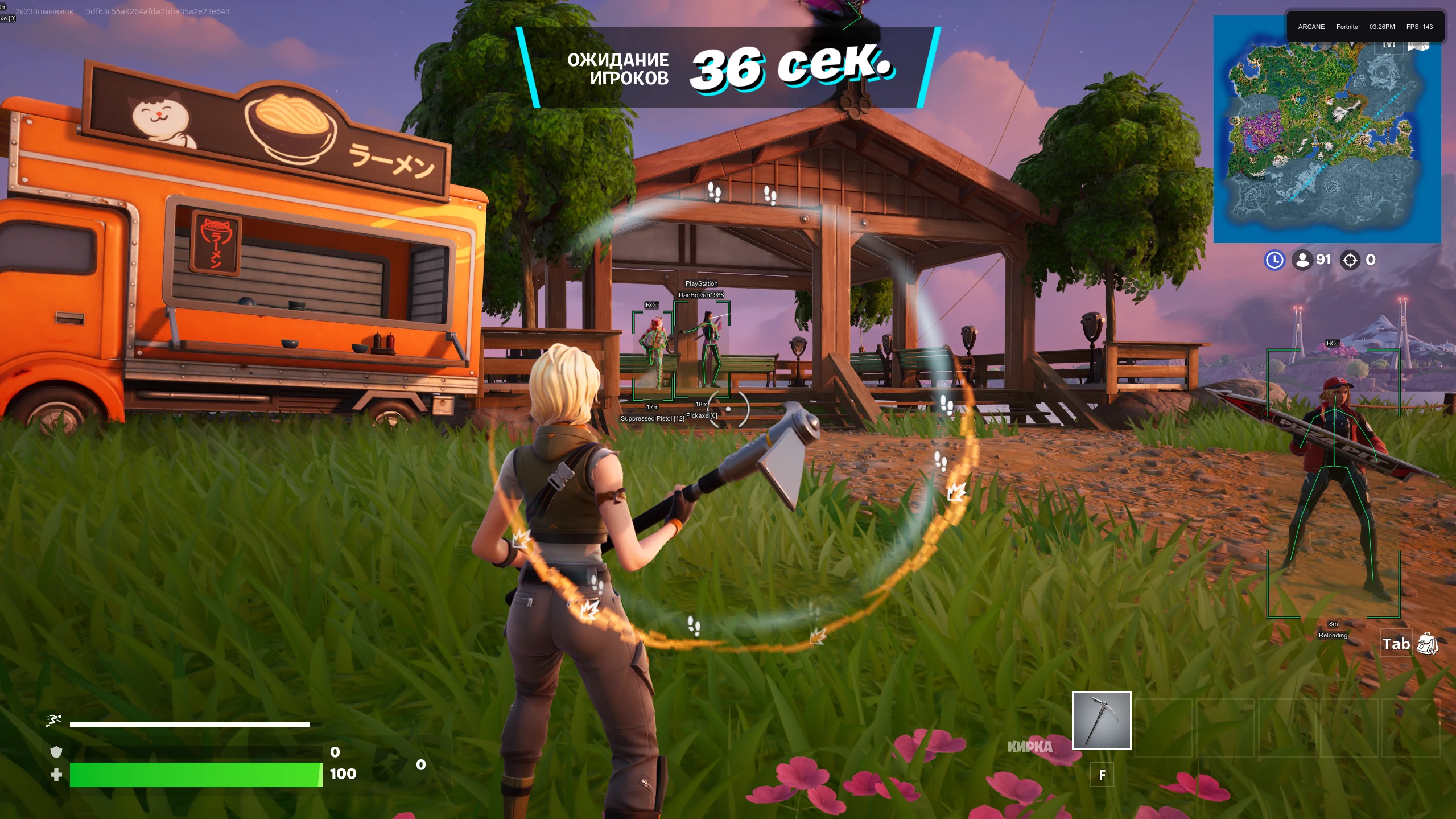
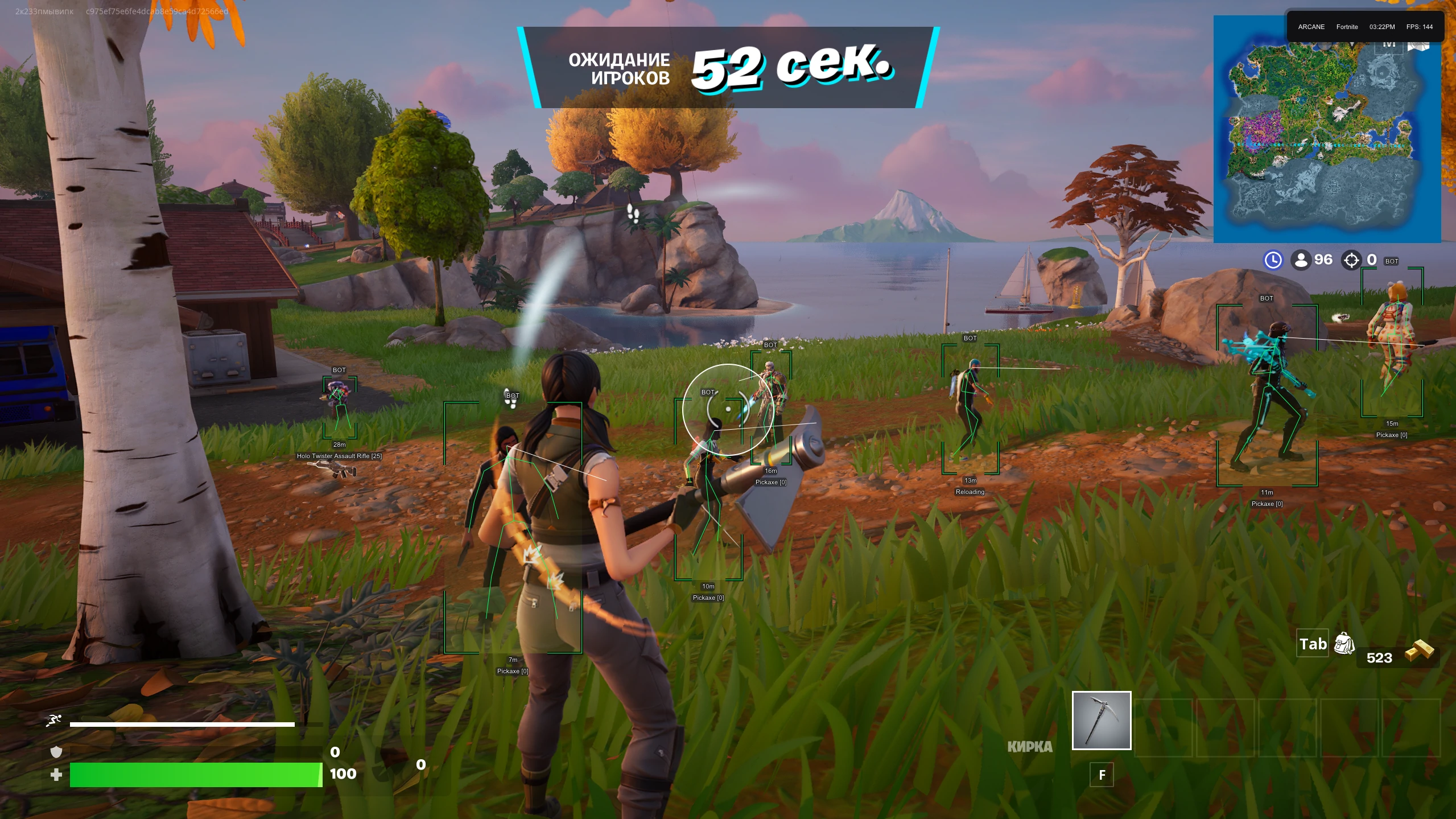
Player ESP solves all of this by rendering every enemy through walls, terrain, and structures with customizable box outlines or skeleton overlays. Distance tags show exactly how far each player is — critical for deciding whether to engage or rotate. Health bars reveal weakened opponents worth pushing versus full-health squads that should be avoided. Weapon tags display what each enemy is carrying, so you know whether you're walking into a shotgun player at point blank or a Vengeful Sniper Rifle holder who's waiting for you to peek. Name display helps track specific players across a match, especially useful in competitive lobbies where you recognize dangerous opponents.
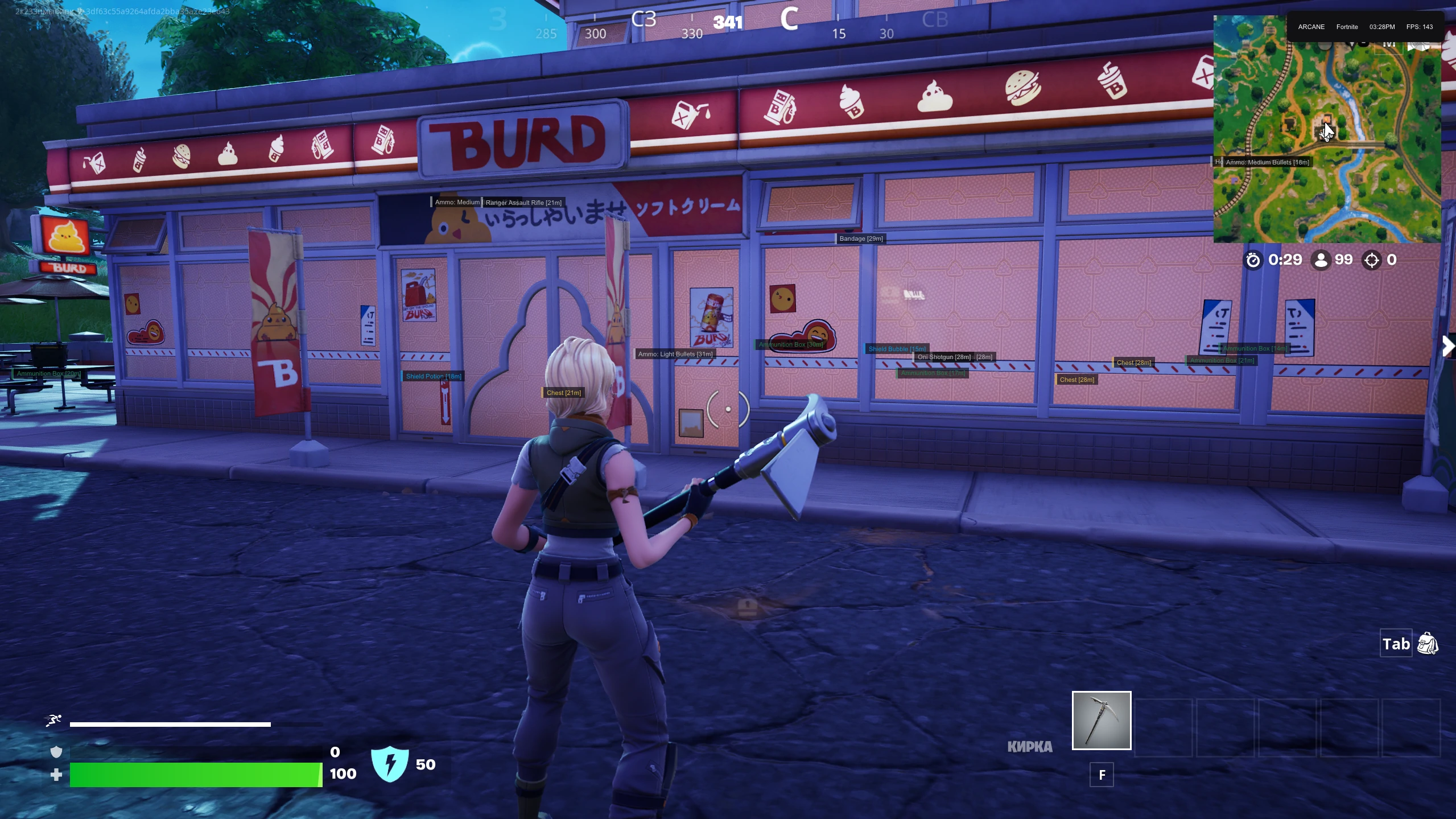
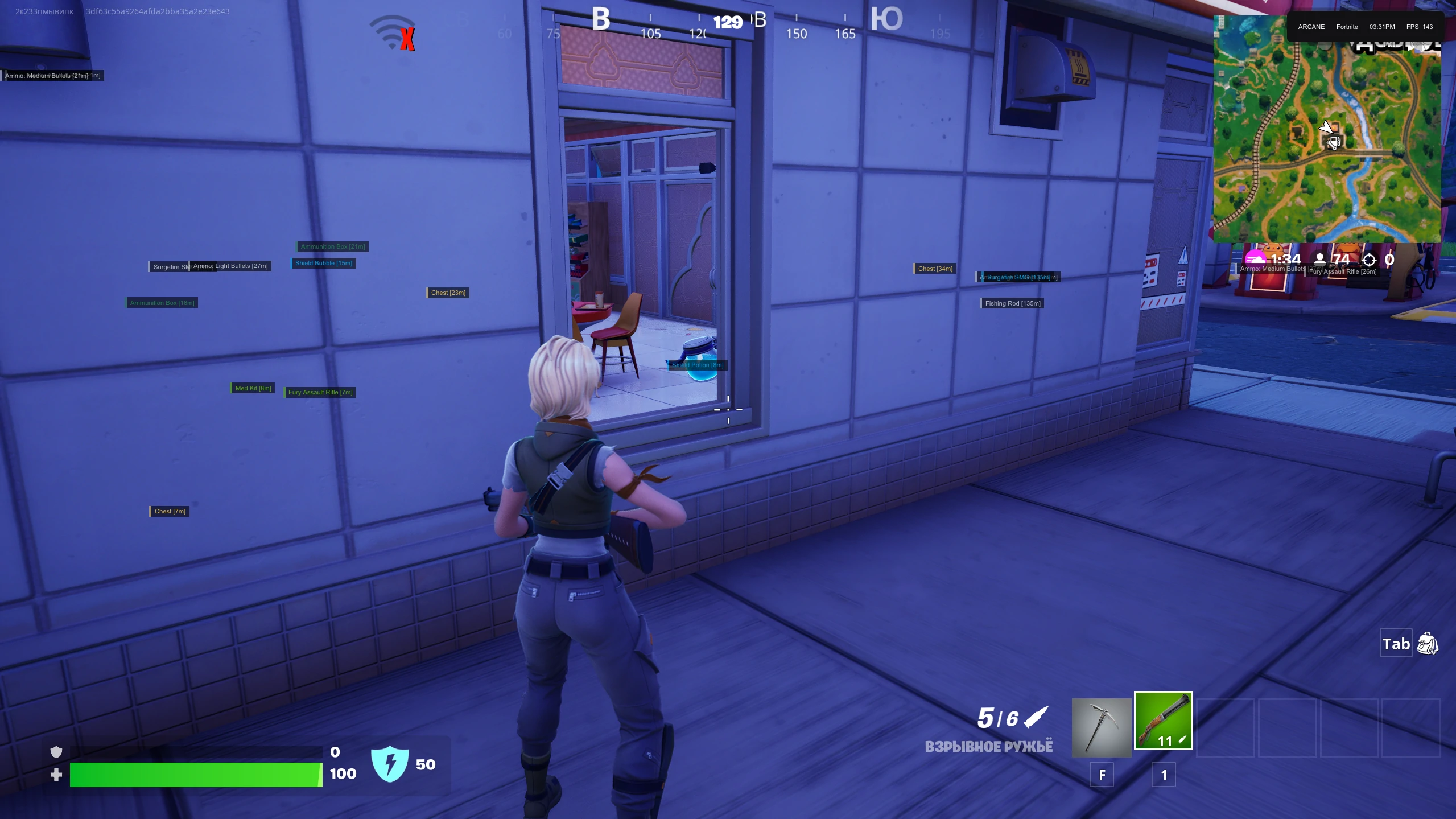
Item and loot ESP highlights weapons, shield potions, med packs, and ammo through floors and walls across the entire map. In Chapter 7, this is particularly valuable because the new loot pool means players are still learning where high-tier gear spawns. Legendary weapons appear in Classified Canyon's underground section and in specific rare chests throughout Battlewood Boulevard — knowing exactly where they are before anyone else gets there creates an early-game advantage that compounds throughout the match. The store carries multiple products with different ESP configurations, from minimal distance-only overlays to full information displays with health, weapon, inventory, and movement direction data.
Triggerbot — Automated Fire Timing for Split-Second Edit Windows
Fortnite's building mechanic creates a unique aiming problem that no other BR has: edit windows. The dominant playstyle in competitive Fortnite involves boxing your opponent (placing walls around them), then editing a small opening in your wall, firing a shotgun shot through it, and closing the edit — all within roughly 200 to 300 milliseconds. The window of time where your opponent is actually visible and shootable is extremely small. Miss that window and you've wasted your edit advantage. Hit it perfectly and you deal 150+ damage with a clean Iron Pump headshot.
A triggerbot automates the firing action the instant your crosshair passes over an enemy hitbox. In Fortnite, this is most valuable with shotguns, where a single perfectly timed shot outperforms spray-and-pray. Shotgun-only mode restricts the triggerbot to shotgun weapons, preventing it from wasting SMG or AR ammo on distant targets. Custom delay settings prevent inhuman reaction times — a zero-delay triggerbot fires within one frame of seeing a target, which looks suspicious in replays. Adding 30 to 80 milliseconds of simulated delay produces timing that falls within normal human reaction ranges while still being faster and more consistent than manual firing.
Max distance controls limit triggerbot activation to ranges where your current weapon is effective. An Iron Pump Shotgun triggerbot with a 15-meter max range won't accidentally fire at a player 80 meters away, maintaining realistic engagement patterns. Combined with aimbot, the triggerbot creates a system where you open an edit, your crosshair snaps to the nearest visible enemy, and your weapon fires — all within a single edit-peek-close sequence. That's the combination that turns average builders into players who actually win their box fights.
Radar — The Information Advantage That Doesn't Touch Your Aim
Not everyone wants aimbot. Some players have strong mechanical skills but lose fights because they didn't know someone was behind them, above them, or rotating toward their position. Radar provides a two-dimensional minimap overlay showing the real-time position and movement direction of every player within range. It uses the same data as ESP but presents it in a compact overhead view that doesn't clutter your main screen.
In Chapter 7, radar is especially useful during the new wave launcher drop phase. Instead of diving from the Battle Bus, matches start at the edge of the storm and players ride a wave launcher inward — timing your jump increases how far you travel. Radar shows where other players are dropping in real time, letting you identify uncontested landing spots or intentionally land on isolated opponents before they find weapons. During mid-game rotations, radar reveals squad movements across the map so you can avoid third-party sandwiches or position yourself to clean up teams that just finished fighting. In endgame, where the storm shrinks the playable area to a tiny circle, radar shows exactly where every remaining player is hiding — information that's worth more than any weapon upgrade.
Radar is also the lowest-risk feature category because it doesn't alter your aim, your fire timing, or your movement. It only gives you information. There's no replay evidence that proves you had radar — you just happened to look in the right direction, rotate at the right time, and avoid the right spots. For players who want an edge without any mechanical assistance, radar alone can move a consistent top-20 player into consistent top-5 territory.
DMA Hardware — External Operation Below EAC's Detection Layer
Software-based cheats run on the same machine as Fortnite and EAC, which means they exist in the same memory space that EAC monitors. DMA (Direct Memory Access) hardware solutions operate from a physically separate device — a second computer connected to the gaming PC via a PCIe card that reads game memory through hardware-level access. The cheat software runs entirely on the external device. The gaming PC sees only normal mouse and keyboard inputs routed through a KMBox or similar input device. EAC cannot scan, detect, or even identify the external hardware because it exists outside the operating system's addressable space.
Epic's February 2026 IOMMU requirement for tournaments is a direct counter to DMA hardware. IOMMU restricts which hardware devices can access system memory, theoretically blocking unauthorized DMA reads. However, this requirement currently applies only to tournament modes. Standard Battle Royale, Ranked, Reload, and Creative modes do not enforce IOMMU, leaving DMA hardware fully operational for the vast majority of Fortnite gameplay. Even in tournament environments, IOMMU implementations vary by motherboard manufacturer and firmware version, creating inconsistencies that sophisticated DMA firmware can potentially navigate.
The practical advantage of DMA is straightforward: it cannot be detected by any software-based anti-cheat scan. Period. EAC's kernel driver, Epic's statistical analysis, and behavioral detection can still flag suspicious gameplay patterns, but they cannot identify the tool itself. This means DMA users face detection only through their gameplay behavior — making proper configuration (appropriate smoothing, realistic accuracy percentages, varied hitbox targeting) the only real security consideration. For detailed information on DMA setup, compatibility, and firmware requirements, see the DMA hardware guide.
Chapter 7 Tactics — How Features Map to Current Meta Situations
Chapter 7's Pacific Break map plays differently than any previous Fortnite map, and effective tool usage requires understanding the specific situations you'll encounter this season.
Wave Launcher Drops: The new drop system starts you at the storm's edge riding inward on a wave launcher. Timing your jump determines distance. With ESP active, you can see exactly where other players are jumping and where they're landing, letting you either contest a specific enemy (if you're confident in your loadout skills) or find completely uncontested ground. Radar makes this even cleaner — the overhead view shows player density across the entire drop path.
Battlewood Boulevard Fights: The main POI features multi-story buildings, narrow streets, and a cinema. Close-quarters combat dominates here. An Iron Pump Shotgun with aimbot configured for wide FOV, head targeting, and minimal smoothing is the optimal setup. ESP showing enemy positions through building walls prevents you from getting flanked through doorways you didn't cover. Triggerbot set to shotgun-only mode with 40-60ms delay fires perfect edit-peek shots.
Classified Canyon Runs: The underground base section contains rare chests with legendary weapons. The zipline descent and green goo (which grants temporary invisibility) create chaotic fights where knowing enemy positions through ESP is the difference between getting ambushed and controlling the engagement. Item ESP marks the rare chest locations so you can grab them and leave before other squads even find the entrance.
Hot Air Balloon Sniping: Chapter 7 introduced hot air balloons as traversal vehicles that double as elevated sniping platforms. The Vengeful Sniper Rifle combined with aimbot prediction and narrow FOV creates devastating long-range capability from a balloon. ESP shows distance to every player on the ground, letting you engage only targets within effective range. The tradeoff: you're visible to everyone while riding a balloon, so radar helps you track approaching threats.
Endgame Storm Circles: Late-game Fortnite is a build fight. The storm forces everyone into a tiny area, builds stack on top of each other, and the last team standing wins. ESP showing every player's exact position through layers of builds is the single most valuable feature in endgame. You know who's above you, below you, beside you, and who's weak enough to push. Without ESP, endgame is chaos. With it, you're making calculated decisions while everyone else is guessing.
Choosing the Right Tool for Your Playstyle
BurgerCheats carries four separate Fortnite products at different price points and feature levels. Rather than listing specifications, here's how to choose based on how you actually play.
If you play casual solos or duos and just want to win more: Start with the most affordable option. A basic ESP plus aimbot package gives you the two features that produce the biggest immediate improvement — you'll see everyone, and you'll hit your shots. No complex configuration needed. Set aimbot to medium smoothing, body targeting, and moderate FOV, and you'll immediately notice a difference without needing to learn advanced settings.
If you play ranked and care about climbing: Mid-tier options that include triggerbot and more granular ESP controls let you fine-tune for competitive settings. Ranked lobbies have tighter SBMM (Skill-Based Matchmaking), so your opponents are closer to your skill level. The advantage from triggerbot in build fights — where perfectly timed shotgun shots win every box fight — is worth the price difference over basic packages. Configure everything to look natural: higher smoothing, varied hitbox targeting, and realistic accuracy ranges.
If you stream, create content, or play in any monitored environment: Products with streaming mode ensure your overlay is invisible in OBS, Streamlabs, or any screen capture software. The ESP, aimbot menu, and all visual indicators are hidden from recordings while remaining visible on your monitor. Multiple products include this feature — check the store for specific streaming mode availability.
If maximum security is your priority: DMA hardware solutions operate from external devices that are invisible to EAC entirely. The higher upfront cost includes both software and hardware-level protection that software-only solutions cannot match. If your account has significant skin inventory value or you play in any competitive capacity, DMA is the safest long-term investment. Check the status page before purchasing to confirm current detection status for all products.
Account Safety — What Gets You Banned and What Doesn't
Epic's anti-cheat operates on two layers, and understanding both is essential for long-term account safety.
Layer 1: EAC Signature Detection. This catches known cheat binaries, injected DLLs, modified game files, and known memory patterns. It's fast and automated — detected software triggers a ban within hours or days. Defense: use private, regularly updated software that EAC hasn't profiled. Public cheats, free downloads, and open-source tools on GitHub get signature-detected almost immediately. The products at BurgerCheats are updated within 2-4 hours of every Fortnite patch specifically to stay ahead of new EAC signatures.
Layer 2: Behavioral/Statistical Detection. This monitors your gameplay statistics over time and flags accounts that deviate significantly from normal human performance. Key thresholds that trigger review include headshot percentages consistently above 40-50% (depending on weapon category), K/D ratios that spike dramatically from your historical baseline, win rates that jump from 2-3% to 15%+ overnight, and accuracy numbers that remain suspiciously consistent across different weapon types and engagement distances.
Practical rules for staying under behavioral detection:
Vary your hitbox targeting. Don't run headshot-only aimbot in every fight. Switch between head, chest, and body targeting. Real players don't hit 80% headshots — they hit a mix of head, chest, and limb shots depending on the situation. Configure your aimbot to reflect this.
Lose fights intentionally. Not every fight, but enough to keep your stats within normal ranges. If your K/D was 1.2 before using tools, don't let it rocket to 5.0 in a single week. Gradual improvement over weeks looks natural. Sudden spikes don't.
Don't use ESP to make impossible rotations. If three squads are hiding in buildings with no line of sight and you perfectly avoid all of them, your pathing looks suspicious on server-side replay analysis. Use ESP to make informed decisions, not omniscient ones. Sometimes the "right" play is to walk into a fight you know about and win it naturally rather than avoiding it with perfect routing.
Match your stats to your lobby level. SBMM places you in lobbies based on your recent performance. If your stats climb too fast, SBMM puts you in stronger lobbies where your actual skill (without tools) can't keep up convincingly. The result is account flagging. Let your improvement curve match what SBMM expects — steady, gradual, and punctuated by occasional bad games.
Use different configurations for different modes. Your casual solo stats should look different from your ranked stats, which should look different from your Reload stats. Running identical accuracy numbers across all modes is a statistical red flag. Vary your settings by mode.
Frequently Asked Questions
Does Fortnite use Easy Anti-Cheat or BattlEye?
Fortnite uses Easy Anti-Cheat (EAC) with kernel-level driver access. Epic Games also runs proprietary server-side detection using statistical analysis and machine learning algorithms to identify suspicious gameplay patterns. As of February 2026, tournament modes additionally require Secure Boot, TPM, and IOMMU hardware security features enabled in BIOS.What happens if I get banned?
First-time cheating offenses (since April 2025) result in a one-year matchmaking ban. You can still log in and use text/voice chat, but you cannot play any matchmade experience. Second offense results in a permanent lifetime ban. Tournament cheating results in immediate lifetime tournament ban plus potential forfeiture of prize money and legal action.Can I use cheats on console?
Software-based cheats work on PC only. Console players can use external hardware solutions (DMA devices with capture cards) that read game data from the HDMI output, but these operate differently from PC-based tools. All products listed at BurgerCheats are designed for PC Windows environments.How fast are updates after Fortnite patches?
Fortnite patches every two weeks on the Chapter 7 schedule. BurgerCheats products are typically updated within 2-4 hours of any game patch. Check the status page for real-time detection status and update availability before launching any product after a patch.Will cheats work in Chapter 7 Season 2?
Chapter 7 Season 2 launches March 19, 2026, with expected map changes, new weapons, and loot pool adjustments. Major season transitions may require slightly longer update times (6-12 hours) as new game structures are analyzed and integrated. All active subscriptions continue through season transitions without additional cost.Is DMA hardware still safe after the IOMMU requirement?
IOMMU is currently required only for tournament modes (FNCS and similar competitions). Standard Battle Royale, Ranked, Reload, and Creative modes do not enforce IOMMU. DMA hardware remains fully operational for all non-tournament Fortnite gameplay. If IOMMU requirements expand to ranked or casual modes in the future, firmware updates will be released to address the change.Can I use tools while streaming?
Yes. Multiple products include streaming mode that hides all visual overlays from screen capture software including OBS, Streamlabs, and Discord screen share. Your audience sees clean gameplay while you retain full ESP, aimbot, and radar visibility on your monitor.What's the difference between software and DMA products?
Software products run on your gaming PC and rely on anti-cheat bypass code to avoid EAC detection. They're updated frequently and are more affordable. DMA products run on external hardware connected via PCIe, operating completely outside your gaming PC's software environment. DMA cannot be detected by any software-based anti-cheat scan, making it the safest option for high-value accounts. See the DMA hardware guide for detailed setup information.Start Winning More Fights in Fortnite
Fortnite in 2026 is a game where the skill floor rises every season. Chapter 7's new mechanics, weapons, and map layout add complexity on top of a building system that already requires thousands of hours to master. The players in your lobbies have put in that time. If you haven't — or if you took a break and the meta left you behind — the gap between where you are and where you need to be is wider than ever.
BurgerCheats offers multiple Fortnite products covering every feature category and budget range, from basic ESP-only packages to full DMA hardware solutions with aimbot, triggerbot, radar, and streaming mode. Every product is covered by 24/7 live support, same-day patch updates, and a satisfaction guarantee. Browse the complete Fortnite product lineup, verify current detection status on the status page, and start closing the gap today.
-
-
Total Members 5,530
-
Most Online 149
-
Newest Member 순용 황

-
-
Reviews
-

By Xulsty · Posted
Easiest cheese every to download and use for real, bought it like 4 times and loved it every time -

By sacisback · Posted
I needed to find an HWID spoofer and came across one here. It’s great—the technical support is fast as well, and they respond quickly through their ticket system. I haven’t had any issues using it; everything is automated, and there’s no risk of scam -

By Discord Review · Posted
+rep @admin really fast support and noce cutom service the delivery speed was fast he helped me with the settings you need to change an do and that in 10 min thats crazy. -

-

By 3ttuu · Posted
My firmware is working perfectly thanks to the kind explanations and help from the Burger Cheat admin. They were always very friendly and responded quickly to customers. If you're considering a purchase, I highly recommend it
-