
-
Sea of Thieves Cheats — Ship ESP, Aimbot & Hacks for Every Voyage
Ship ESP, cannon trajectory aimbot, mermaid detection & treasure radar across all four regions. Solo sloop to full Galleon crew.
-
Featured Products
-
Sea of Thieves — Unreal Engine 4, full crossplay across PC (Steam, Microsoft Store), Xbox, and PS5, over 40 million lifetime players. Up to six crews share a server, and every piece of treasure is a physical object you carry to an outpost and sell by hand. Until that sale lands, any crew can steal it.
That "everything is stealable" design sets Sea of Thieves apart from every other game on the BurgerCheats roster. No loadouts, no level-gated weapons, no power progression — a Day 1 pirate and a 3,000-hour Pirate Legend carry identical cutlasses. The only edge is information: where every ship is sailing, what loot they carry, who's hiding on your deck. ESP doesn't just help — it replaces the most important resource in the game: awareness.
Sea of Thieves Hacks — Your Whole Toolkit, From Ship ESP to Treasure Radar
Sea of Thieves Hacks fall into four buckets that all solve one problem — you can't see what you can't see. Ship ESP renders every vessel through fog, storms, and night. Player and Mermaid ESP tags pirates through hulls and terrain, and flags the mermaid that spawns when someone leaves their ship to board or tuck on yours. Cannon aimbot solves the ballistic-arc-over-moving-waves problem that decides every naval fight. Treasure radar marks every chest, world event, and supply barrel through ground and water. None of it changes what you can do — it changes what you know before you commit, the only edge in a game where everything is stealable.
Sea of Thieves Cheats — How They Actually Work
Sea of Thieves cheats are, at heart, an awareness layer: they take the information the game deliberately hides from you — where ships are, what loot they carry, who's tucked on your deck — and put it on screen. There's no magic in that, and there's a lot of nonsense to clear out first. This is a live-service online game running on the developer's servers, so there is no single-player console waiting for a cheat code: no "money code," no "unlock all." Anything sold as instant gold or instantly unlocked cosmetics is an exploit against the live economy, and exploits like that get patched fast and earn bans. Cheat Engine falls into the same hole — a memory editor writing values inside the running game is exactly the in-process tampering EAC's kernel scanner exists to catch. Real sot hacks don't hand you a code — they give you information the game hides, in a way that survives the scan.
Surviving that scan is what makes a build usable, and it's ongoing work rather than a one-time trick. Every patch can move the memory offsets a build reads, so after each update those offsets have to be re-mapped and the build re-verified clean before it's invisible to the kernel anti-cheat again — a short stretch offline, then back online clean. Nothing is permanently undetectable, and anyone telling you an update will "never break" a build is selling you a fantasy. HWID protection exists alongside this for recovering a machine that's already been hardware-banned — a separate piece of the picture, not the headline.

Ship ESP — The Single Most Valuable Feature in Sea of Thieves
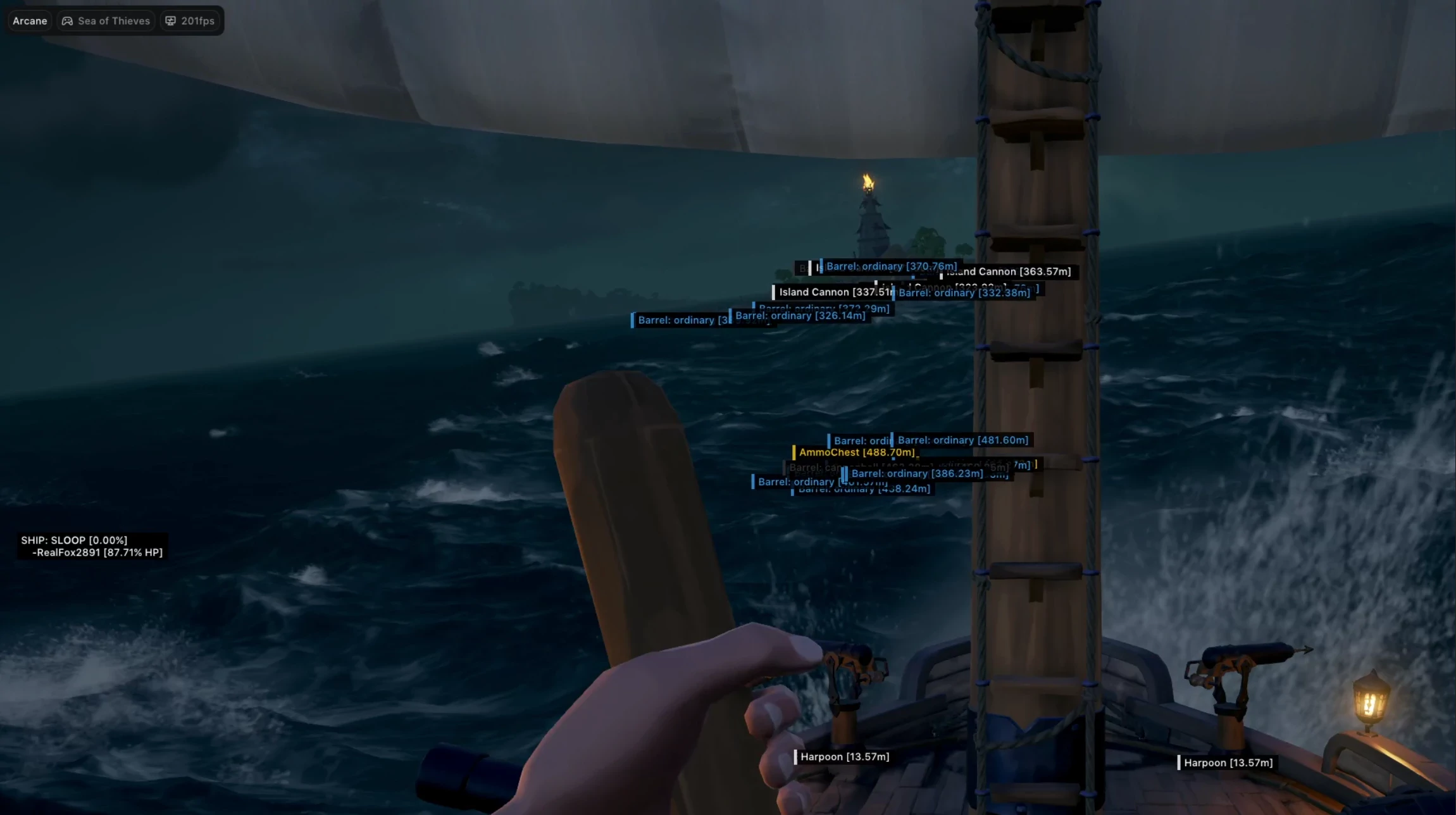
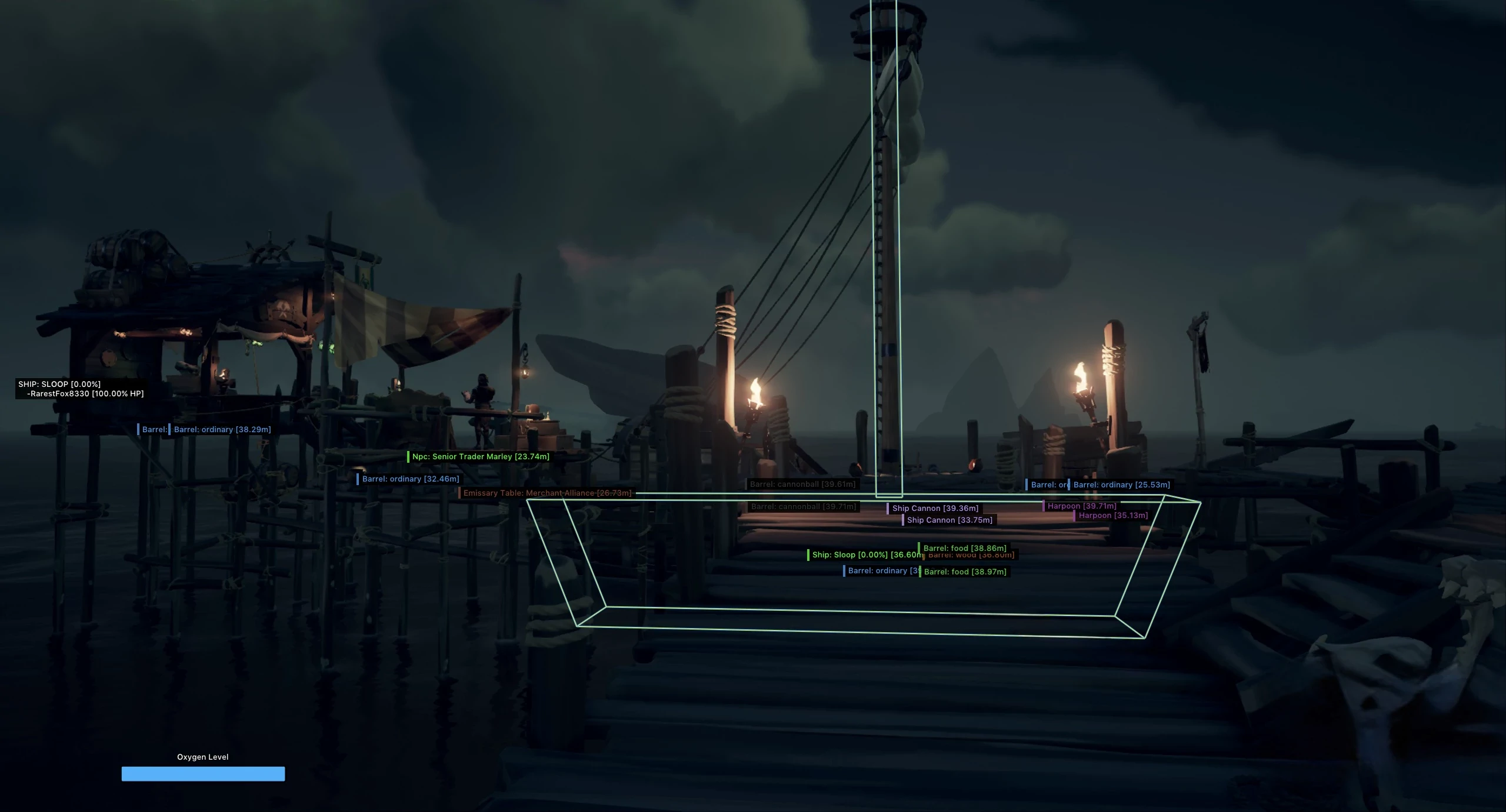
Ship ESP is the one feature that pays for itself in the first hour: it renders every vessel on the server through any visual obstruction — fog, storms, islands, nighttime darkness, distance haze — so you spot the other crew before they spot you. Sea of Thieves is a game about ships. Three types — the Sloop (1–2 crew, 2 cannons, fastest against the wind), the Brigantine (1–3 crew, 4 cannons, fastest overall in crosswind), and the Galleon (1–4 crew, 8 cannons, fastest with tailwind) — sail a 26×26 grid map across four regions: Shores of Plenty, The Ancient Isles, The Wilds, and the volcanic Devil's Roar. Up to six crews share each server. The game provides no built-in radar, no map markers for other ships, and no way to see through fog, storms, or night. Ship encounters are decided by whoever spots the other first.
This is the feature people search for under names like "ship wallhack" or "ship radar," and the practical version is exactly that. Each ship displays: type (Sloop/Brig/Galleon/Skeleton Ship/Burning Blade), distance, heading, speed, and whether it's a player crew or AI skeleton ship. On a practical level, this means you always know whether the island you're approaching has a Galleon parked on the other side, whether the storm you're sailing through is hiding a Reaper's Bones Brigantine on an intercept course, and whether the outpost you're heading to sell at has another crew already docked.
The Emissary system makes Ship ESP even more valuable. Ships flying Emissary flags (Gold Hoarders, Order of Souls, Merchant Alliance, Athena's Fortune, or Reaper's Bones) earn multiplied gold and reputation — up to 2× at Grade V. But Emissary ships are targets: a Grade V Emissary flag, when sunk, drops a Broken Emissary Flag worth significant gold to Reaper's Bones. Reaper's Emissary ships are visible on every player's map table at all times with their grade displayed — making them both hunters and hunted. At Grade V, Reapers can see shadows of all other Emissary ships on the map table. Ship ESP provides this information to every player on every ship at every grade, eliminating the Reaper's Grade V advantage entirely and giving non-Reapers the situational awareness that the game locks behind a specific faction grind.
For solo sloop players — widely acknowledged as the game's hardest experience — Ship ESP transforms viability. A solo sloop can't outrun a crewed Brigantine in crosswind, can't outfight a crewed Galleon's 8 cannons, and can't multitask repairs/steering/cannon fire effectively against any coordinated crew. What a solo sloop can do is avoid fights it can't win — if it knows where every threat is. Ship ESP turns the solo sloop from "hard mode with constant anxiety" into "informed decision-making at every stage of the voyage."
Player ESP & Mermaid Detection — Seeing the Pirate, Not Just the Ship
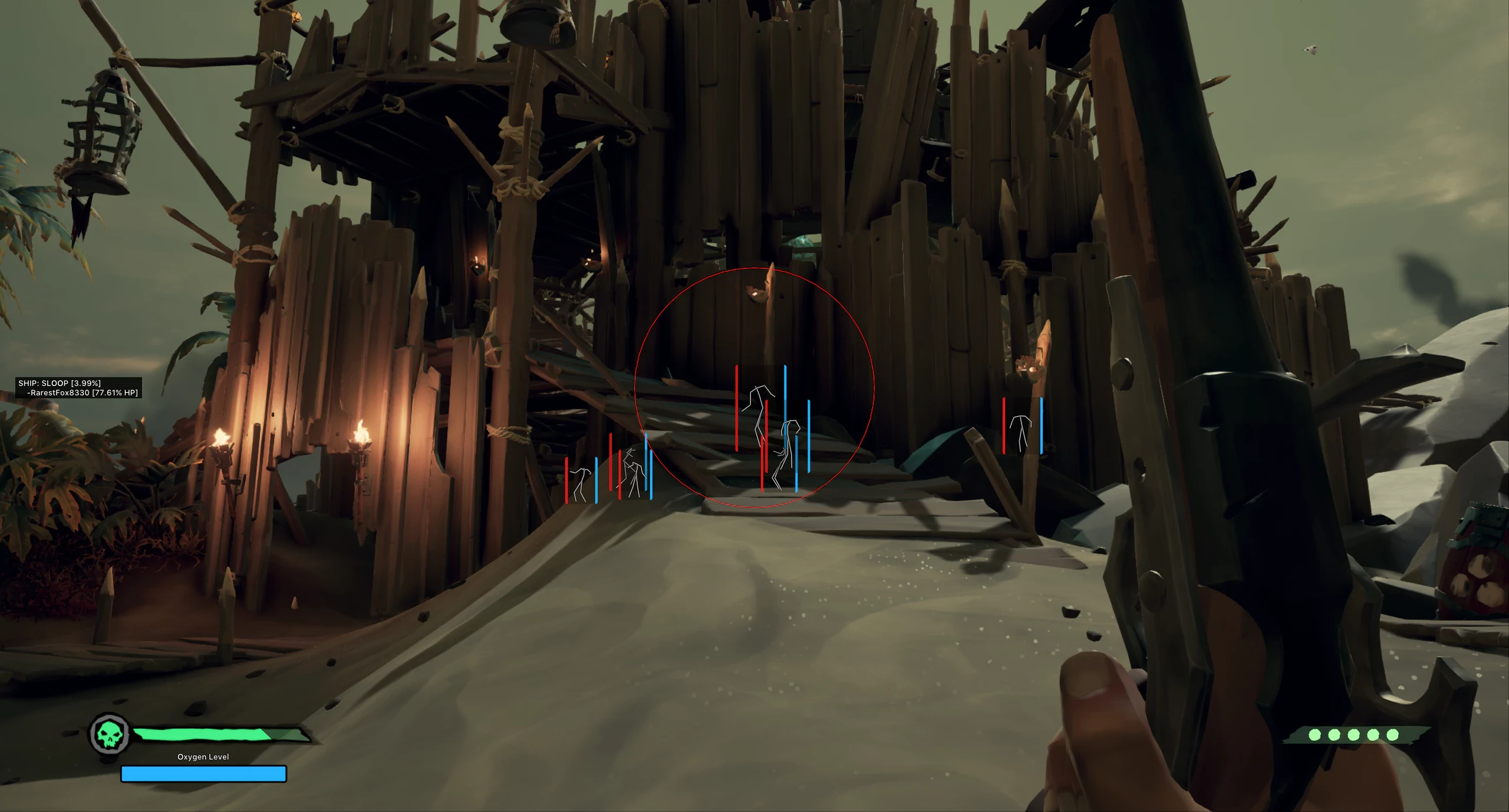
Player ESP renders every pirate on the server with bounding boxes, skeleton overlays, health bars, distance markers, held weapon identification, and name tags through any surface — ship hulls, island terrain, underwater, inside buildings. The immediate combat value is obvious: seeing through fog during boarding, tracking enemies below deck while repairing, spotting players swimming toward your ship from a distance.
But the SoT-specific value is "tucking" detection. Tucking is a core Sea of Thieves strategy where a player boards an enemy ship, hides in a concealed spot (inside barrels, behind capstans, in crow's nests, under staircases), and uses "sit" or "sleep" emotes with dark clothing to become nearly invisible. Tuckers steal treasure as crews sell at outposts, drop anchors at critical moments during fights, report ship positions and loot via voice comms to their own crew, or simply wait for the perfect moment to kill the helmsman during a world event. The intended counter is manually checking every hiding spot on your ship — a tedious and easily forgotten task, especially on a Galleon with dozens of concealment points.
Mermaid ESP is the most Sea of Thieves-unique feature in any cheat product. When a player swims away from their ship (to board, tuck, or explore an island), the game spawns a mermaid near the water's surface as a recall mechanism — a blue or red smoke flare visible at moderate range. Mermaid ESP detects these spawns and marks them through terrain and distance, creating an automated "hidden player detector" that reveals: (1) a hostile player is nearby and separated from their ship, (2) their approximate location relative to the mermaid, and (3) a probable boarding or tucking attempt in progress. In a game where a single tucked player can ruin a four-hour Gold Hoarder Emissary V session by stealing the Chest of Legends off your deck at the outpost, mermaid detection is the difference between losing everything and catching the thief before they act.
Sea of Thieves Aimbot — Cannons, Flintlocks, and Why Naval Combat Needs Prediction
Sea of Thieves combat operates on two layers: personal weapons (on foot) and ship cannons (naval). Personal weapons use 100 HP health pools. The Flintlock Pistol deals 55% per shot (2-shot kill), the Eye of Reach sniper deals 70% (1 shot + 1 cutlass slash kills), the Blunderbuss deals up to 100% at point-blank (10 pellets × 10% each, spread tightens with ADS), and the Cutlass deals 25% per slash with a 60% charged lunge. Players carry 2 weapons simultaneously (switchable at Armouries) with 5 shots each, refilled at Ammo Chests. The "double-gun" meta (carrying two firearms, no sword) is viable but a deliberate equip delay prevents instant combos.
Personal weapon aimbot in SoT follows standard FPS aimbot principles — the sot aimbot stack is the familiar one: bone selection, FOV circle, smoothing, triggerbot. The Eye of Reach with aimbot turns every engagement into a 70% first-hit → cutlass lunge → kill sequence. The Blunderbuss with tightened aimbot ensures the one-shot close-range kill that normally requires precise ADS centering. Player ESP reveals enemies through ship hulls, making pre-aim possible before rounding corners below deck. The same aim-heavy stack carries over to faster, more aggressive EAC shooters — our undetected The Finals cheat with aimbot and ESP runs on the same awareness-first approach.
Cannon aimbot is the harder — and more valuable — engineering problem, because it has to solve a ballistic arc fired from one moving deck at another across simulated waves. Sea of Thieves naval combat involves two ships moving on physically simulated waves, with cannonball projectiles following ballistic arcs affected by gravity and distance. A broadside from a Galleon fires 4 cannons simultaneously, each requiring manual aim adjustment for wave sway, ship speed, target distance, and target movement. Chainshot (which dismasts enemy ships, the most impactful single action in naval combat) has a lower arc than standard cannonballs and half the hull damage — precision matters because missed chainshot is wasted utility. Cannon aimbot with trajectory prediction calculates the intersection point accounting for both ships' vectors and wave motion, turning every cannonball into a waterline hit and every chainshot into a mast-breaker. On a Sloop with only 2 cannons, converting every shot into a hit compensates for the firepower disadvantage against Brigantines (4 cannons) and Galleons (8 cannons).
Cursed cannonball selection is another layer: Anchorball drops the enemy's anchor instantly (the most devastating cursed cannonball — a stopped ship is a sinking ship), Helmball locks their wheel, Ballastball makes their ship ride low and take water, Riggingball raises all their sails. Cannon aimbot ensures these rare and powerful cannonballs land every time instead of sailing past into the ocean.
Treasure ESP & World Event Radar — Finding Gold Before Anyone Else
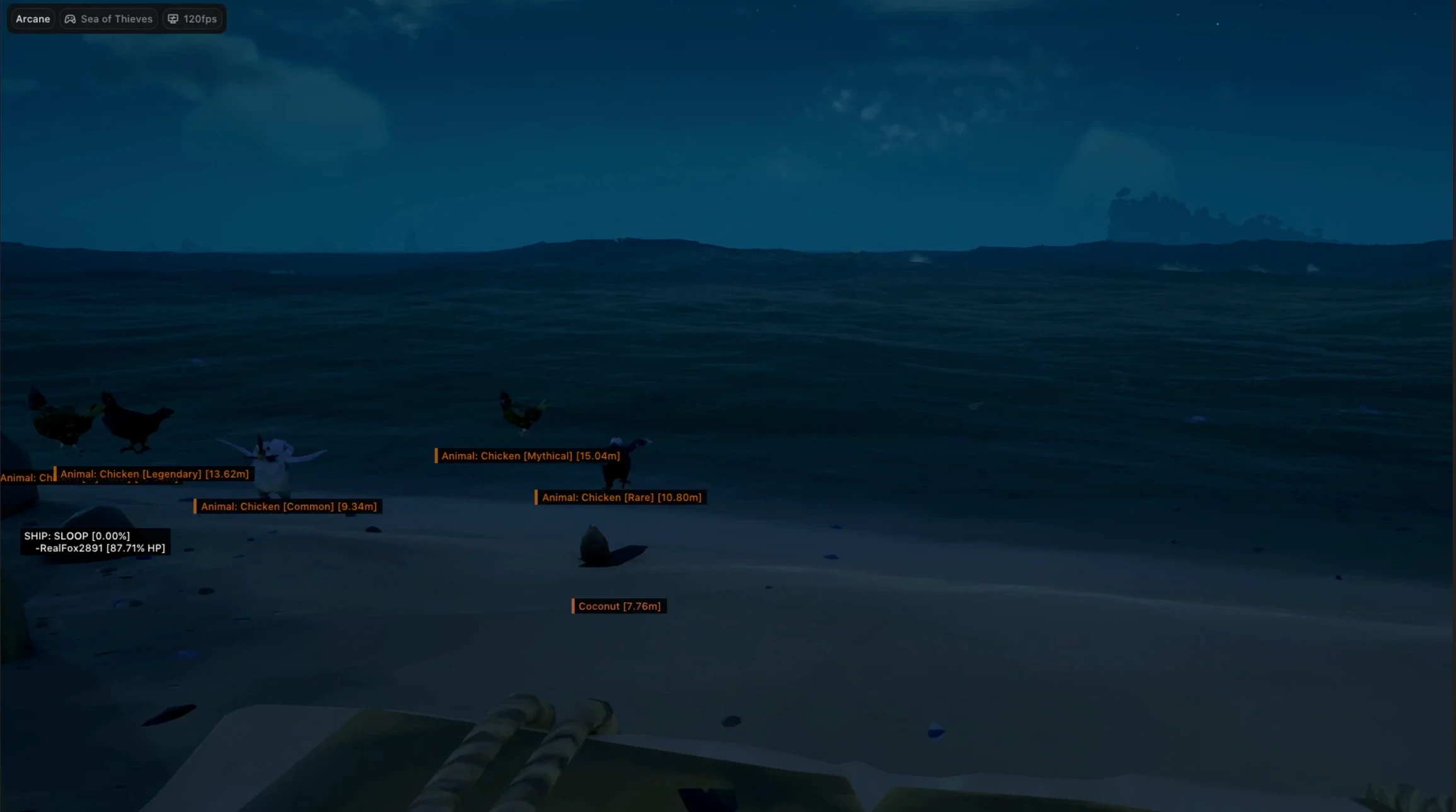
Every piece of gold in Sea of Thieves starts as a physical object somewhere in the world: buried on an island, locked in a vault, dropped by a defeated skeleton captain, floating in a shipwreck, sinking from a destroyed ship, or sitting on another crew's deck waiting to be sold. Treasure ESP marks all of it — through terrain, water, ship hulls, and distance. Categories include: Treasure Chests (Castaway's through Captain's Chest, Ashen variants, and the ultra-valuable Chest of Legends), Bounty Skulls, Merchant Alliance cargo, Mermaid Gems, Artifacts, Trinkets, the Box of Wondrous Secrets (one of the rarest items in the game), and the Reaper's Chest/Bounty (which are normally visible only on the Reaper's Hideout map table).
The practical value scales with play style. PvE grinders use Treasure ESP to clear islands faster — finding every buried chest without completing riddle clues, locating Vault keys dropped by skeleton captains in dense combat, spotting shipwreck treasure without diving into every hold. PvP pirates use it to assess targets — seeing what loot another crew's ship is carrying before committing to an attack. A Galleon hauling 30 pieces of Athena's Fortune treasure is worth the fight. A freshly spawned Sloop with a single Castaway's Chest isn't. Reapers use it to locate high-value targets efficiently: Emissary flags on sunken ships, Reaper's Chests glowing on islands, and supply-rich floating barrels.
World Event ESP marks active Skeleton Forts (skull cloud), Skeleton Fleets (ship cloud), Fort of Fortune (red skull), Ashen Lords (tornado), Reaper Fortress, and the Burning Blade — plus their exact locations, distance, and completion status. The game shows large cloud formations in the sky as event indicators, but ESP additionally reveals events that lack visible sky markers, shows precise distances, and marks Reaper's Chests and Bounties that are normally map-table-only information. For players who server hop to find specific events (a common strategy), World Event ESP immediately confirms whether the current server has the desired event active.
Barrel ESP marks floating Barrels of Plenty (supply barrels adrift at sea carrying cannonballs, planks, bananas, and occasionally cursed cannonballs or firebombs), island supply barrels, and resource crate types. Skeleton ESP tags all PvE threats: skeleton type (Regular, Gold, Shadow, Plant, Coral), skeleton captains (who drop valuable orders and treasure), Phantom variants, Ocean Crawlers, Megalodons (5 standard species plus the new Ancient variants), and Kraken tentacles during Kraken encounters.
Sea of Thieves Anti-Cheat & Ban Risk — What EAC Actually Detects
What anti-cheat does Sea of Thieves use? Two layers: a client-side kernel-level Easy Anti-Cheat (EAC) driver on PC, plus a proprietary server-side behavioral-ML system that watches movement, accuracy, and gold/reputation gain rates from the game's own servers. That combination — one scanner on your machine, one analysis layer on their servers — is the whole picture, and any honest read of ban risk has to account for both.
Here is the honest ban-risk picture: EAC is a kernel-level client-side scanner on PC that hunts for in-process memory tampering and modified .pak files, and under the points-based enforcement system, cheating that gets caught means an immediate permanent ban with no second chances. Reading game state from below that client-side scan layer reduces what EAC can see — but the server-side behavioral ML still flags impossible accuracy or movement regardless of how clean your client looks. The takeaway is simple: lower detection risk is not zero detection risk, and you still have to play like a real person. Anyone promising "100% permanently undetectable" is lying to you. Realistically, expect a short recovery period where a build can sit detected right after a major patch lands, until it's re-mapped and verified clean again. This is the same detection model behind our Rust cheats and their detection track record, where EAC pairs aggressive hardware bans with the same client-side scan boundary.
Sea of Thieves ran with no formal anti-cheat for its first six years. The developers relied on a proprietary server-side behavioral-ML system — monitoring movement speeds, accuracy patterns, and gold/reputation gain rates. The game later added Easy Anti-Cheat (EAC), a kernel-level client driver on PC, ahead of the console launch. This client runs only while the game is active (not always-on like some rival always-on anti-cheats) and updates independently from SoT's patch schedule.
Community perception is deeply skeptical. When EAC launched, a significant portion of the "TDM community" (players who used the game's PvP arenas for Team Deathmatch practice) vanished from servers — suggesting EAC did catch casual cheaters using free or widely-distributed tools. But the competitive PvP community (Hourglass of Fate players, Reaper's Bones grinders) reports persistent cheating: aimbots, ESP, teleportation, godmode, and invisibility. A veteran's forum post calling the cheater situation "unsustainable" and "catastrophic" received significant community support. Banned players create new accounts within minutes — the cheap sale price makes ban evasion trivially cheap.
The game introduced a points-based enforcement system: every player starts at 0, and cheating earns an immediate 12 points — which means instant permanent ban with no second chances. Points for minor offenses decay at 1 per month. The developers have since reported provisional wins and are working on detecting modified .pak files. The underlying limitation remains: EAC is a client-side scanner, and approaches that read game state without modifying memory from inside the process sit below its detection threshold — the same architectural gap that affects every other EAC-protected game. EAC protects 200+ games across the industry, and the same client-side scan boundary holds in any of them — you can see Easy Anti-Cheat detection in Apex Legends running the identical engine. That architectural gap is exactly why the DMA route below is the most resilient way to play.
Sea of Thieves DMA Cheats & Hacks
Sea of Thieves DMA cheats use a separate physical device to read game memory at the hardware level, which is the most hardware-isolated way to play under EAC's kernel scanner. A DMA card reads memory over PCIe from a second machine without any process injection or API calls on the gaming PC, so EAC's kernel-level scanner has no visibility into what a second piece of hardware is doing — the read happens off-box entirely. Think of it as an extra hardware isolation layer on top of our software builds, not a replacement for them: another route to the same awareness, for players who want the read happening on physically separate hardware.
The reason this works so well here specifically is that the game has been thoroughly reverse-engineered. Sea of Thieves on UE4 structures all game entities (ships, players, treasure, NPCs) as "actors" with documented memory layouts, and an open-source ESP framework (SoT-ESP-Framework) extensively maps how that actor data is organized in memory. That public mapping is evidence of how well-understood the memory surface is for this title — it is the groundwork the resilient vector is built on, not a download-and-run tool. The Co-op angle compounds it: one crewmate running ESP and calling positions over voice gives the whole crew a permanent lookout, since the overlay is client-side only and your crewmates never see it — the Alliance system even lets multiple crews share 50% of each other's sold gold while one of you runs awareness.
The hardware side — FPGA cards, PCIe slots, a second PC, KMbox for aimbot input, firmware tuning — is its own topic, and getting the firmware right is what keeps the device invisible to a kernel anti-cheat in the first place. Because EAC is kernel-level, that is the firmware bar you have to clear: see our DMA firmware guide for VGK, BE & EAC for the full hardware and flashing walkthrough on Sea of Thieves DMA hacks.
HWID Spoofer — Recovering a Hardware-Banned Machine
EAC reads hardware fingerprints (motherboard serial, disk IDs, MAC addresses, GPU info) and supports hardware bans alongside account bans. The cheap sale price and free Microsoft account creation make account replacement trivial, but a hardware ban persists across new accounts on the same machine — that is what a spoofer addresses, by generating clean identifiers before EAC loads so a hardware-banned rig can play again.
One correction worth being precise about: hardware bans are not automatically shared across every EAC title. EAC supports hardware bans, but each ban is issued and enforced per game / per deployment, at the individual developer's discretion — a hardware ban in one EAC game does not silently follow you into another. A spoofer resets this game's hardware fingerprint specifically, letting a banned machine get back onto Sea of Thieves. For the full breakdown of how spoofing works and what it does and doesn't cover, see our HWID spoofer guide.
Frequently Asked Questions
Are Sea of Thieves cheats undetected?
BurgerCheats' Sea of Thieves products maintain active undetected status against EAC, but no honest provider claims permanent undetectability — check the live detection status before every session. EAC operates as a kernel-level client-side scanner on PC, and our builds are engineered to keep their footprint below that scan layer. Separately, the Azure server-side ML monitors behavioral patterns, so aimbot users should keep realistic accuracy statistics and avoid speed-related exploits, which are server-validated. Play like a real person and keep an eye on the live status — after a big patch a build can need a short turnaround before it's confirmed clean again.
What's the most valuable cheat feature for Sea of Thieves specifically?
Ship ESP. Sea of Thieves is a game about ship encounters, and the game provides zero built-in radar or ship tracking (except Reaper's Grade V, which shows only Emissary ships). Knowing where every ship on the server is — through fog, storms, behind islands, at any distance — decides every engagement: when to fight, when to flee, when to sell, and when to ambush. For solo sloop players, Ship ESP is the difference between constant anxiety and informed navigation.
What is Mermaid ESP and why does it matter?
When a player separates from their ship (to board enemies, tuck/hide, or explore islands), the game spawns a mermaid as a recall mechanism. Mermaid ESP detects these spawns through distance and terrain, acting as a "hidden player detector." If a mermaid appears near your ship and none of your crew is in the water, a hostile player is attempting to board or tuck. This counters one of Sea of Thieves' most effective PvP strategies — tucking — without requiring manual barrel-checking.
Does cannon aimbot account for wave movement?
Sea of Thieves naval combat involves two ships on physically simulated ocean waves, with cannonball projectiles following ballistic arcs. Cannon aimbot with trajectory prediction calculates the intersection point accounting for both ships' movement vectors, wave sway, distance, and projectile drop. This is especially critical for chainshot (lower arc, dismasts enemy ships on hit) and cursed cannonballs (rare resources where a miss wastes significant strategic value).
Does Sea of Thieves have anti-cheat on Xbox and PS5?
Xbox reportedly does not run EAC — relying on closed console hardware security and server-side behavioral analysis. PS5 is similar. Console players can opt out of crossplay to avoid PC cheaters entirely. PC cheats only work on PC (Steam, Microsoft Store). EAC is a PC-only implementation in Sea of Thieves.
Does this work on Xbox or console?
No — everything here is PC-side. Our Sea of Thieves builds run on the PC versions of the game (Steam and Microsoft Store), where the cheat reads memory and draws an overlay on your machine. Consoles are locked-down environments: an Xbox or PS5 won't let you load this kind of software at all, and Xbox reportedly doesn't even run EAC, leaning on console hardware security instead. The practical upshot for console players is the reverse problem — because Sea of Thieves has full crossplay, a console crew can run into PC cheaters, and the only built-in defense is turning off crossplay so you only share servers with other console pirates. If you want to actually run the tools, you need to be playing on PC.
Sea of Thieves gives every player the same sword, the same ship, and the same ocean. The only advantage is knowing what's out there before it finds you. A Galleon hiding behind Crook's Hollow with a 4-man crew waiting to broadside your Emissary V sloop. A tucked pirate sleeping in your crow's nest with a Blunderbuss aimed at the ladder. A Chest of Legends sitting in a shipwreck 400 meters below a passing storm. Ship ESP, Mermaid ESP, Treasure Radar, and Cannon Aimbot don't change what you can do in Sea of Thieves — they change what you know. And in a game where everything is stealable, knowing is everything.
Ready to Set Sail?
Ship ESP, cannon aimbot, mermaid detection, treasure radar — everything you need to own every server from Shores of Plenty to The Devil's Roar. Check live detection status, browse available plans, or jump straight into the store.
-
-
Total Members 5,755
-
Most Online 149
-
Newest Member ejder0234

-
-
Reviews
-

By nineyt. · Posted
I've had a great experience not only with jjboy, but burger themselves. They have great staff that get back to you on time, and solve pretty much any issue you end up running into. -

By 10_jacob_01 · Posted
Howdy! I've been purchasing products from Burger cheats since 2025 and they've had the best ranges of selection for multiple products! Next cheat full and Lite (EFT) - major fan! honestly one of the best I've used and it has the features for pvp and pve, some tailored for those pve mains like myself, customizable UI, very modular and super user friendly, absolutely would recommend it to others! Collapse (EFT) - Great all around and it's nice and very straight forward, I do enjoy the UI of this one Ancient (EFT) - A good beginner one for people just getting into EFT cheesing. and lastly Vortex (War Thunder) - This has been my go too every time I want to just go ham in war thunder, I absolutely love it! Overall with burgercheats they've provided such clear fool proof instructions I simply cannot thank them enough, as they were my first service provider and will always be my go to service provider via myself or recommending to others! - A very happy Customer!! -

By sieto215 · Posted
I’ve had a really good experience with the service so far. The website is easy to use, everything is well organized, and the AI assistant is surprisingly helpful and actually gives useful answers. What impressed me most was the support. Whenever I had a question or needed help, I got a proper response instead of just a generic answer. The support was friendly, helpful, and really tried to solve the issue. Overall, I’m very satisfied with the website, the tools, the AI assistant, and especially the customer support. Definitely a very positive experience and something I would recommend. -

By EnteMitTalente · Posted
great product, paypal purchase went flawless with fast response and @admin helped me solve my tech issues -

By _swappy · Posted
I have gotten one of the best marketplace experience here. I personally have bought apex legends cheat here several times already and have recommended a few of my friends as well. In my personal opinion it is the best marketplace in this domain as of right now.
-