
-
Active Matter Cheats & Hacks — Aimbot, ESP, Wallhack & Radar for Dalniy Island Raids
Active Matter hacks and cheats with precision aimbot, filtered ESP & radar for Dalniy Island raids. Undetected under BattlEye's kernel driver on the Dagor Engine.
-
Featured Products
-
60-Second Load, 20 Players, and Gravity That Fights Back
Most extraction shooters make you wait. Active Matter drops you into a PvPvE raid on Dalniy Island in roughly sixty seconds — faster than any competitor in the genre. That speed matters because the raid itself wastes nothing. Up to twenty operatives spawn into quantum-unstable zones alongside Flowermen that disguise themselves as hedgerows, stone statues that freeze the moment you look at them, and Poltergeists that hurl debris through corridors that fold overhead. The extraction resource — active matter — sits in deposits scattered across sub-areas like Shegolskoe and Ozernoe, each one a gravity anomaly waiting to rotate your entire frame of reference mid-fight.
The engine underneath is Gaijin's proprietary Dagor Engine, the same codebase running War Thunder and Enlisted. BattlEye operates at kernel level, loading a Ring 0 driver that monitors memory access and process injection before the game even reaches the main menu. The combination — a publicly documented engine defended by kernel-level anti-cheat — creates a technical environment unlike anything else in the extraction genre.
Every hack covered below is built around that environment: aimbot that compensates for gravity transitions, ESP that identifies creatures by entity metadata instead of visual appearance, wallhack that reveals inverted architecture, and radar that maps portal-connected zones the base game deliberately keeps hidden. The Dagor Engine defines what works here — and what BattlEye has to defend.

Active Matter Aimbot — Locking Through Gravity Wells and Portal Transitions
An aimbot in Active Matter automatically tracks and locks onto enemy operatives or creatures, compensating for the game's gravity anomalies that shift vertical orientation mid-fight. The system calculates aim adjustments across portal transitions and inverted surfaces where standard mouse input loses spatial reference. Bone selection — head, chest, pelvis — determines both damage output and detection profile under BattlEye's aim-vector validation.
You're pushing through the Shegolskoe refinery on Dalniy Island. A portal drops you onto the ceiling of the room you just cleared. The AK in your hands is pointing at your own feet — which are now above your head. A Flowerman unfolds from the wall planter six meters away. You have about one second. Without bone lock maintaining target acquisition through that coordinate flip, the Flowerman's 1,200-damage lunge connects before your crosshair finds center mass. The aimbot tracks the Flowerman's world-space position independently of your camera rotation, snapping to the chest bone the instant the gravity zone finishes its transition.
Active Matter Aimbot Settings — FOV and Bone Selection
FOV determines how wide the lock-on cone extends from your crosshair center. A tight setting around 25–35 degrees limits acquisition to targets you're already tracking — the kind of adjustment that looks like natural aim correction under BattlEye's trajectory analysis. Wider FOV pulls targets from peripheral angles, which matters in gravity zones where enemies approach from surfaces that your muscle memory doesn't expect. Bone selection shifts between head (maximum damage, highest detection signature) and chest (consistent hitbox, lower flag rate). On raids with heavy creature density, chest lock clears Flowermen and Alpha Flowermen without the snap-to-head pattern that BattlEye's statistical model flags over sustained sessions.
Creature Priority and Skip Filters
Active Matter raids stack twenty operatives against dozens of AI creatures in the same zone. A skip filter separates the two — locking onto operatives during PvP engagements while ignoring Flowermen, Invisibles, and Poltergeists that would otherwise pull your crosshair away from the human target. In PvE Isolated Raids, the filter inverts: creatures become primary targets, and the aimbot prioritizes high-threat entities like Alpha Flowermen over standard spawns. The distinction matters because Escape from Tarkov hacks with full bone-lock aimbot solve a simpler version of this problem — Tarkov doesn't have creature swarms pulling aim priority away from PMCs mid-fight. Active Matter's dual-target environment requires a filter layer that most extraction aimbot configs don't ship with.
Active Matter ESP — Filtering Operatives, Creatures, and Loot Across Fractured Geometry
You're moving through Ozernoe on the eastern edge of Dalniy Island. The compound looks empty — quiet enough to sprint toward the active matter deposit glowing behind the generator building. Twelve meters to your left, something that looks like a juniper bush sits against a concrete wall. It's a Flowerman. The game renders it using the same mesh pipeline as environmental foliage, and your eyes can't tell the difference until it lunges. Behind the generator, two operatives are prone on the second floor — except the building's gravity is inverted, so "second floor" is underneath the foundation from your perspective. A VSSK Vykhlop crate sits in the basement below their feet, which is currently a ceiling above yours.
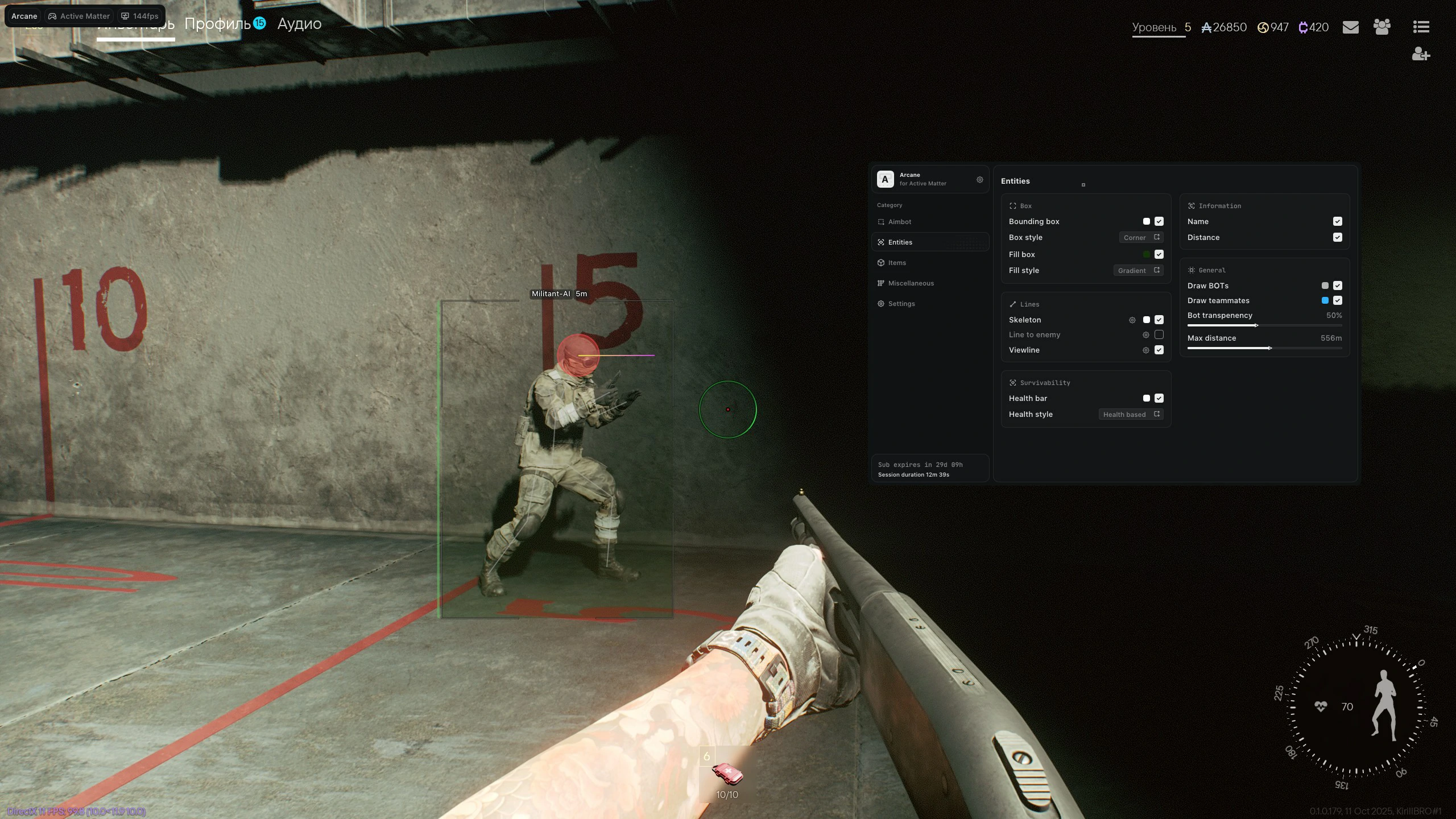
ESP overlays real-time information — player positions, creature locations, loot grades, and extraction points — directly onto the game screen. In Active Matter's gravity-warped environments, the overlay must render through portal boundaries and across inverted surfaces where standard depth perception collapses entirely. The system reads entity classification data from memory, not visual appearance, which is why it catches Flowermen that the Dagor Engine's renderer deliberately disguises as terrain.
Active Matter ESP Settings — Entity Filtering
Entity filtering separates Active Matter's ESP from generic implementations. The overlay sorts targets into operatives, hostile creatures (Flowermen, Invisibles, Poltergeists, stone statues, Alpha Flowermen), neutral fauna, active matter deposits, weapon crates, and Chronogene containers. Each category toggles independently — during high-traffic PvP zones around extraction points, disabling creature overlays reduces visual noise so that operative positions remain readable. In quieter sections where Flowermen cluster near loot deposits, full creature display prevents the ambushes that account for a significant share of early-raid deaths. Gray Zone Warfare ESP for filtered loot and player tracking handles a similar PvPvE split, but Active Matter adds the creature-disguise layer that makes entity metadata — not visual scanning — the only reliable identification method.
Distance and Health Readouts Through Portals
Distance values in Active Matter are misleading by design. A portal might connect two points that are three meters apart in screen space but ninety meters apart in world-space coordinates. ESP calculates true world-space distance, not screen-projected distance, so the readout tells you whether that operative on the other side of the portal is a three-second sprint or a ninety-meter repositioning commitment. Health readouts pair with this — knowing that the operative beyond the portal is at 40% health changes the engagement calculus from cautious approach to aggressive push. The same readout applies to creatures: stone statues display remaining health even while frozen (they regenerate when unobserved), and Invisibles show position markers despite having no visible model in the Dagor Engine's render pass.
Active Matter Wallhack — Seeing Through Dalniy Island's Inverted Architecture
The Dogorsk lab complex on Dalniy Island stacks three levels of corridors that fold through gravity zones. Walk through one doorway and the hallway above becomes a room to your right. Walk through the next and a squad sitting directly overhead — four meters away in world space — is invisible behind a concrete slab that used to be a floor. The architecture isn't just opaque. It's spatially deceptive. Standard line-of-sight checks fail because "behind the wall" might mean "standing on the other side of a gravity boundary that redirected the entire structure."
A wallhack removes or makes transparent the solid geometry that blocks line of sight. In Active Matter, this includes not just conventional walls and floors but gravity-inverted structures where corridors fold overhead and enemies approach from surfaces that function as ceilings. The transparency renders through the Dagor Engine's geometry pipeline, stripping material opacity while preserving wireframe outlines so that spatial orientation remains readable even when the physical structure disappears.
Structural Transparency in Quantum Zones
Quantum zones are where wallhack delivers the most value. These gravity-shifted areas compress multi-floor structures into overlapping geometry that the base game renders as solid walls from every angle. Transparency reveals the full spatial layout — every operative, every creature spawn point, every loot container — across floors that are physically adjacent but visually separated by concrete and steel. In Shegolskoe's refinery, the processing tower contains three gravity-separated tiers. A wallhack collapses those tiers into a single readable view, showing who occupies each level and which extraction path avoids contact entirely.
Active Matter Wallhack Settings — Opacity and Range
Opacity controls how much geometry remains visible. Full transparency gives maximum information but destroys depth cues — in Active Matter's already-disorienting gravity zones, losing even more spatial reference can be counterproductive. A 30–50% opacity preserves wall outlines while revealing entities behind them, maintaining enough environmental context to navigate portals without losing orientation. Range determines how far the transparency extends: a 50-meter radius covers most engagement distances on Dalniy Island sub-areas while keeping distant geometry solid enough to provide a visual horizon. Shorter ranges work better in tight indoor complexes like the Dogorsk labs where the relevant threats are within 20 meters and full-range transparency turns the screen into unreadable wireframe noise.
How BattlEye Defends an Engine Cheaters Already Know
BattlEye is a kernel-level anti-cheat system that installs a Ring 0 driver to monitor memory access, process injection, and system calls before the game process loads. Active Matter's deployment of BattlEye on the Dagor Engine — the same engine running War Thunder and Enlisted — means the driver must defend memory structures that the cheat development community has mapped for years. The open-source EdenSpark fork of the Dagor Engine, released under a BSD-3 license, made the rendering pipeline's memory layout publicly available — BattlEye's scanning rules have to assume attackers begin with source-level knowledge, not just runtime observation.
That assumption changes the defensive posture entirely. On proprietary engines like Unreal or Unity, anti-cheat benefits from obscurity — memory offsets shift between builds, and attackers reverse-engineer each update from scratch. On Dagor, the entity allocation patterns, coordinate storage formats, and renderer state machines are documented. BattlEye compensates with behavioral detection: monitoring aim-vector statistics over time, flagging impossible trajectory changes across gravity transitions, and cross-referencing DMA bus activity for external read patterns. The kernel driver's position at Ring 0 gives it visibility into hardware-level memory access that user-mode cheats can't hide from — but DMA hardware operating through PCIe bypasses that layer entirely, which is why the War Thunder cheats on the same Dagor Engine ecosystem has shifted heavily toward external hardware solutions.
Dagor Engine Memory Structures and BattlEye Scanning
War Thunder ran Easy Anti-Cheat for years before switching to BattlEye. That transition happened because EAC's user-mode scanning couldn't keep pace with kernel-level exploits targeting Dagor's known memory layout. Active Matter launched with BattlEye from day one, inheriting the stronger kernel-level protection but also inheriting the same engine-level attack surface that forced the switch. The practical implication: detection methods that worked against War Thunder cheats under EAC no longer apply, but the underlying engine knowledge transfers directly to Active Matter. BattlEye's response is continuous driver updates that shift scanning patterns — what worked last week may trigger a flag this week, and the update cadence is measured in days, not months.
Active Matter BattlEye — What Makes This Implementation Different
Two factors separate Active Matter's BattlEye configuration from other titles using the same anti-cheat. First, the game is paid-entry only — the developers explicitly stated that avoiding free-to-play is partly an anti-cheat measure, because each ban costs the cheater $30–80 for a new copy instead of zero. Second, the extraction-mode memory patterns differ from War Thunder's vehicle simulation: entity position updates happen at infantry tick rates with gravity-vector metadata attached, creating a detection surface that BattlEye can monitor for impossible position reports — operatives moving at vehicle speeds, passing through geometry without portal authorization, or reporting aim vectors that don't align with the local gravity orientation. Linux and Proton are unsupported entirely; the developers confirmed that BattlEye's kernel driver requires Windows, and no workaround is planned.
Active Matter No Recoil — Taming the ASh-12 and VSSK Kick Patterns
You're holding a chokepoint on the Shegolskoe catwalk with the ASh-12. The heavy bullpup kicks hard enough to pull your crosshair off-target after two rounds at full auto. Then the gravity zone shifts. Your camera rotates ninety degrees, and the ASh-12's vertical kick — which was pulling your crosshair upward — now pulls it sideways across your screen. The recoil pattern didn't change, but your visual reference frame did. Every muscle memory adjustment you've trained for vertical compensation is suddenly applying force in the wrong axis.
No recoil eliminates or reduces the weapon kick pattern that displaces your crosshair after each shot. In Active Matter, weapons like the ASh-12 heavy bullpup and KS-23 shotgun produce aggressive vertical climb that compounds during gravity-shifted firefights. The compensation adjusts to the current camera orientation, maintaining consistent recoil neutralization regardless of which surface the game considers "down" at any given moment.
Per-Weapon Intensity — ASh-12 vs PP-2000 vs Gepard
The ASh-12 produces the heaviest recoil in the current arsenal — the 12.7mm heavy rounds generate vertical climb that exceeds most assault rifles in the extraction genre. Full no-recoil compensation turns it into a precision instrument at ranges where the base game makes it nearly uncontrollable past three-round bursts. The PP-2000 sits at the opposite end: low recoil with 44-round extended magazines that reward sustained fire. Minimal compensation keeps the spray pattern tight without eliminating the slight horizontal drift that BattlEye's pattern analysis expects to see. The Gepard's 40-round magazine and moderate kick sit between the two — enough recoil to matter in gravity zones, not enough to justify maximum compensation. Suppressed options like the AS VAL and VSS Vintorez add subsonic ballistic drop on top of their recoil patterns, meaning no-recoil addresses only the kick component while bullet drop still requires manual compensation or separate ballistic prediction. Matching intensity to each weapon's baseline pattern keeps the compensation within statistical norms that BattlEye considers natural variation rather than input manipulation.
Active MatterRadar Hack — Mapping Raids When the Map Folds in Half
Active Matter doesn't give you a minimap. The game expects you to learn Dalniy Island's layout through repetition — memorizing which portal leads to Shegolskoe's upper level, which gravity corridor shortcuts the Ozernoe approach, and which routes avoid the Flowermen clusters near high-value deposits. That design choice amplifies the horror atmosphere, but it also means every engagement starts with incomplete spatial data. You hear footsteps but can't tell if they're above, below, or on a surface that your brain hasn't mapped yet. Zone collapse is approaching from the east, and you have no way to know if the extraction point is three portals away or one corridor over.
A radar hack displays a real-time minimap overlay showing all player and creature positions within detection range. In Active Matter's multi-level raids where portals connect separated zones and gravity shifts redefine elevation, radar provides the spatial orientation that the base game deliberately withholds. The overlay resolves the fundamental problem of non-Euclidean navigation — knowing where entities exist in world space even when the local geometry makes their physical location unintuitive.
Active Matter Radar Settings — Range and Entity Filters
Range determines the radar's detection radius in world-space meters. On Dalniy Island's larger sub-areas like Ozernoe, a 150–200 meter range covers the primary engagement zones around extraction points and active matter deposits. Tighter indoor spaces like the Dogorsk lab complex benefit from shorter ranges — 50–80 meters — that keep the overlay readable without cluttering it with entities in adjacent gravity zones that aren't reachable from your current position. Entity filters mirror the ESP categories: operatives, hostile creatures by type, loot containers, extraction points, and vehicles including quad bikes. Tracking extraction timer and zone collapse direction on the radar overlay converts what the base game presents as ambient pressure into actionable routing data — the shrinking boundary appears as a contracting circle, and the nearest extraction point highlights with a distance readout. For players running DayZ radar hacks for survival extraction raids, the spatial logic is familiar, but Active Matter's portal system adds a vertical dimension that flat-map radar implementations don't account for.
Active Matter Hacks — HWID Spoofing on a Paid-Entry Extraction Shooter
HWID spoofing masks your hardware identification — motherboard serial, disk volume ID, network adapter MAC address — to prevent BattlEye's global ban system from recognizing a previously flagged machine. Active Matter's paid-entry model means each ban costs the price of a new game copy on top of the hardware fingerprint block. Unlike free-to-play extraction competitors where creating a new account costs nothing, Active Matter's $30–80 editions make each ban a financial event that compounds with the progression loss — Chronogene perks built over dozens of raids downgrade or vanish entirely, and the Shelter's stored blueprints and Monolith progress reset with the account.
Why Paid Entry Changes the Ban Equation
The developers chose paid entry partly as an anti-cheat strategy — raising the cost of each new account after a ban. BattlEye's global ban system uses unique hardware fingerprints that persist across account changes, meaning a standard account swap doesn't bypass the block. The spoofer generates new hardware identifiers for each component BattlEye fingerprints, allowing a fresh account to register on a machine that BattlEye previously flagged. The cross-title dimension adds another layer: BattlEye bans in other Gaijin titles like War Thunder or Enlisted can cascade into Active Matter because the anti-cheat shares a global database across games. A hardware flag from a War Thunder ban carries into Active Matter's BattlEye instance, triggering immediate detection on the first login attempt. The spoofer prevents that cascade by presenting hardware identifiers that don't match any existing ban record. For players in the EFT Arena hacks with HWID protection ecosystem, the logic is identical — BattlEye's global fingerprinting works the same way — but Active Matter's paid model and Gaijin's multi-title portfolio make the cascade risk uniquely expensive.
Active Matter Cheats — Frequently Asked Questions
Does the aimbot compensate when gravity flips during a fight on Dalniy Island, or does it lose lock when the coordinate system rotates through a portal?
The aimbot maintains bone lock through gravity transitions by tracking the target's world-space position independently of your camera orientation. When a portal or gravity zone rotates your view, the lock recalculates aim vectors against the new local coordinate system within the same frame. The target never drops off — whether you're upright, inverted, or mid-rotation through a Shegolskoe portal, the bone lock holds until the entity leaves detection range or dies.
Can ESP distinguish Flowermen disguised as bushes from actual environmental foliage, or does it only highlight entities after they aggro?
ESP identifies Flowermen by entity classification, not visual appearance. The Dagor Engine tags them as hostile entities in memory before they reveal themselves, even while they're rendered using the same foliage mesh as environmental bushes. The overlay highlights Flowermen with creature-type markers the moment they load into your detection range, regardless of aggro state. Alpha Flowermen and standard variants display different markers.
If I get hardware banned in War Thunder or Enlisted, does BattlEye carry that ban into Active Matter since they all run on the Dagor Engine?
BattlEye global bans are tied to hardware fingerprints, not individual game licenses. A ban in any BattlEye-protected Gaijin title flags your hardware identifiers in a shared database. When Active Matter's BattlEye instance checks those identifiers on login, it recognizes the existing flag and blocks access. An HWID spoofer generates fresh identifiers that don't match the ban record, preventing the cross-title cascade from triggering on your Active Matter account.
The ASh-12 kicks harder than anything I've used in other extraction shooters — does no recoil handle that level of vertical climb, especially when gravity zones rotate my screen orientation?
No recoil compensates for the ASh-12's aggressive vertical pattern regardless of camera orientation. When a gravity zone rotates your view ninety degrees, the compensation recalculates axis mapping so that what was vertical climb becomes horizontal correction in the new orientation. The ASh-12's 12.7mm kick — the heaviest in Active Matter's current arsenal — receives full compensation at default intensity, turning multi-round bursts into controlled groupings even during mid-transition firefights.
Is Active Matter's BattlEye implementation the same version that War Thunder uses, or did Matter Team configure it differently for the Dagor Engine's extraction mode?
Active Matter uses the same BattlEye kernel driver as other Gaijin titles, but the detection ruleset is configured independently for the extraction-mode environment. Infantry tick rates, gravity-vector metadata, portal-authorized movement patterns, and entity interaction frequencies create a detection surface distinct from War Thunder's vehicle simulation. The kernel driver version stays synchronized across Gaijin's portfolio through centralized updates, but what triggers a flag in Active Matter differs from what triggers one in War Thunder because the gameplay data patterns are fundamentally different.
That raid on Dalniy Island doesn't have to end with a Flowerman ambush you couldn't see or a squad waiting on the ceiling you didn't know existed. Every feature covered above — from gravity-compensated aimbot to entity-filtered ESP and portal-aware radar — runs beneath BattlEye's kernel driver with continuous updates matched to each patch the Dagor Engine receives.
-77Xo7nfZZc.webp.bffd17988f191914eae203aaaeaea201.webp)
-dYJUcGV2EG.webp.c23ea189e6aa7c00bbf8d780c470914e.webp)
-I30BHlNfbd.webp.a0498b86e8e2a7660bad6b30d438be4d.webp)
-
-
Total Members 5,566
-
Most Online 149
-
Newest Member CAPODEPR

-
-
Reviews
-

By _swappy · Posted
I have gotten one of the best marketplace experience here. I personally have bought apex legends cheat here several times already and have recommended a few of my friends as well. In my personal opinion it is the best marketplace in this domain as of right now. -

By shot2654 · Posted
I’ve been using this product for a while now and I’m honestly really happy with it. From the start, the whole experiance was smooth. The website was easy to navigate, payment went through without any issues, and I got access very quickly. What stood out to me the most was the support. Any time I had a question or wasn’t sure about a setting, they answered fast and explained things in a clear way. They didn’t just send me some generic reply; they actually took the time to help me step by step until everything was working perfectly on my PC. That gave me a lot of confidance in what I was using. The product itself works exactly how it’s described. The features are all there, it runs stable, and I haven’t had any crashes or weird problems. Once I had it set up, it was very easy to use and adjust to my own prefrences. I didn’t have to constantly mess with it or fix things, it just did what it was supposed to do. Overall, I’m really satisfied with both the product and the support behind it. It’s rare to find something that works this well right out of the box and is backed by people who actually care if you’re having a good experiance. Based on my time using it, I can say it’s been completely positive for me. -

By Xulsty · Posted
Easiest cheese every to download and use for real, bought it like 4 times and loved it every time -

By sacisback · Posted
I needed to find an HWID spoofer and came across one here. It’s great—the technical support is fast as well, and they respond quickly through their ticket system. I haven’t had any issues using it; everything is automated, and there’s no risk of scam -

By Discord Review · Posted
+rep @admin really fast support and noce cutom service the delivery speed was fast he helped me with the settings you need to change an do and that in 10 min thats crazy.
-