
-
Dune Awakening Cheats & Hacks — Aimbot, ESP, Wallhack, Radar & More
Dune Awakening hacks and cheats with precision aimbot, full-map ESP, Deep Desert radar, and undetected BattlEye bypass. Tested across Hagga Basin and weekly storm resets.
-
Featured Products
-
-
189,000 Players, One Desert, and a Storm That Resets Everything Weekly
Dune: Awakening hit 189,000 concurrent players on Steam within its first week. A 576 km² Deep Desert stretches beyond the Shield Wall, hosting up to 300 players per server in full-loot PvP. Every Tuesday, the Coriolis Storm regenerates the entire grid — every Testing Station, every spice field, every Control Point relocates to a new position on the A1–I9 coordinate map. Your base, your vehicles, your cached spice melange — gone. The fog of war resets. Map knowledge from last week is worthless.
That weekly wipe is what separates Dune Awakening hacks from anything else available. In a game where the terrain itself is temporary, information tools don’t just help — they redefine how fast you recover from each Coriolis reset. BattlEye runs at the kernel level on every client, scanning memory and process signatures from the moment the launcher opens. Funcom has already executed a 444-account enforcement action. The Holtzman Shield blocks every fast-moving projectile until you deliberately drop it, which means even aimbot works differently here than in any standard shooter.
What follows breaks down each tool through the lens of Arrakis — how aimbot interacts with shield-drop timing, why ESP compounds in value every Wednesday morning, and what Funcom’s ban wave data tells you about BattlEye’s actual detection patterns. Every section is built around real scenarios: Sandcrawler extractions, Hagga Basin base raids, ornithopter dogfights, and the sandworm vibration meter that punishes you for moving too slowly or too loudly on open sand.
Dune Awakening Aimbot — Landing Karpov Rounds Through a Holtzman Shield Drop
An aimbot in Dune: Awakening automates target acquisition across the game’s third-person and scoped combat systems. It locks onto player hitboxes during the narrow window when a Holtzman Shield deactivates, converting every shield-drop into a lethal opening with weapons like the Karpov 38 or Dunewatcher sniper. Unlike standard FPS aimbots that fire continuously, Dune’s shield mechanic means the system waits for the exact frame a target’s protection goes down before committing a shot.
You’re holding a ridgeline in Deep Desert sector D-5. Three ornithopters circle a Sandcrawler parked on a Ringmouth Spice Field. The pilot drops shields to fire a lasgun at a ground target — and that shield-drop window is your moment. The Dunewatcher deals 262 base damage plus a poison tick that keeps working after impact. Miss the window and shields snap back up; your round deflects harmlessly. Hit it and the pilot is dead before the lasgun bolt leaves the barrel. That’s the margin that separates Dune from games like Escape from Tarkov where aimbot tools also face BattlEye but never have to read a shield state.
Dune Awakening Aimbot Settings — Shield-Drop Trigger Configuration
FOV determines how wide the aimbot scans for valid targets. In the Deep Desert, where engagements happen at 150–300 meters between ornithopter pilots and ground squads, a 25–35° FOV keeps the lock tight enough to avoid snapping to unintended targets while catching every shield-drop within your Karpov’s effective range. Aim bone selection matters more here than in most games — the Dunewatcher’s poison tick applies on any hit, but a headshot on a shieldless target delivers enough burst to kill before a medkit can activate.
PvE vs Deep Desert Aimbot Tuning
Hagga Basin PvE encounters play differently. Enemy NPCs at Raider Camps and Abandoned Sietches don’t run Holtzman Shields — they rely on numbers and positioning. Here, the aimbot’s target priority filter earns its value by ignoring low-threat infantry and locking onto Commanders who drop rare schematics. In a Testing Station like TS-10, where four players push through tight corridors against armored NPCs, bone-lock to the head eliminates targets before they can close melee range with crysknives.

Dune Awakening ESP — Tracking Spice Blows and Players Across the Deep Desert
You’re in a Scout Ornithopter at 200 meters altitude over sector E-3. It’s Wednesday — twenty-four hours since the Coriolis Storm regenerated the entire Deep Desert grid. Your guild needs fresh Ringmouth Spice Fields before the Harkonnen alliance locks down the high-yield sectors. The native game shows nothing. No minimap. No resource markers. Just sand, rock formations, and fog of war that demands hours of manual scouting. ESP changes that equation completely.
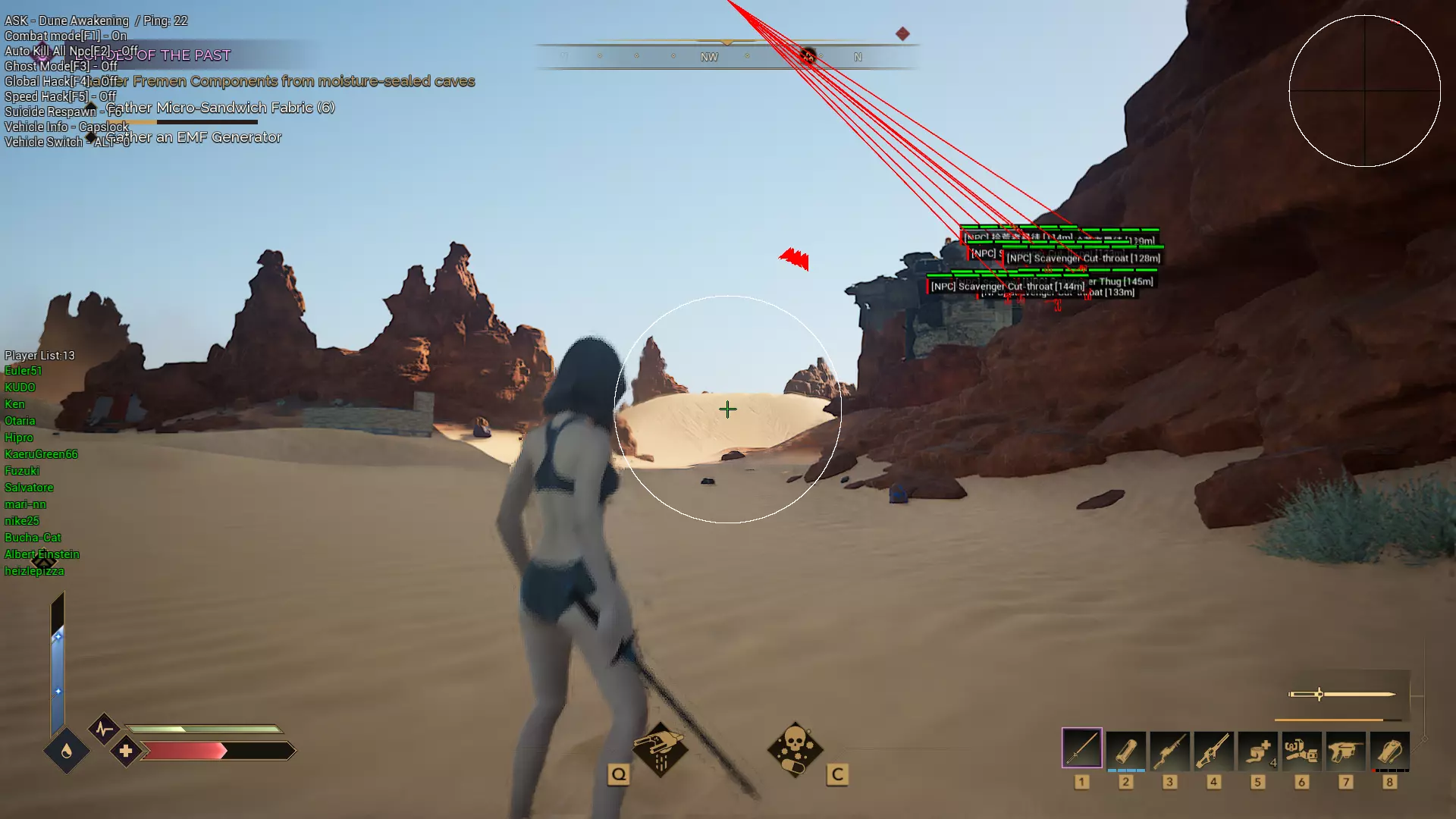
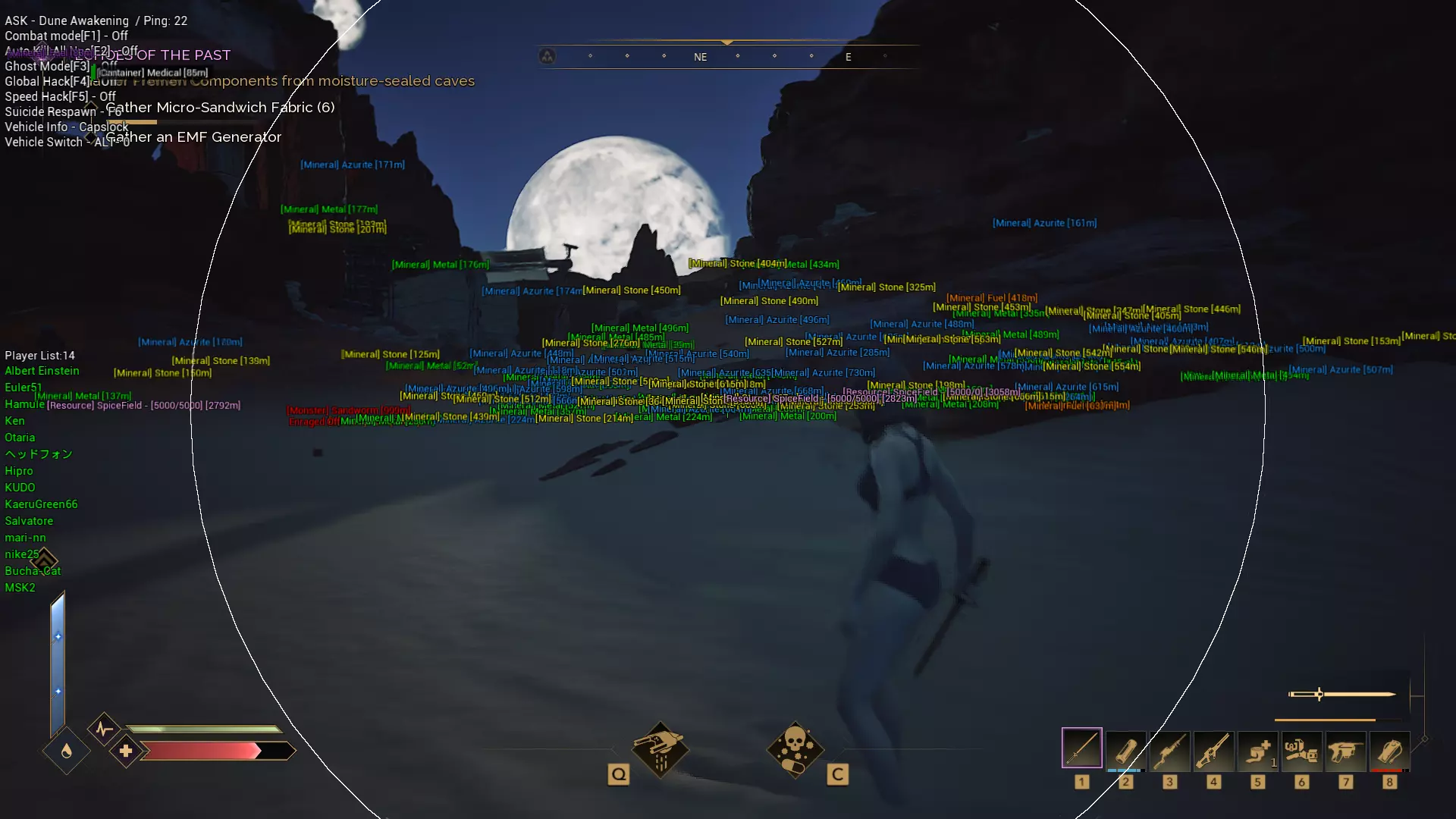
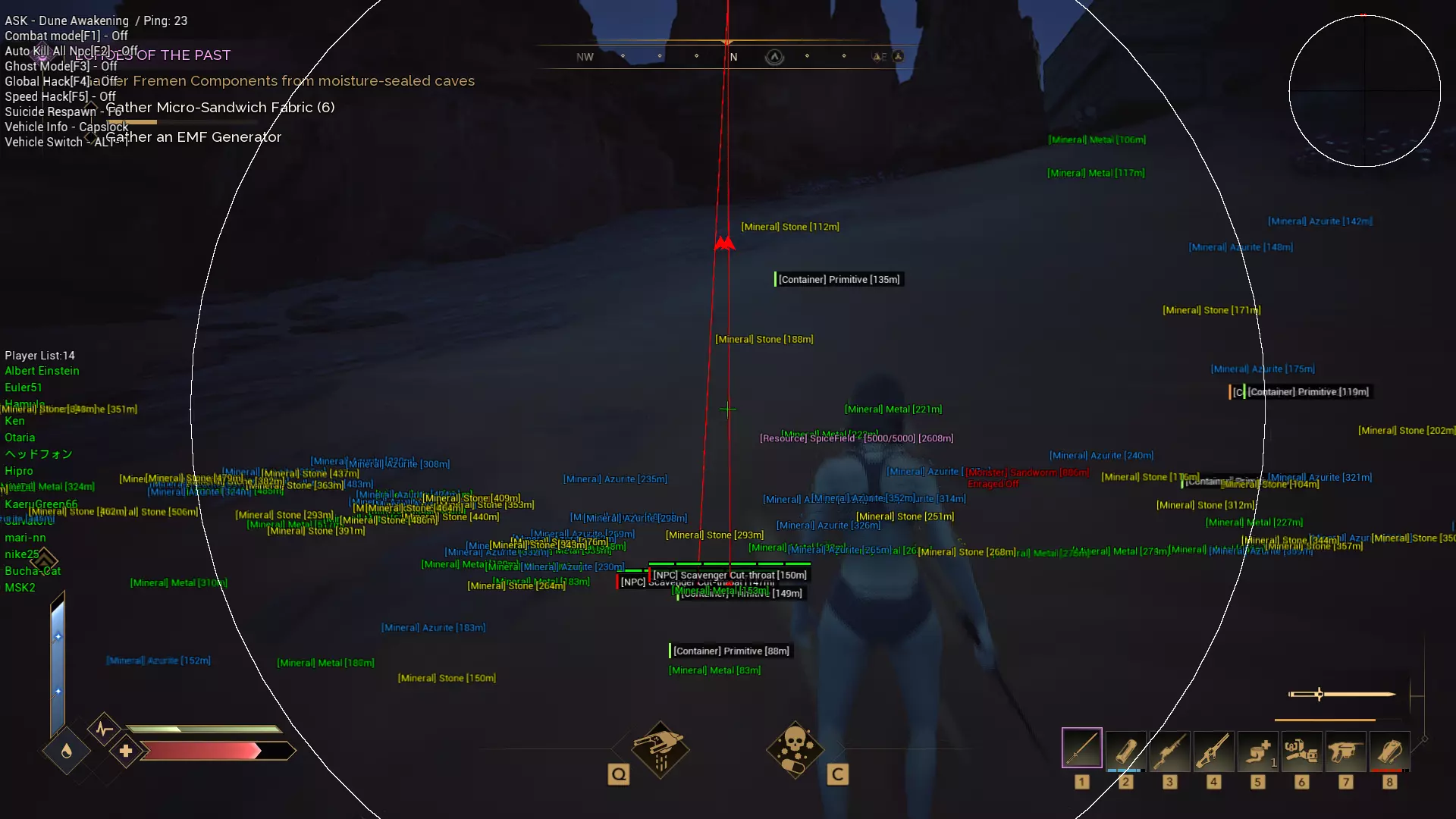
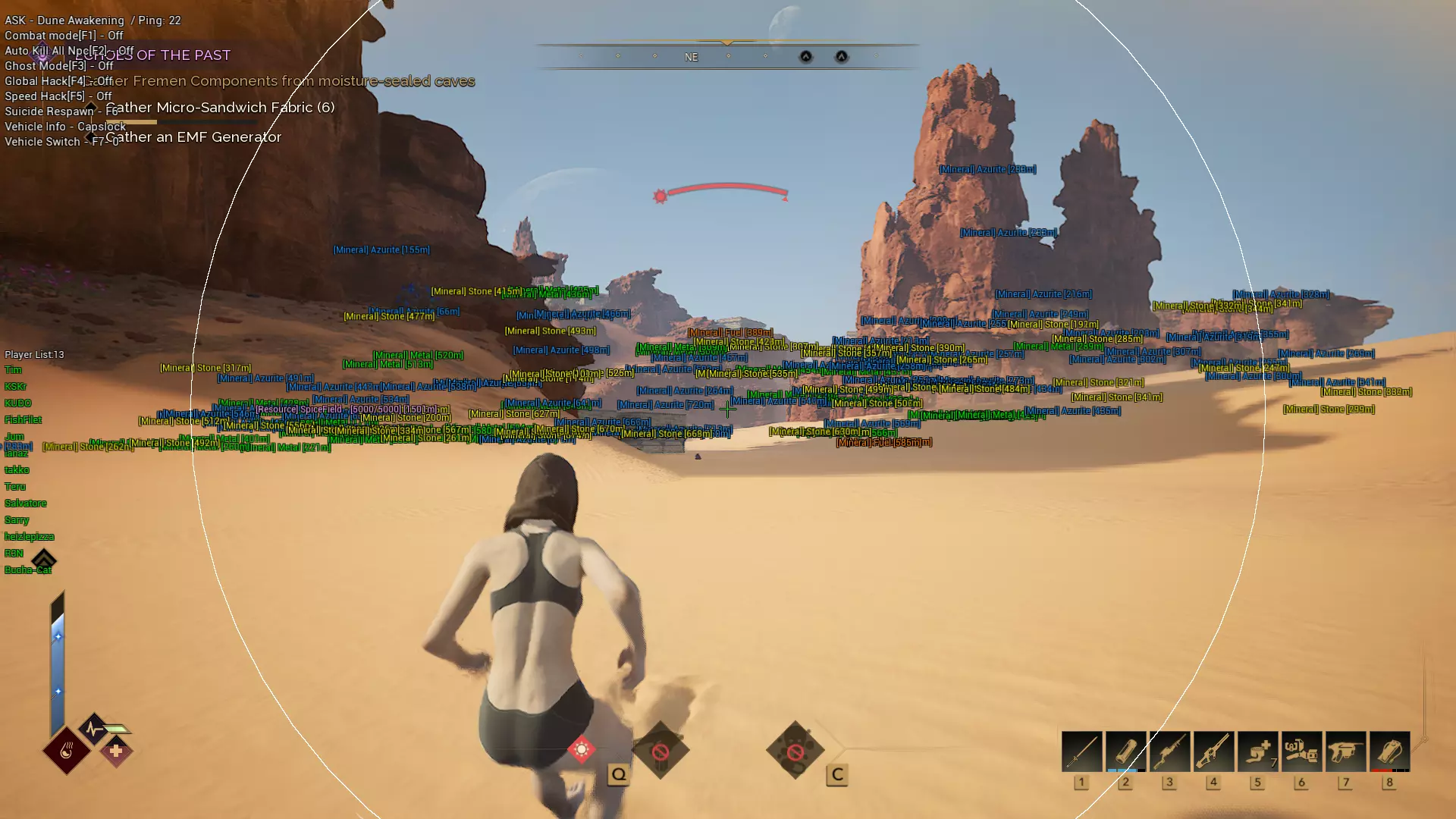
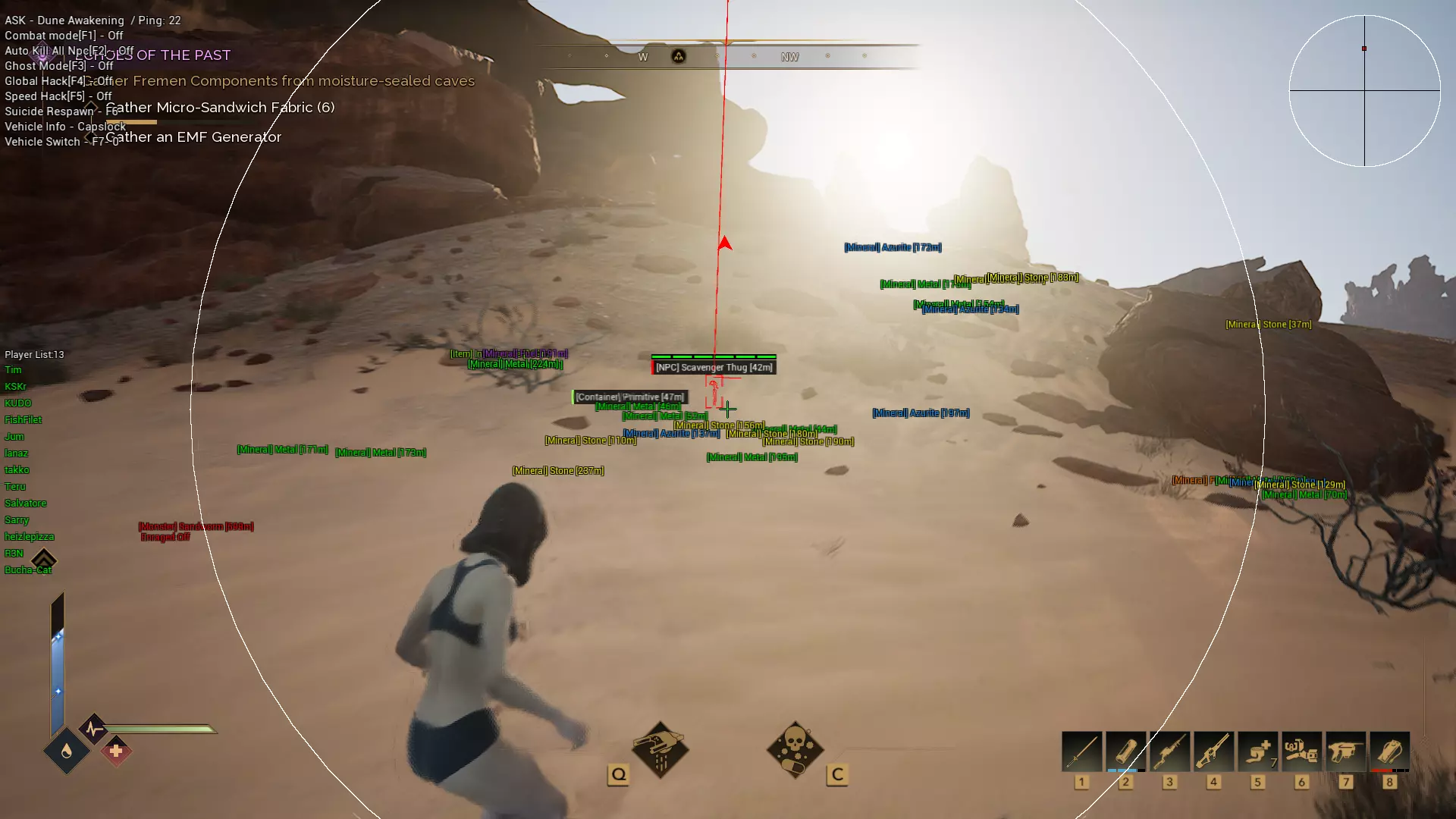
ESP overlays real-time positional data onto the game client, revealing hidden players, loot containers, resource nodes, and AI enemies through terrain and structures. In Dune: Awakening, the overlay displays player distance, health bars, equipped weapons, vehicle types, spice blow locations, and sandworm proximity — all on a game that deliberately resets its fog of war every seven days. Every other survival game lets you memorize the map over time. Arrakis erases it every week. That’s why DayZ ESP in BattlEye-protected survival environments shares design principles with Dune — both run under kernel-level anti-cheat, but only Dune demands re-learning the map every single cycle.
Dune Awakening ESP Settings — Filtering Players from NPCs
The Deep Desert hosts up to 300 players alongside Raider patrols, sandworm spawn zones, and environmental hazards. Running unfiltered ESP in a sector with 40+ entities turns the overlay into noise. Entity filtering separates real players (tagged with guild name, distance, weapon type) from NPC camps (tagged by threat level and loot tier). A spice harvesting run in sector G-7 needs different filters than a Control Point assault in B-3 — one prioritizes resource nodes and sandworm proximity, the other prioritizes player count and ornithopter approach vectors.
Resource ESP and Spice Blow Detection
Spice blows erupt at random intervals across the Deep Desert, creating temporary high-yield extraction points that attract every nearby player. Without ESP, you spot a spice blow by watching for the sand plume on the horizon — which means everyone else sees it too. Resource ESP marks the eruption coordinates the moment the server generates them, before the visual effect renders. That gives you a 15–30 second head start to reposition your Sandcrawler or divert your ornithopter. On a map where spice melange fuels everything from Landsraad donations to endgame crafting, those seconds convert directly into economic advantage over guilds still relying on visual spotting.
Why Dune Awakening Wallhack Turns Every Hagga Basin Base Raid Into a Blueprint
You’ve spent three days crafting a Black Market K-28 Lasgun specifically for this raid. The target base sits on a plateau in Vermillius Gap, its outer walls thick enough to hide everything behind them. You can see the shield generator dome on the roof. What you can’t see: how many turrets sit behind the first wall, whether the front rooms are decoy storage or actual vaults, or where the owner placed their Sub-Fief Console. A failed breach wastes the lasgun charge, alerts every guild member on the server, and leaves you stranded on a hostile plateau with nothing to show for it.
A wallhack renders terrain, structures, and base walls transparent, revealing player positions, storage container contents, and turret placements behind solid geometry. In Dune: Awakening’s base raiding meta, that transparency converts a blind gamble into a planned demolition. You see the generator’s exact position before you cut through the wall. You identify which room holds the crafting stations and which is an empty shell. You count the turrets, map their firing arcs, and plan your entry angle — all before the first lasgun shot.
Seeing Through Base Walls Before Committing a Lasgun Charge
The K-28 Lasgun is the only efficient structural damage weapon in Dune: Awakening. It cannot fire at targets running Holtzman Shields, and its ammunition is expensive to produce. Every charge spent on a decoy wall or an empty room is a charge you don’t have for the actual vault. Wallhack shows exactly which wall section leads to the highest-value storage, letting you breach in one shot instead of three. On a plateau base in Jabal Eifrit, where the owner has built vertically across multiple tiers, that information separates a clean hit from a 20-minute siege that draws every nearby player.
Wallhack in Testing Stations and Dungeons
Testing Stations are Dune: Awakening’s instanced mini-dungeons, designed for four-player groups pushing through corridors filled with armored NPCs. TS-10 — nicknamed “Noobkiller” by the community — features blind corners where Commanders with crysknives wait past the doorframe. Wallhack removes the ambush. You see every NPC position through the corridor walls before rounding the corner, letting your squad pre-aim and coordinate fire instead of reacting to a melee lunge at point-blank range. The schematic drops from these stations fund ornithopter upgrades and endgame weapon crafting — clearing them efficiently pays for itself across the weekly cycle.
How BattlEye Detects Dune Awakening Cheats — And Where It Fails
BattlEye is a kernel-level anti-cheat operating at Ring 0 — the deepest access layer of the operating system. In Dune: Awakening, BattlEye’s driver loads at boot and maintains persistent memory scanning throughout the client session. It cross-references injected DLL signatures against a server-side database, runs real-time memory region checksums to flag unauthorized read/write operations, and forwards behavioral telemetry to Funcom’s analytics pipeline for batch processing.
What makes BattlEye on Arrakis different from SCUM’s BattlEye kernel-level bypass approach or any other BattlEye title is Funcom’s enforcement cadence. The studio ran a three-week data collection period before executing its largest ban wave — 155 permanent bans and 289 temporary suspensions, totaling 444 enforcement actions targeting a Hagga Basin base exploit. That pattern — silent collection followed by batch enforcement — means BattlEye isn’t flagging Dune Awakening cheats in real time on every scan cycle. It’s logging anomalies, building dossiers, and acting weeks later.
Why BattlEye’s n64 Errors Trigger False Positives on Dune Clients
The n64 error code has become a persistent frustration for legitimate Dune: Awakening players. It fires when BattlEye’s process scanner flags a running application as a potential injection vector — and the false positive list includes popular antivirus real-time scanners, GPU overlay tools, and streaming software like OBS. A Steam Community discussion thread on this issue reached 135 comments, with players sharing workaround lists for software that triggers the flag. The takeaway: BattlEye’s scan surface is wide, and it trips on legitimate software regularly, which means understanding what the scanner targets is essential for staying below the detection threshold.
Batch Enforcement vs Real-Time Detection
Funcom’s enforcement model reveals something critical. The 444-action ban wave targeted a specific exploit and followed weeks of data collection rather than an immediate client-side flag. BattlEye’s kernel scans operate as the first layer, generating anomaly logs. Server-side behavioral analysis operates as the second, correlating player actions (impossible movement speeds, statistically improbable accuracy, resource acquisition rates exceeding manual harvesting caps) against threshold models. The gap between those layers is where detection timing varies and where bypass engineering focuses its effort.
Dune Awakening Radar — Reading the Grid Before Tuesday’s Fog Clears
Your guild needs sector E-4’s Control Point before the Harkonnen alliance establishes forward operating bases. The Deep Desert grid just regenerated — Tuesday’s Coriolis Storm wiped every marker, every cached waypoint, every scouted route. Native fog of war shows nothing beyond your immediate visual range. You’d normally spend two hours on a Sandbike running search patterns through D-3 to F-5, burning fuel and exposing yourself to both sandworm detection and PvP ambushes. Radar changes the calculus. Three ornithopter markers converge on E-4 from the northwest. A radar tool built for Gray Zone Warfare’s extraction combat applies the same positional awareness — but Dune’s weekly regeneration means radar value never depreciates.
A radar hack projects a real-time minimap overlay displaying all player positions, vehicles, AI enemies, and key objectives within detection range. In Dune: Awakening, radar maps directly onto the Deep Desert’s 9×9 grid coordinate system, providing persistent spatial awareness that the game’s native HUD — limited to nearby waypoints and the sandworm threat meter — deliberately withholds. No other survival game wipes its map weekly. That cycle means running Dune Awakening hacks with radar lets you skip the scouting phase that starts every Wednesday for everyone else.
Grid-Based Radar for Deep Desert Navigation
The Deep Desert divides into rows A through I and columns 1 through 9. Row A serves as a PvE-flagged landing strip — the buffer zone where ornithopters transition from Overland travel into the PvP grid. Rows B through I scale in resource density and PvP intensity. Radar overlays player markers onto this coordinate system in real time, showing not just position but bearing and speed. When a group of four in sector C-6 suddenly shifts heading toward your Sandcrawler in C-7, you have 30–45 seconds to decide: extract the partial spice load or commit and risk a fight.
Radar Range and Sandworm Alert Integration
The sandworm threat meter tracks vibration intensity from footsteps, vehicle movement, shield activation, and suspensor use on a White → Yellow → Red scale. Red means a sandworm is inbound — instant death with complete inventory and vehicle destruction. Radar provides an early warning layer the native meter doesn’t: it shows the worm’s approach vector and timing, giving you enough lead to reach rock terrain or deploy a Thumper decoy. On a Sandcrawler extraction run where vibration output is already high, that radar warning is the margin between losing everything and pulling your haul to safety.
Dune Awakening No Recoil — Dunewatcher Accuracy at 300 Meters
The Dunewatcher sniper hits for 262 base damage plus a poison tick that keeps burning after impact. At 300 meters, it’s the hardest-hitting ranged weapon in Dune: Awakening — and it kicks like a sandstorm. Scope sway pulls your crosshair left on every shot, and recovery between rounds is long enough that a moving target at range can reposition behind cover before your second shot lines up. The Karpov 38 on sustained auto is worse — recoil climbs sharply after the third round, scattering shots past 150 meters.
No recoil strips weapon kick entirely, locking the crosshair to the original aim point through every round. On the Dunewatcher, your second shot lands exactly where the first did — and since the first caught the target during a shield-drop, the follow-up finishes the kill before a medkit activates. On the Karpov 38, no recoil converts a mid-range rifle into a long-range beam delivering consistent damage at 250+ meters.
Rifle Recoil Profiles and Weapon Pairing
Each weapon class in Dune: Awakening has a distinct recoil signature. The JABAL Spitdart fires poisoned projectiles with a sharp horizontal kick making sustained fire erratic. The Drillshot FK7 scattergun has minimal recoil but limited range — designed for close quarters where shield-penetrating darts don’t need precision. The Vulcan GAU-92 is a mounted heavy weapon with vertical climb that makes ground-to-air fire against ornithopters nearly impossible without compensation. No recoil pairs best with the Dunewatcher and Karpov 38 — high-damage weapons where accuracy at distance directly correlates with kills per engagement.
No Recoil in Ornithopter Dogfights
Air combat involves Scout and Assault Ornithopters engaging at 100–200 meters while managing two flight modes — Dragonfly for hovering engagements and Vulture for high-speed passes. Mounted weapons on the Assault Ornithopter have their own recoil patterns compounded by vehicle movement, making accurate sustained fire from a moving thopter extremely difficult. No recoil keeps weapon output stable through banking turns and altitude changes, letting you maintain damage pressure on a fleeing Scout instead of losing half your rounds to flight-induced weapon sway.
Dune Awakening Speed Hack — Crossing the Deep Desert Before Your Sandworm Meter Peaks
You’re on foot in Deep Desert sector F-6. Your Sandbike was destroyed in a PvP skirmish two minutes ago. The sandworm vibration meter sits at yellow — every step on open sand pushes it closer to red. The nearest rock formation is 480 meters northwest. At normal sprint speed, that’s roughly 50 seconds. At yellow, you have maybe 40 seconds before the meter hits red and a sandworm surfaces beneath you. A sandworm hit means instant death and complete inventory loss — everything you carried is gone permanently.
Speed modification increases movement velocity beyond the normal maximum, shortening traversal exposure and reducing time spent triggering sandworm vibration detection. In Dune: Awakening, where the Deep Desert spans 576 km² and the vibration meter punishes every second on open sand, speed directly trades against one of the game’s most punishing mechanics. A 50% increase cuts that 50-second sprint to roughly 33 seconds — within the yellow-to-red window. The tradeoff: excessive speed is the most visually obvious modification and the one BattlEye’s behavioral analysis flags most readily through server-side movement validation.
Speed and Sandworm Vibration Mechanics
The vibration meter operates on a tri-state system. White means safe. Yellow means a worm has detected vibrations and is orienting toward you. Red means the worm is surfacing and you have seconds to reach rock, deploy a Thumper, or board an ornithopter. Speed hacks create a paradox specific to Dune: Awakening — faster movement generates more vibration per second, which accelerates the meter from yellow to red. But it also reduces total exposure time, which can net out to less vibration if the distance is short enough. Under 300 meters, speed wins. Over 500 meters, the increased vibration rate can trigger red before you reach cover.
Movement Speed in Vehicle and On-Foot Contexts
On-foot speed has the highest impact during the first minutes of a weekly cycle. Wednesday morning in the Deep Desert means no vehicles — your Sandbike and ornithopter were destroyed by Tuesday’s Coriolis Storm along with everything else. Players spawn into a fresh grid and start the resource race on foot. Speed during this window lets you reach the first mineral deposits, claim a forward base position, and start crafting a replacement Sandbike before competitors finish initial scouting. Once vehicles are rebuilt, speed shifts to foot traversal during harvesting loops where you park the Sandcrawler and hand-gather surrounding spice mounds, constantly managing the vibration meter between deposits.
Undetected Dune Awakening Hacks — What Funcom’s Ban Wave Reveals
An undetected cheat operates below the threshold of BattlEye’s scanning patterns, avoiding signature matches, behavioral flags, and memory anomaly alerts. In Dune: Awakening, “undetected” means surviving the kernel-level driver’s boot-time initialization, the persistent memory checksums during gameplay, and the server-side behavioral correlation Funcom processes in batch cycles. The studio’s enforcement record — 155 permanent bans plus 289 temporary suspensions in a single action — confirms that detection is real, consequential, and runs on a delayed timeline rather than instant flagging.
That 444-account ban wave targeted a specific Hagga Basin base exploit, not a broad sweep. Funcom collected behavioral data for three weeks before acting — the window between detection and punishment is long enough to analyze but short enough that running flagged software accumulates risk every session. The price tag on Dune: Awakening makes each account ban expensive, and BattlEye escalates repeat offenders to HWID bans that persist across new purchases on the same hardware.
Stream Proof Mode for Arrakis Content Creators
Dune: Awakening attracts a specific creator demographic — Twitch streamers and YouTube operators producing Deep Desert raid content, guild war coverage, and weekly Landsraad competition recaps. Stream proof mode renders all overlay elements invisible to screen capture software while keeping them visible on the primary display. OBS, Streamlabs, and Discord screen share capture only the native game client without ESP markers, radar overlays, or aimbot indicators. Given that BattlEye’s n64 error already triggers false positives on OBS installations, stream proof avoids compounding that detection surface by ensuring capture software never interacts with overlay rendering.
HWID Ban Recovery After a BattlEye Flag
BattlEye’s kernel-level access lets it fingerprint hardware identifiers — motherboard serial, drive volume ID, MAC address, GPU identifier. A standard game ban requires purchasing a new copy on a new Steam account. An HWID ban persists across accounts on the same machine, meaning a new purchase alone doesn’t restore access. The spoofer market for Dune: Awakening exists precisely because BattlEye escalates to hardware bans for repeat violations, and because Funcom’s Rules of Conduct explicitly state that third-party software use results in permanent action. Comparing how Rust handles anti-cheat across survival contexts, both games share the same escalation path — but Dune’s entry price makes each step more painful than any free-to-play title.
Dune Awakening Cheats — Frequently Asked Questions
My Sandcrawler holds 12,000 Spice Sand and I’m extracting from sector G-7 — will ESP show ornithopters approaching before weapon range?
ESP displays all ornithopters and players within render distance, including bearing, speed, altitude, and equipped weapon type. During a Sandcrawler extraction in sector G-7, the overlay tracks every approaching vehicle in real time. You’ll see incoming threats while they’re still repositioning — long before a Karpov 38 or lasgun enters effective range. That lead time lets you decide whether to extract the partial load or commit to filling the full 12,000 units.
Does the aimbot fire during the shield-drop window when someone deactivates their Holtzman Shield to use a lasgun?
The aimbot tracks targets continuously and fires the instant a shield status change is detected. In Dune: Awakening, the Holtzman Shield blocks all fast-moving projectiles — lasguns cannot fire at shielded targets at all. When an opponent drops shields to use their own lasgun, the aimbot exploits that exact frame window. The system doesn’t waste rounds on shielded targets, conserving ammunition and avoiding the deflection animation that signals your position.
After Tuesday’s Coriolis Storm resets the Deep Desert, does radar immediately show new Testing Station locations?
Radar begins displaying all entities the moment you enter the regenerated Deep Desert. Testing Stations, Control Points, spice fields, and player positions all populate as soon as the server loads the new grid layout. There’s no warmup period — the radar reads the same entity data the server generates for the fresh map. That eliminates the scouting phase that normally occupies the first several hours of every Wednesday for guilds exploring blind.
BattlEye flagged me with an n64 error and I wasn’t cheating — will an HWID spoofer protect my hardware?
The n64 error is a documented BattlEye false positive in Dune: Awakening, often triggered by antivirus real-time scanning or GPU overlay software. If you receive a permanent ban rather than a kick, an HWID spoofer masks the hardware identifiers BattlEye fingerprints — motherboard serial, drive volume ID, network adapter MAC. This prevents the hardware-level ban from persisting across new accounts. Before running any spoofer, verify the flag was actually a false positive.
I only play PvE in Hagga Basin and never enter the Deep Desert — does BattlEye still scan my client?
BattlEye scans at the kernel level regardless of which zone you occupy. It monitors all running processes from the moment the game client launches through session end. Whether you’re building a base in Hagga Basin South, clearing Testing Station 10, or trading on The Exchange in Arrakeen, the anti-cheat driver is active. Zone selection affects your PvP exposure, not your anti-cheat exposure.
Can wallhack show storage contents inside an enemy base before I waste a K-28 Lasgun charge on a decoy room?
Wallhack renders all base structures transparent and highlights interactable objects including storage containers, crafting stations, generators, turret placements, and the Sub-Fief Console. You can identify which rooms hold actual materials and which are empty decoy shells before breaching. Given that the K-28 Lasgun is one of the most resource-intensive weapons to craft in Dune: Awakening, using wallhack to plan your breach path saves charges, minimizes exposure, and maximizes raid value in Hagga Basin and Vermillius Gap.
That Sandcrawler load of spice doesn’t have to vanish to an ornithopter you never saw coming. Every tool covered above — from shield-drop aimbot timing to Deep Desert radar that reads the grid before Wednesday’s fog clears — runs beneath BattlEye’s kernel driver with active bypass engineering informed by Funcom’s own enforcement patterns.
-
-
Total Members 5,755
-
Most Online 149
-
Newest Member ejder0234

-
-
Reviews
-

By nineyt. · Posted
I've had a great experience not only with jjboy, but burger themselves. They have great staff that get back to you on time, and solve pretty much any issue you end up running into. -

By 10_jacob_01 · Posted
Howdy! I've been purchasing products from Burger cheats since 2025 and they've had the best ranges of selection for multiple products! Next cheat full and Lite (EFT) - major fan! honestly one of the best I've used and it has the features for pvp and pve, some tailored for those pve mains like myself, customizable UI, very modular and super user friendly, absolutely would recommend it to others! Collapse (EFT) - Great all around and it's nice and very straight forward, I do enjoy the UI of this one Ancient (EFT) - A good beginner one for people just getting into EFT cheesing. and lastly Vortex (War Thunder) - This has been my go too every time I want to just go ham in war thunder, I absolutely love it! Overall with burgercheats they've provided such clear fool proof instructions I simply cannot thank them enough, as they were my first service provider and will always be my go to service provider via myself or recommending to others! - A very happy Customer!! -

By sieto215 · Posted
I’ve had a really good experience with the service so far. The website is easy to use, everything is well organized, and the AI assistant is surprisingly helpful and actually gives useful answers. What impressed me most was the support. Whenever I had a question or needed help, I got a proper response instead of just a generic answer. The support was friendly, helpful, and really tried to solve the issue. Overall, I’m very satisfied with the website, the tools, the AI assistant, and especially the customer support. Definitely a very positive experience and something I would recommend. -

By EnteMitTalente · Posted
great product, paypal purchase went flawless with fast response and @admin helped me solve my tech issues -

By _swappy · Posted
I have gotten one of the best marketplace experience here. I personally have bought apex legends cheat here several times already and have recommended a few of my friends as well. In my personal opinion it is the best marketplace in this domain as of right now.
-