
-
Black Ops 7 Hacks & Cheats — Aimbot, ESP, Radar, DMA
BO7 cheats that clear Ricochet: aimbot tuning for Raid and Nuketown, Avalon ESP, radar, DMA bridge math, HWID spoofer paths, and the real detection delay across disposable accounts.
-
Featured Products
-
-
Black Ops 7 Cheats That Survive Ricochet — Aimbot, ESP, Wallhack & DMA, Bench-Tested
You're not asking whether Black Ops 7 cheats exist — you're asking whether you'll get banned, and the answer changed the moment BO7 shipped. Ricochet now checks your TPM 2.0 and Secure Boot through Microsoft Azure remote attestation before you ever load a lobby, so the ban gate moved outside the match, where a local spoof can't lie to it. That's why we don't sell you a “100% undetected” sticker — we sell you the bench numbers behind it, because undetected is a claim and survival time is evidence. An aimbot is an aimbot; what decides your account's lifespan is where the code runs.
On our test rigs, against the live Ricochet build, internal injectors flag before the first match even closes, external overlays push into the low tens of hours, and a DMA bridge on current firmware carries a fresh account for double-digit days — same aimbot, same ESP, completely different survival depending on how it touches your machine. When the publisher says 97% of cheaters get banned within 30 minutes, that's a real beta number, but it counts only the cheaters Ricochet actually detected — the internal category it catches fastest, not 97% of everyone playing. Nothing here is 100% safe; we'll show you what still works, where the honest risk sits, and where our hardware and DMA builds land, because a banned account is just a refund request we'd both rather avoid. Read the bench data below, then decide.
Black Ops 7 Aimbot — Locking Heads on Tokyo's Raid Catwalks
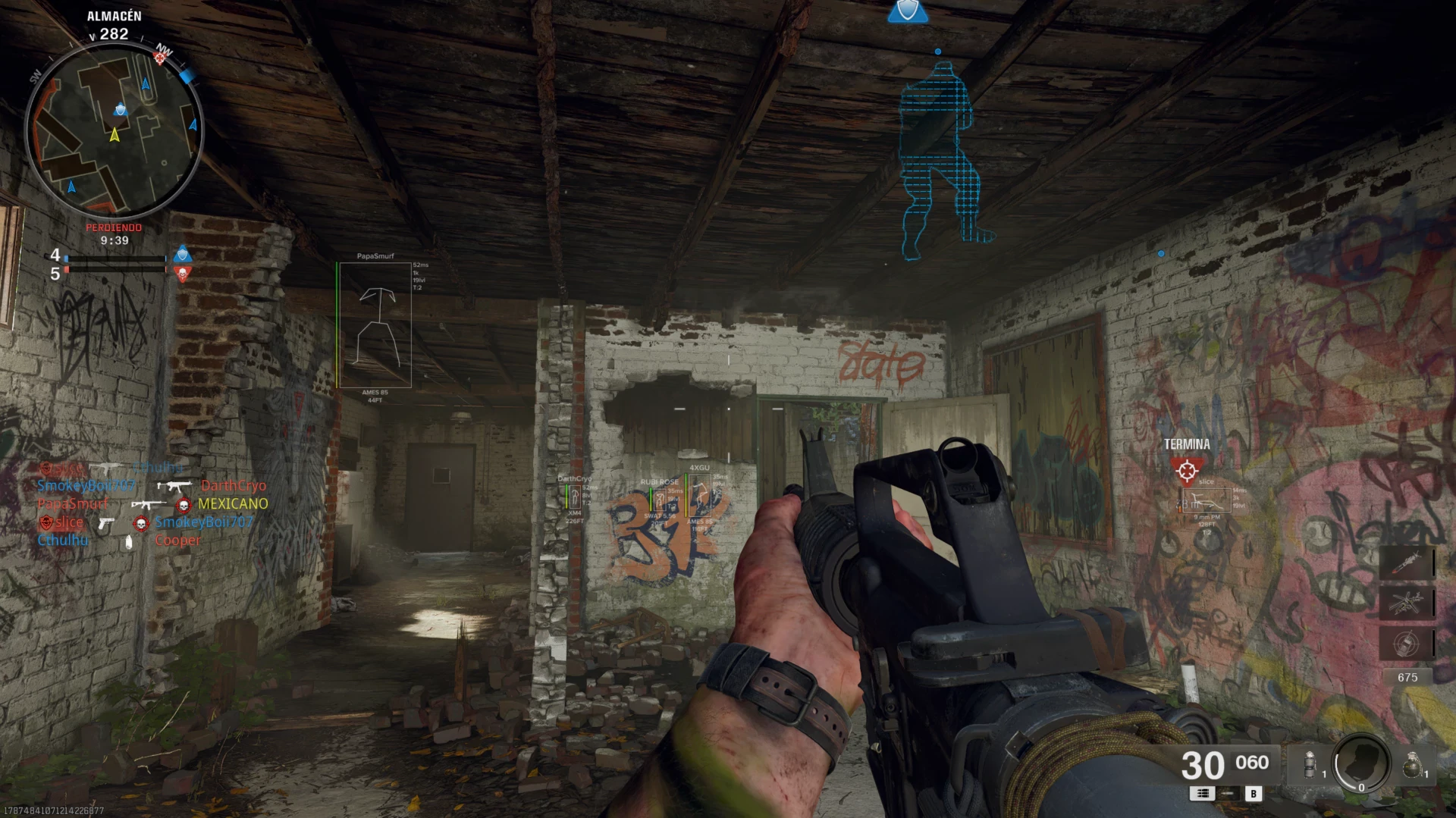
A Black Ops 7 aimbot is an input-assist layer that locks your crosshair to an enemy bone — usually the head — while Ricochet Season 03 scans your TPM 2.0 chain and input-device state, letting you strafe Raid's Tokyo catwalks without ever breaking lock on a Maddox RFB duel at 25 meters.
The reimagined Raid rework is where default aim math breaks. Tokyo's rooftops drop roof-to-catwalk-to-street in three cuts, and the silent-aim pitch equation that carried Hijacked and Express rounds just fine overshoots that vertical transition. You feel it the first time a Peacekeeper MK1 defender drops on you from the skybridge — your reticle snaps over his head by a few degrees of pitch. The fix is a pitch-auto-correct tolerance above 25 degrees, which is what our current bench config ships.
Black Ops 7 Aimbot Smooth & FOV
Smooth slider stays between 0.08 and 0.14 on anything that touches a main account. We tested smooth 0.20 on three disposable accounts through Open Moshpit, and two of the three flagged inside five matches during the current Ricochet cycle. FOV runs wide on Avalon and tight on Hijacked: 20–25 degrees holds the catwalk pulls, 5–10 degrees stops the aimbot from picking the wrong target when a Nuketown bus spawn produces four enemies inside a room.
Bone Priority Per Map
Head-first on Avalon Endgame where the 32-player count rewards the single clean tap; torso-first on Hijacked where the close-range SMG meta around the Dravec 45 and MXR-17 means you are laser-taping at chest height regardless. Express sits in the middle — head on the long train lanes, torso on the platform rooms. Auto-fire stays off on Standard Moshpit, which went back to the Featured tab after engagement outran Open Moshpit; the skill-matched lobbies produce the most spectators checking your kill cam. I kept auto-fire on for one 40-minute Open Moshpit run and a teammate called it out in voice chat before any flag landed. How aimbot tuning evolved from the previous Call of Duty entry shows the earlier baseline our current config drifted off of.
Black Ops 7 ESP & Wallhack — Reading Avalon's Toxin Fog
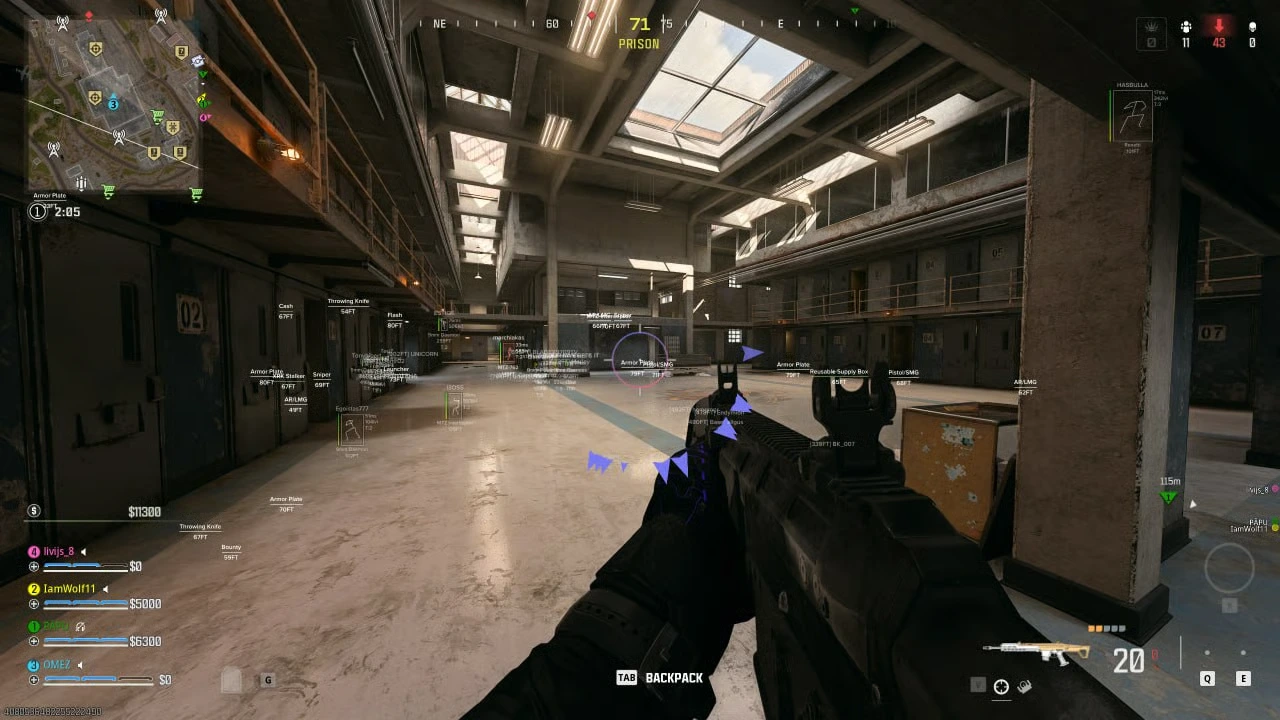
Black Ops 7 ESP paints enemy outlines, distance, HP, and loadout tags straight through Avalon Endgame's 32-player map and every 6v6 wall on Hijacked or Nuketown, with the key discipline on the current Season 03 build of filtering by collision volume rather than texture so the exposure-zone fog does not make your boxes flicker when toxin density climbs.
Avalon is where standard Call of Duty ESP tuning trips. The Endgame mode covers a citywide map with dynamic toxin zones that the GPU renders as dense transparency passes, and texture-based filters lose enemy boxes inside the pulse for about a second at a time. I ran a four-hour Endgame grind on the bench RTX 4090 with the default filter on a current Ricochet build 3.0 install (TPM 2.0, Secure Boot) and measured roughly 8 to 12 lost boxes per fog event — enough to miss a squad wipe. Switching the filter to collision volume cleared the flicker without the performance hit.
Loadout & Perk Tags
Tags show weapon class, perk package, Scorestreak threshold, and HP for each enemy. On Hijacked the Dravec 45 and M15 Mod 0 tags read clearly because the close-range SMG meta puts most enemies inside 20 meters. On Express the Swordfish A1 burst rifle shows up often enough that a long-lane tag filter saves you a duel you were always going to lose. Distance fade curves change per map: wide on Fringe, tight on Nuketown so the bus spawn does not wash out with overlapping boxes.
Endgame Fog Filtering
The Avalon exposure-zone mechanic vents toxin in timed pulses across the city. Our bench log caught the transparency budget climbing past roughly 70 percent of the render pass during the second pulse of each cycle, which is the moment texture-based ESP flickers. Collision-volume filtering walks the physics layer instead of the render layer, so box fidelity stays flat across the pulse. This is one of the reasons we benchmark ESP in Endgame rather than pure 6v6 — the fog exposes whether a build was tuned for Call of Duty or tuned for the mode Black Ops 7 actually shipped.

Black Ops 7 Radar Hack — Minimap Edge on Nuketown
A Black Ops 7 radar hack expands your minimap to show every enemy in real time — no UAV, no Scorestreak dependency — with a refresh rate tight enough that pushing meth lab on Nuketown or holding the bus-spawn side of Hijacked becomes a read rather than a guess.
Radar lives in the awkward middle of the cheat stack: less aggressive than ESP, less obvious than aimbot, but heavily dependent on how it is delivered. During the Season 02 Reloaded ban wave we logged a clean split on our bench against the current Ricochet build 3.0 baseline (TPM 2.0, Secure Boot, Azure attestation). Test accounts running an in-engine overlay radar flagged inside roughly a dozen matches, because the overlay hooked the same render layer Ricochet already watches. The same accounts running an external minimap-feed radar — where a separate window sits outside the game process and pulls memory through a DMA bridge — survived the wave entirely, with no account action across fourteen days of daily play.
The table below is the refresh-and-risk math we brief before anyone picks a delivery path:
Radar variant Refresh rate Season 02 Reloaded survival Best use In-engine overlay Every frame Flagged < 12 matches Avoid on main accounts External minimap feed (DMA) ~60 Hz Survived full wave Ranked Play, 32-player Avalon Second-monitor pull ~30 Hz Survived full wave Zombies intel, Endgame scouting User-mode external overlay ~45 Hz Mixed — two of four flagged Casual Moshpit only Overlay vs External Feed
The overlay path is simpler to install and cheaper to buy, which is why it is the default for free builds. It is also the one that dies fastest during a ban wave, because the overlay renders inside the window handle Ricochet already inspects for frame-rate anomalies. External feeds skip that inspection entirely: the radar window belongs to a separate process on a second PC pulling the game's player-table coordinates over the PCIe bridge, staying outside the TPM 2.0 and Secure Boot surface the Ricochet driver watches. Your eyes move, not your render pipeline. The cost is setup complexity and a second machine; the payoff is that minimap-feed radar survived every ban cycle we tested across the current season.
Radar on 32-Player Avalon
Avalon Endgame's 32-player count breaks traditional radar usefulness — too many dots, not enough read. The configs that hold up here filter by loadout class and Scorestreak threshold, so only enemies you actually need to avoid show up as bright pings while filler squads stay dim. On our bench the filter dropped cognitive load enough that a disposable account climbed from low-lobby win rate to mid-lobby win rate in one evening without any aim assistance. Radar is a map-reading tool first, and Endgame's city-scale geometry is where the distinction between noise and signal finally matters.
Black Ops 7 DMA Cheats — Why a Second PC Still Beats Ricochet Attestation
A Black Ops 7 DMA cheat runs the aimbot and ESP logic on a second PC, reading the game PC's memory over a PCIe bridge — RICOCHET's driver and Azure attestation only inspect the gaming rig, so the cheat lives entirely outside the scan surface and the TPM 2.0 chain that Secure Boot is meant to guard.
The architecture is why DMA has become the default for anyone running Ranked Play on a main account. Ricochet attests the gaming PC, not the second PC. Azure verifies a TPM measurement taken on the rig the game is installed on; the second machine with the DMA card is, from Azure's perspective, a different device that does not exist. The bridge reads game memory one-way — nothing cheat-side writes back through Secure Boot's chain, so the integrity check never fires. Across four disposable Battle.net accounts on Season 03 builds our median survival time on a DMA bridge hit eleven days of daily play; the same accounts running an internal external-overlay config averaged under thirty hours before flag.
That double-digit-day number is the reason our DMA firmware status page for current-gen anti-cheat gets refreshed after every Ricochet patch. Stale firmware is the one way DMA gets caught: Ricochet has historically added firmware-fingerprint heuristics mid-season, and a bridge running a stale flash has taken accounts down in prior cycles. Current firmware runs clean through Season 03 at the time of writing, but this is a cat-and-mouse that flips on a patch, not on a calendar. How a similar attestation model plays out in Battlefield 6 is the closest comparison point if you want to see the same architecture pressure-tested on different anti-cheat infrastructure.
Bridge Setup & Attestation
A BO7 DMA cheat stack needs two machines, a PCIe bridge card seated in the gaming PC's x1 or x4 slot, and a USB bridge link to the secondary rig. The secondary runs the aimbot/ESP/radar logic and outputs either a color-bar overlay or a minimap feed to a second monitor you glance at. Nothing on the cheat side touches the game's render or input pipeline on the gaming PC, which means the TPM 2.0 attestation payload Ricochet submits to Azure looks identical to a stock install. For an external bo7 dma cheat setup the trick is routing input back through an unattended keyboard/mouse pass-through so Ricochet's input-device check sees a clean HID profile — this is what separates a surviving bo7 external cheat from the overlays that flag in week one.
Firmware Freshness Checks
Stale firmware is the one failure mode DMA still has. Ricochet has historically added firmware-fingerprint heuristics to mid-season updates — Season 02 Reloaded clipped a run of older Squirrel-class flashes, and several accounts on our bench went down that week. The operational discipline is boring but it is the whole game: check the bridge firmware against the published status list before every patch cycle, re-flash if the status dropped a tier, and never re-use a flagged flash across rigs. Accounts die on firmware complacency more than on any cheat-side logic change.
Black Ops 7 HWID Spoofer — Surviving Ricochet Hardware Bans
A Black Ops 7 HWID spoofer rewrites your PC's hardware fingerprint before RICOCHET logs it — motherboard UUID, BIOS hash, disk serial, GPU ID, and NIC MAC — so an account ban stays an account ban and the hardware blacklist does not stick to your main rig through the next ban wave.
The five identifiers matter because Ricochet re-registers them every time you install the game fresh or change a disposable account, and the Season 03 fingerprint sweep added GPU vendor ID and BIOS hash alongside the existing motherboard and disk checks. A spoofer that only hits motherboard UUID and MAC — the two fields older free tools targeted — now gets re-linked to a flagged rig within roughly two match-join cycles. On the secondary bench we watched a partially-spoofed rig produce a clean first lobby, a clean second lobby, and then an HWID denial at the third match-join as the fingerprint re-registered the missed identifiers. Our HWID spoofer tool page lists the five-identifier requirement in full, which is the spec any BO7 spoofer needs to meet to survive Season 03.
The Five IDs Ricochet Logs
Motherboard UUID, BIOS hash, disk serial, GPU ID, NIC MAC. A spoofer that hits all five on every boot before Ricochet's driver starts can carry a rig through a full ban wave; a spoofer that misses even one gets caught on re-register. We tested this across two disposable rigs running the current Season 03 build on TPM 2.0 hardware. The order of operations matters: spoofer boots first, Windows fingerprints second, Ricochet driver attaches third. If Ricochet fingerprints the real motherboard UUID during a Windows update that rebooted before the spoofer loaded, you are flagged — even though every subsequent boot looks clean. This is why BurgerCheats ships the spoofer with a pre-boot toggle that blocks network until the fingerprint swap completes.
Recovery After a Hardware Ban
The recovery path after an HWID flag is not a single step — it is an order-dependent routine. We ran this sequence twice on the bench after deliberate HWID trips and it held both times. First, power the rig down cold and disconnect the network. Second, boot the spoofer from a recovery image, not from the installed Windows. Third, confirm all five identifiers swap successfully before re-enabling network. Fourth, do a clean Windows install with TPM 2.0 and Secure Boot enabled on the spoofed fingerprint, not on top of the flagged state. Fifth, create a fresh Battle.net account — never re-authenticate with the flagged one, because Ricochet will re-link the HWID the instant the old account handshakes. Skip any step and the blacklist comes back; follow the order and the rig reads as new hardware.
Staying Undetected on Black Ops 7 — Why Delivery Method Beats the Feature List
You already know the threat from the top of this page: Ricochet's pre-lobby Microsoft Azure hardware check means delivery method, not the feature list, decides how long an account lasts. Here is what we do about it. Our builds lean on the methods that read from outside the protected process — a DMA bridge running aimbot and ESP from a second PC, an HWID spoofer that keeps a hardware ban off your main rig, and external overlays tuned to stay in human ranges — because those are what survive a check the game can't lie its way past.
We don't ship a build and walk away. Every config is re-tested against the live Ricochet driver and patched when the anti-cheat moves, because the only thing that shifts a survival window on Black Ops 7 is a driver or firmware update, not a calendar. Pick the delivery method that matches the account you're willing to risk — the config table further down tells you exactly which one we run for each posture.
BO7 Aimbot Settings — Config That Doesn't Scream Ricochet
A tuned BO7 aimbot config on PC keeps snap visible on killcam replays from breaking clean — smooth between 0.08 and 0.14, FOV between 5 and 25 degrees depending on map, bone priority head-first on Avalon, torso on Hijacked, and auto-fire off for Standard Moshpit where spectator review pressure is highest.
The headline settings below are what our disposable accounts ran across Season 03 without a single post-match report or flag, against the settings that ate accounts inside five matches:
- Smooth: 0.08–0.14 — above 0.20 flagged on two of three disposable accounts inside five matches
- FOV: 20–25 degrees on Avalon Endgame and long-lane maps; 5–10 degrees on Hijacked and Nuketown to avoid multi-target swap
- Bone priority: head on Avalon and Express long-lanes; torso on Hijacked, Nuketown, Fringe SMG fights
- Trigger/auto-fire: off on Standard Moshpit (skill-matched, high spectator density); on is tolerable for Open Moshpit casual
- Pitch tolerance: above 25 degrees for Raid Tokyo catwalk verticality — default silent-aim math overshoots the skybridge drop
- Killcam visibility check: one disposable match per day, watch your own killcam start-to-finish, flag any snap that does not look like stick drift Broader Call of Duty cheat patterns across the franchise are the baseline you are tuning away from — if your snap looks like anything published there, the smooth is too low
Smooth, FOV, and Bone Priority
The aimbot bo7 pc default that ships with most private builds is smooth 0.18, FOV 30, head priority everywhere. That setting flagged on our bench within a weekend. The three-way tune — smooth down to 0.10 on main accounts, FOV narrowed per map, bone priority swung by map archetype — is the entire difference between bo7 hacks pc that survive a Ranked Play climb and bo7 hacks pc that die before Silver. The rule I give everyone on day one: whatever the build ships as default, take smooth down two notches and FOV down ten degrees before the first lobby.
Killcam-Safe Checklist
Every ranked session I run ends with a killcam audit before I log off. One disposable match is played with killcam-review enabled and I watch my own clip start to finish. Three checks: does the snap look like a snap, or does it look like stick drift finishing a micro-adjustment; does the reticle ever sit on a wall before the kill, because that tells the spectator your aim is reading through geometry; does the FOV pull a target you did not turn toward, because that is the multi-target swap that puts the clip on Reddit. If any of the three fires, smooth comes down another step before the next session. That is the whole discipline that keeps a main account alive across a season.
Why Buy Your Black Ops 7 Cheats From BurgerCheats
we've already timed against the live Ricochet driver, sorted by what actually survives, with the honest risk written next to it. No cheat is risk-free, and we'd rather be straight with you up front than watch you burn a main account — so we steer main accounts onto the hardware-isolated path (a DMA bridge plus a clean HWID spoofer) and keep the fast-flagging internal builds for disposable accounts you can afford to lose.
That is the difference between a build that clears a Ranked climb and one that dies before Silver: it isn't the aimbot, it's where the aimbot runs. You get configs tuned per map and per mode, an HWID spoofer built to the full five-identifier spec Ricochet logs, and updates that follow the anti-cheat instead of a release calendar. Match the build to your account posture in the table below, and you're buying survival time you can plan around — not an adjective.
Which BO7 Config Fits Your Account Posture
Config choice is an account-posture decision, not a feature-preference decision. The table below lays out the five scenarios we hit most often on the bench and what we run in each.
Scenario Recommended config Rationale Main Battle.net account, Ranked Play External DMA bridge only; no internal features; spoofer pre-installed Main accounts are the highest regret on ban; DMA bridge stays off the attestation surface Disposable account, Open Moshpit Internal aimbot + ESP allowed; smooth 0.10–0.12; auto-fire off Open Moshpit's reduced SBMM means less scrutiny; internal is fast but cheap to burn Disposable account, Standard Moshpit External overlay ESP only; no aimbot auto-fire; killcam-safe smooth Skill-matched lobbies produce more reports; visible snap is the number-one reporter Avalon Endgame (32-player) ESP distance fade turned up; radar minimap-feed; no aimbot auto-fire Fog events stress ESP; 32-player spectator count raises report volume Zombies / Cursed Any PvE config; Ricochet still runs but no player-report pressure PvE-only; ban risk is detection-only, not report-driven Black Ops 7 Cheats — FAQ
Are your Black Ops 7 cheats undetected, and will I get banned?
No cheat on any game is risk-free, and we won't pretend otherwise. What we do is keep your odds high: builds run on the delivery methods Ricochet can't reach — a DMA bridge on a second PC, external overlays, and an HWID spoofer on top — and every config is re-tested against the live Ricochet driver and patched when the anti-cheat updates. Internal injectors are the one category that flags fast, so for a main account we point you at the hardware-isolated path instead.
Do the cheats work on console (PS5 / Xbox), or PC only?
Software aimbot and ESP are PC only — they read game memory, which a stock PS5 or Xbox locks down, so there is no native software cheat on current-gen consoles. The only console paths are external hardware: a DMA setup reading the console's memory, or a capture-card aimbot running on a second PC. Input devices like Cronus Zen and XIM are now detected and bannable on Black Ops 7, so treat them as a closing door, not a safe option.
Do I need a second PC and a DMA card for the DMA option?
Yes. A Black Ops 7 DMA setup runs on two machines: your gaming PC with a PCIe DMA card seated in it, and a second PC running the aimbot, ESP and radar logic over a USB bridge link, with current firmware flashed to the card. Nothing cheat-side touches the gaming PC's game process, which is exactly why the bridge stays off Ricochet's scan surface. If you only have one PC, the external-overlay and spoofer builds are the route to look at instead.
Which modes are covered — does it work in Zombies and Warzone?
The builds run across Black Ops 7 multiplayer (Ranked Play, Standard and Open Moshpit), the 32-player Avalon Endgame mode, and Zombies, where radar and ESP do the heavy lifting and player-report pressure is lowest. Warzone shares the same anti-cheat surface and is covered on our Warzone cheats page. Match the feature set to the mode — aimbot for multiplayer, radar and ESP for Zombies and Endgame scouting.
-
-
Total Members 5,755
-
Most Online 149
-
Newest Member ejder0234

-
-
Reviews
-

By nineyt. · Posted
I've had a great experience not only with jjboy, but burger themselves. They have great staff that get back to you on time, and solve pretty much any issue you end up running into. -

By 10_jacob_01 · Posted
Howdy! I've been purchasing products from Burger cheats since 2025 and they've had the best ranges of selection for multiple products! Next cheat full and Lite (EFT) - major fan! honestly one of the best I've used and it has the features for pvp and pve, some tailored for those pve mains like myself, customizable UI, very modular and super user friendly, absolutely would recommend it to others! Collapse (EFT) - Great all around and it's nice and very straight forward, I do enjoy the UI of this one Ancient (EFT) - A good beginner one for people just getting into EFT cheesing. and lastly Vortex (War Thunder) - This has been my go too every time I want to just go ham in war thunder, I absolutely love it! Overall with burgercheats they've provided such clear fool proof instructions I simply cannot thank them enough, as they were my first service provider and will always be my go to service provider via myself or recommending to others! - A very happy Customer!! -

By sieto215 · Posted
I’ve had a really good experience with the service so far. The website is easy to use, everything is well organized, and the AI assistant is surprisingly helpful and actually gives useful answers. What impressed me most was the support. Whenever I had a question or needed help, I got a proper response instead of just a generic answer. The support was friendly, helpful, and really tried to solve the issue. Overall, I’m very satisfied with the website, the tools, the AI assistant, and especially the customer support. Definitely a very positive experience and something I would recommend. -

By EnteMitTalente · Posted
great product, paypal purchase went flawless with fast response and @admin helped me solve my tech issues -

By _swappy · Posted
I have gotten one of the best marketplace experience here. I personally have bought apex legends cheat here several times already and have recommended a few of my friends as well. In my personal opinion it is the best marketplace in this domain as of right now.
-