
-
Rainbow Six Siege Cheats — Aimbot, ESP, Wallhack & DMA for Siege X
Undetected R6S cheats engineered for the one-shot headshot meta — head-only aimbot, gadget ESP through destructible walls, and DMA hardware support. BattlEye & R6 ShieldGuard bypass.
-
Featured Products
-
-
Tom Clancy's Rainbow Six Siege — rebranded Siege X in June 2025 — is a 5v5 tactical shooter developed by Ubisoft Montreal on the AnvilNext 2.0 engine. Originally released in December 2015, it's one of the longest-running competitive FPS titles on the market: 85 million registered accounts, 30 million monthly active players, €3.5 billion in lifetime revenue, and an esports ecosystem worth $59.86 million in total prize pool across 1,200+ tournaments. The game runs on PC (Steam, Ubisoft Connect, Epic), PS4/PS5, and Xbox One/Series X|S with full cross-play and cross-progression.
What separates Siege from every other tactical shooter is the combination of universal one-shot headshots (every weapon kills in one head hit), fully destructible environments (RealBlast procedural destruction system), 60+ operators with unique gadgets, and a sound propagation system so complex it routes audio through physical map geometry. This makes R6S cheats fundamentally different from cheats in any other FPS — and significantly more impactful.
If you're already familiar with the game and want to see what we offer, check the store for current R6S products and the status page for real-time detection status.
Siege X Changed Everything — And Made Cheats More Relevant Than Ever
June 10, 2025 was the biggest update in R6S history. Siege X turned a decade-old premium title into a Free Access game — Quick Match, Unranked, Dual Front 6v6, and Deathmatch all became free. Only Ranked and Siege Cup stayed behind a paywall. The visual overhaul brought 4K textures, rebuilt lighting, and a complete audio propagation rework. A new 6v6 mode called Dual Front landed alongside it.
The player surge was immediate. Steam concurrent players hit 142,000 during Siege X launch — numbers not seen since the COVID peak. But with millions of new free accounts came a cheater influx that Ubisoft publicly acknowledged impacted "both activity and spending." Post-Siege X data shows matches flagged for cheating rose from 1.8% to 2.5%. At the Munich Major Y10S4 reveal, game director Joshua Mills said it plainly: "seriously, f**k 'em."
The current season — Year 11 Season 1, Operation Silent Hunt (March 3, 2026) — features a Solid Snake crossover from Metal Gear Solid, with David Hayter reprising the voice role. Steam concurrent players are back up to 97,000–108,000, driven by the crossover hype. Ranked 3.0 is expected in Y11S2 (June 2026) with a visible Skill Progression system and a new Legend Division that will require Secure Boot.
Here's the competitive reality: 85 million registered accounts, 60+ operators with unique abilities, 13 ranked maps that rotate mid-season, and a ranked ladder where 73% of tracked players sit in Bronze or below. The gap between the bottom and the top — Champion tier, the top ~0.4% — is enormous. That gap is where cheats live.

What Makes R6S Cheats Fundamentally Different from Every Other FPS
Every tactical shooter has aimbots and wallhacks. But R6S has mechanics that make certain cheat categories uniquely powerful — and uniquely difficult to build correctly.
Universal One-Shot Headshots Redefine Aimbot Design
In CS2, a body shot with an AK-47 does meaningful damage. In Valorant, abilities can kill without headshots. In R6S, every weapon in the game — from the AK-12 to a suppressed pistol — kills in one headshot. The headshot multiplier sits around 28x, high enough that even the weakest sidearm is lethal to the head. Shotguns are the only exception (multiplier reduced to 1.0x).
This means R6S aimbot design is head-only by default. There's no reason to target the torso when a single pixel on the skull ends the fight instantly. But head-only targeting in Siege is harder than in any other shooter because of the lean system. Players jiggle-peek angles by rapidly alternating Q/E lean, shifting the head hitbox laterally by 10-15cm between frames. An aimbot that locks to the head center will miss a jiggle-peeking player if it doesn't predict the lean direction. R6S aimbots need prediction algorithms that account for lean velocity, not just position — a problem that doesn't exist in games without independent lean mechanics.
Destructible Environments Make ESP the Most Powerful Tool in the Genre
R6S uses Ubisoft's RealBlast procedural destruction system built into the AnvilNext 2.0 engine. Surfaces fall into three categories: soft walls (wooden studs — shootable, breachable, melee-able), semi-breachable surfaces (floors and ceilings — can be opened for sightlines), and reinforced/hard walls (concrete — only hard breach operators like Thermite, Ace, Hibana, and Maverick can open them).
In any other FPS, seeing an enemy through a wall gives you information but no immediate action path — you can't shoot through a concrete wall in Valorant or CS2. In Siege, soft walls are everywhere. ESP reveals a player's position through a soft surface → you shoot through it → one headshot → they're dead. This isn't an exploit; it's core gameplay. Pro players wallbang through soft surfaces constantly based on sound cues and drone intel. ESP replaces both of those skill requirements entirely.
Gadget ESP is the part that's unique to Siege. Knowing where Kapkan placed his EDD traps, which walls Bandit electrified, where Valkyrie threw her Black Eye cameras, whether Lesion's Gu mines cover a doorway — this information normally takes droning, camera work, and team communication. ESP renders all of that invisible labor visible in a glance.
Intel-Based Gameplay Creates a Cheat Ecosystem Unlike Anything Else
R6S is built around information asymmetry. Attackers spend a 45-second prep phase droning the objective, trying to locate defenders, gadgets, and reinforcements. Defenders place cameras, traps, and jammers to deny that intel. Operators like Valkyrie (hidden cameras), Pulse (cardiac sensor through walls), Lion (global scans), and the new Solid Snake (Soliton Radar proximity detection) exist specifically as intel tools.
ESP bypasses the entire intel system. Every drone, every camera, every operator ability designed to gather or deny information becomes irrelevant when one player can see everything through every surface at all times. In a battle royale, ESP gives you a positioning advantage. In Siege, ESP collapses the game's core design loop.
Sound Propagation — The Skill ESP Replaces
R6S has one of the most complex audio systems in any FPS. Sound propagates through Propagation Nodes placed throughout each map, calculating the lowest-cost path from source to listener — like water finding the easiest route downhill. Path cost depends on distance, cumulated angles, and the destruction level of surfaces between source and listener. A hole in a wall opens new sound paths in real time.
Good players can pinpoint enemy positions through sound alone — footstep direction, gadget deployment audio, the distinctive click of a reinforcement being placed. This takes hundreds of hours to learn and the audio system has known bugs (inverted audio, missing sounds) that frustrate even veterans.
Sound ESP cheats visualize this information directly — overlaying footstep indicators, gadget deployment markers, and directional audio cues on screen. What takes a veteran 1,000 hours of map knowledge to parse by ear, a cheat displays as colored icons in real time.
The Recoil System — Why R6S Scripts Can't Be Perfect
R6S uses a hybrid recoil system: each weapon has a set recoil tendency (upward magnitude, directional bias) with an element of randomness layered on top. Vertical kick is consistent; horizontal spread retains some randomness per shot. This is fundamentally different from CS2, where spray patterns are fully fixed and can be memorized as muscle memory.
The randomness means recoil scripts can't be 100% perfect in Siege the way they can in Counter-Strike. They can dramatically reduce recoil — turning the notoriously wild SMG-11 or the C8-SFW into laser beams — but a small per-shot random deviation remains. Attachments matter too: Muzzle Brake cuts 45% of first-shot kick, Flash Hider reduces 5% vertical, Compensator tightens horizontal spread. Scripts need to account for the equipped attachment configuration per weapon.
Ubisoft is aware. As of Y10S3, they've been developing ML-based Recoil Script Detection in collaboration with pro players — currently in data-gathering phase. The system analyzes mouse input patterns to distinguish human compensation from automated scripts. This hasn't deployed as a banning mechanism yet, but it signals where detection is heading.
Weapons that benefit most from recoil scripts in the current meta: the AK-12 (Ace — highest DPS AR, manageable but significant recoil), F2 (Twitch/Solid Snake — very high fire rate, challenging pattern), SMG-11 (Smoke/Mute — extreme vertical kick), C8-SFW (Buck — notorious recoil), and the Bearing-9 (high-kick machine pistol). The Y11S1 patch added new grip attachments to the F2, changing its recoil profile — scripts need updating every time Ubisoft touches weapon stats.
R6S Aimbot — Engineered for a One-Pixel Kill Zone
The standard R6S aimbot configuration targets head only. No chest fallback, no body shot option. When every weapon in the game is a one-shot kill to the skull, aiming anywhere else is a waste of a bullet. But building an aimbot that consistently hits heads in Siege requires solving problems that don't exist in other shooters.
FOV and Target Acquisition
Field of View (FOV) defines the cone around your crosshair where the aimbot will lock onto targets. Too wide and the lock-on snaps become obvious in killcams — a 180° snap to a target behind you gets reported instantly. Too narrow and you miss targets during fast peeks. The sweet spot for R6S is typically 30–60° FOV with smoothing applied, creating movement that mimics a fast human flick rather than an instant snap. Since Siege rounds are short (3-minute action phase) and every kill removes 20% of the enemy team permanently, precision matters more than speed.
Lean Prediction and Jiggle-Peek Tracking
The lean system is what separates R6S aimbot engineering from everything else. When a player quick-peeks a doorway — alternating Q/E lean at full speed — the head hitbox shifts laterally within milliseconds. A static aimbot that locks to "last known head position" will shoot where the head was, not where it is. Effective R6S aimbots implement velocity prediction: they track the direction and speed of the lean animation and lead the targeting point accordingly.
This gets harder with the crouch/stand/lean combinations that high-rank players use. Crouch-peeking shifts the head vertically while leaning shifts it horizontally — both at once creates a diagonal head movement path that requires multi-axis prediction. Players at Diamond and Champion ranks live on this mechanic. An aimbot that can't track it is useless at the ranks where you'd most want to use one.
Silent Aim and Triggerbot
Silent aim manipulates hit registration on the server side — the crosshair doesn't visibly snap to the target, but bullets register as headshots anyway. In kill cams and match replays, silent aim is significantly harder to spot than traditional lock-on aimbot. For R6S specifically, this matters because the game has both a killcam system and a full Match Replay feature that other players can review.
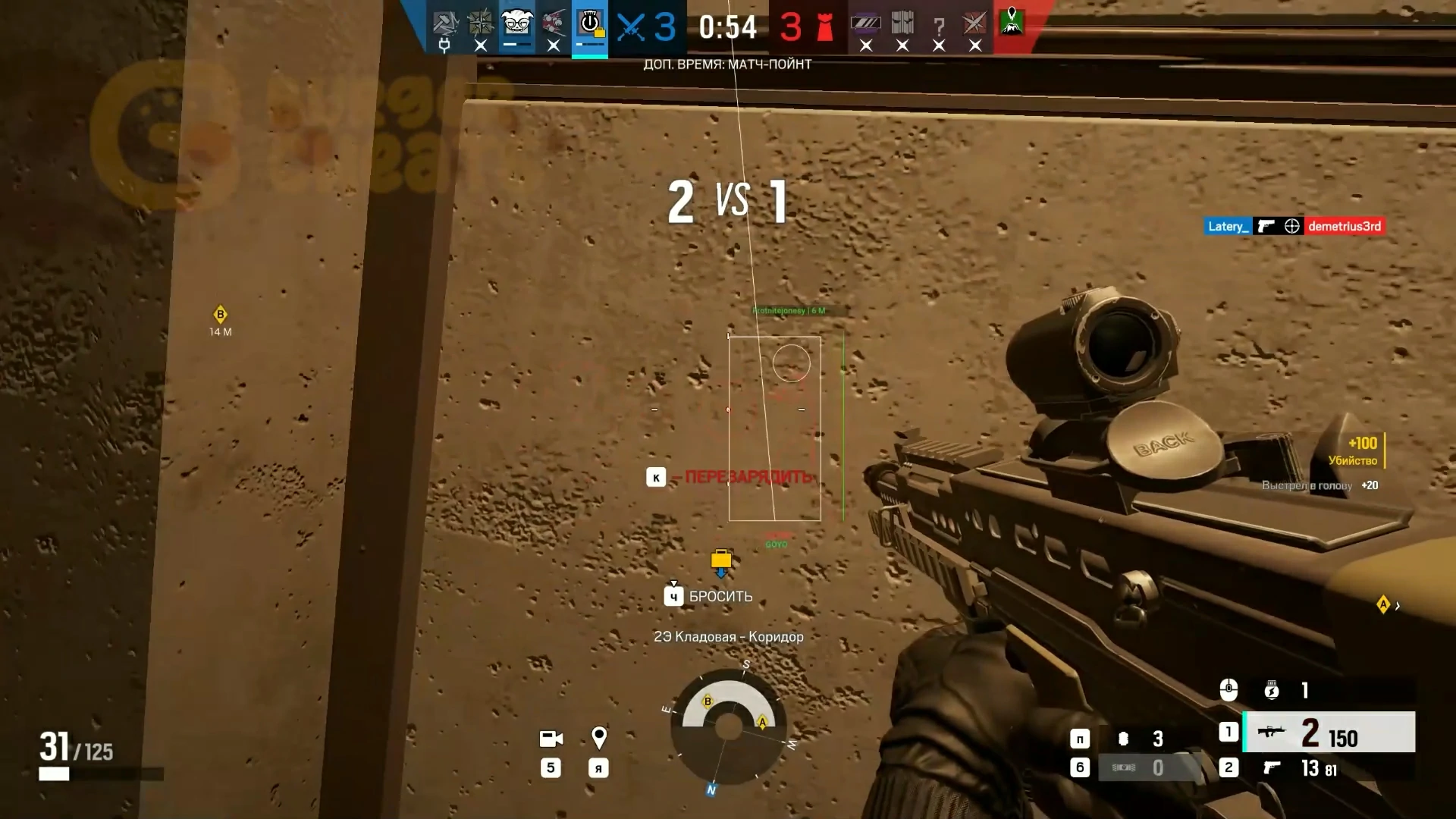
Triggerbot is the complement: it fires automatically the instant your crosshair passes over an enemy hitbox. In Siege's pixel-peek meta — where players hold tight angles with minimal body exposure — triggerbot eliminates the human reaction delay that turns a 200ms window into a missed opportunity. Pair it with an operator like Glaz (thermal scope + high damage DMR) or the BOSG (slug shotgun with extreme single-shot damage) and the effect is devastating.
R6S ESP and Wallhack — Intelligence Through Every Surface
R6S ESP doesn't just show you where enemies are. It replaces an entire layer of gameplay that Siege was designed around.
Player ESP
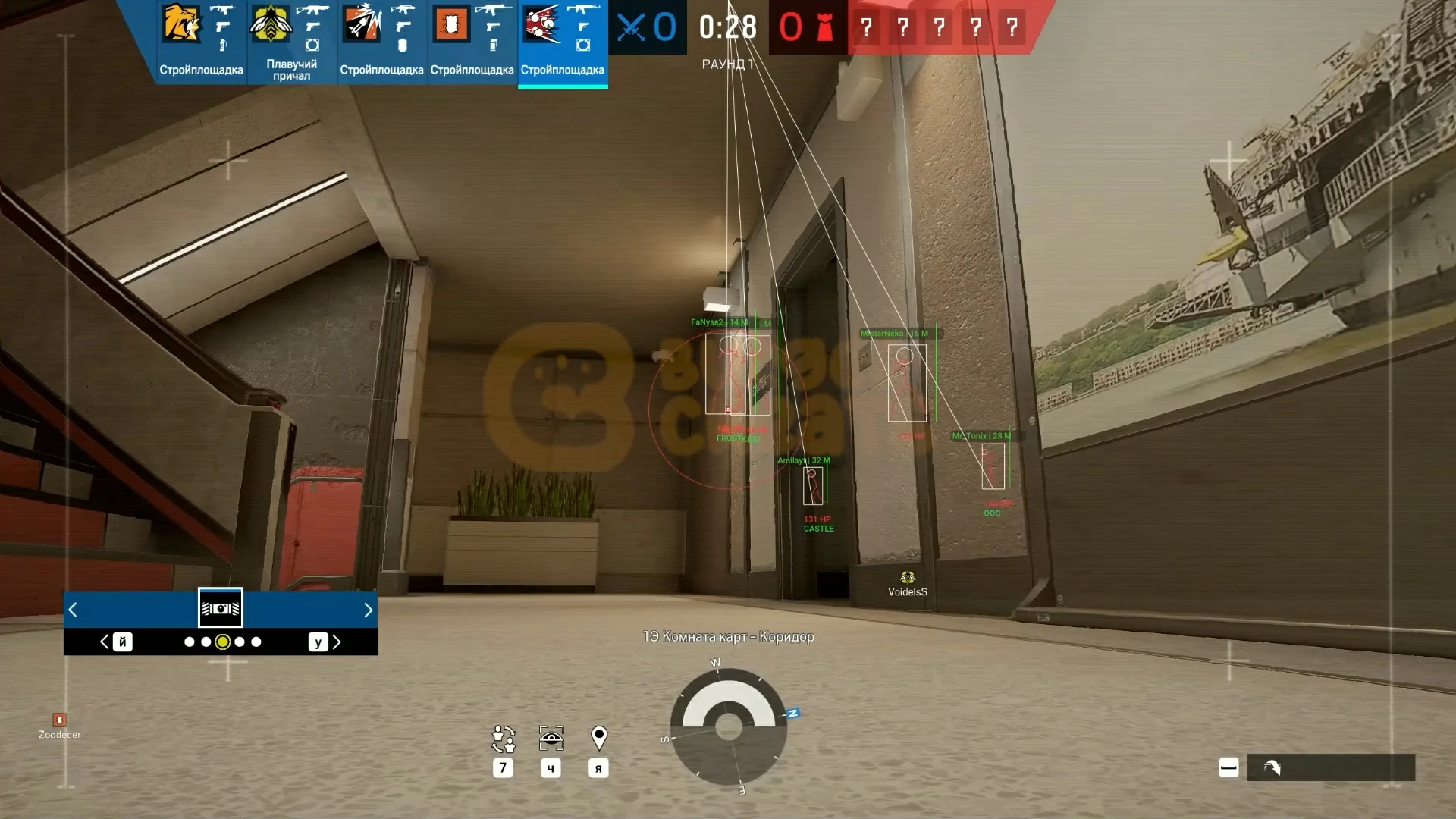
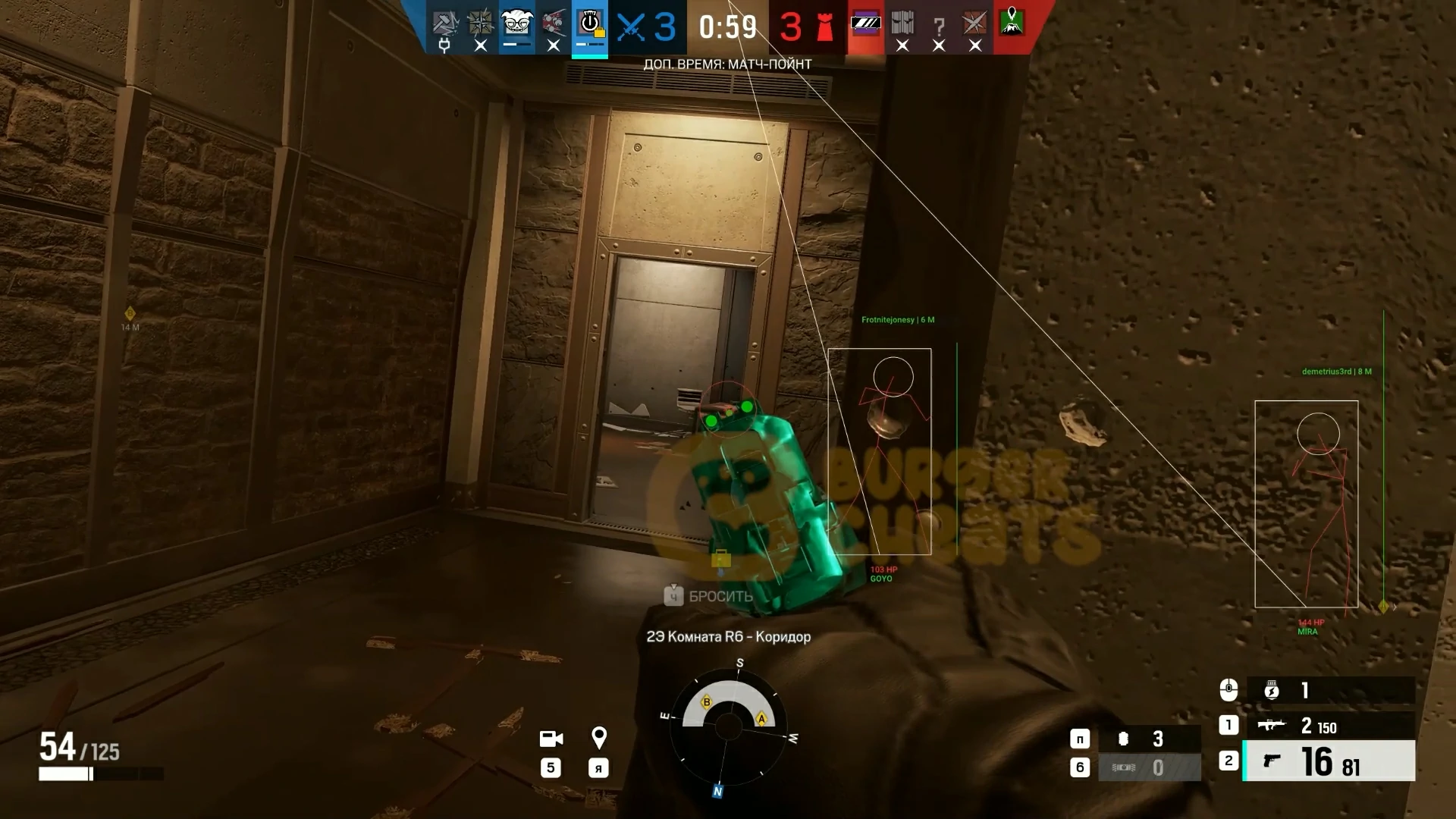
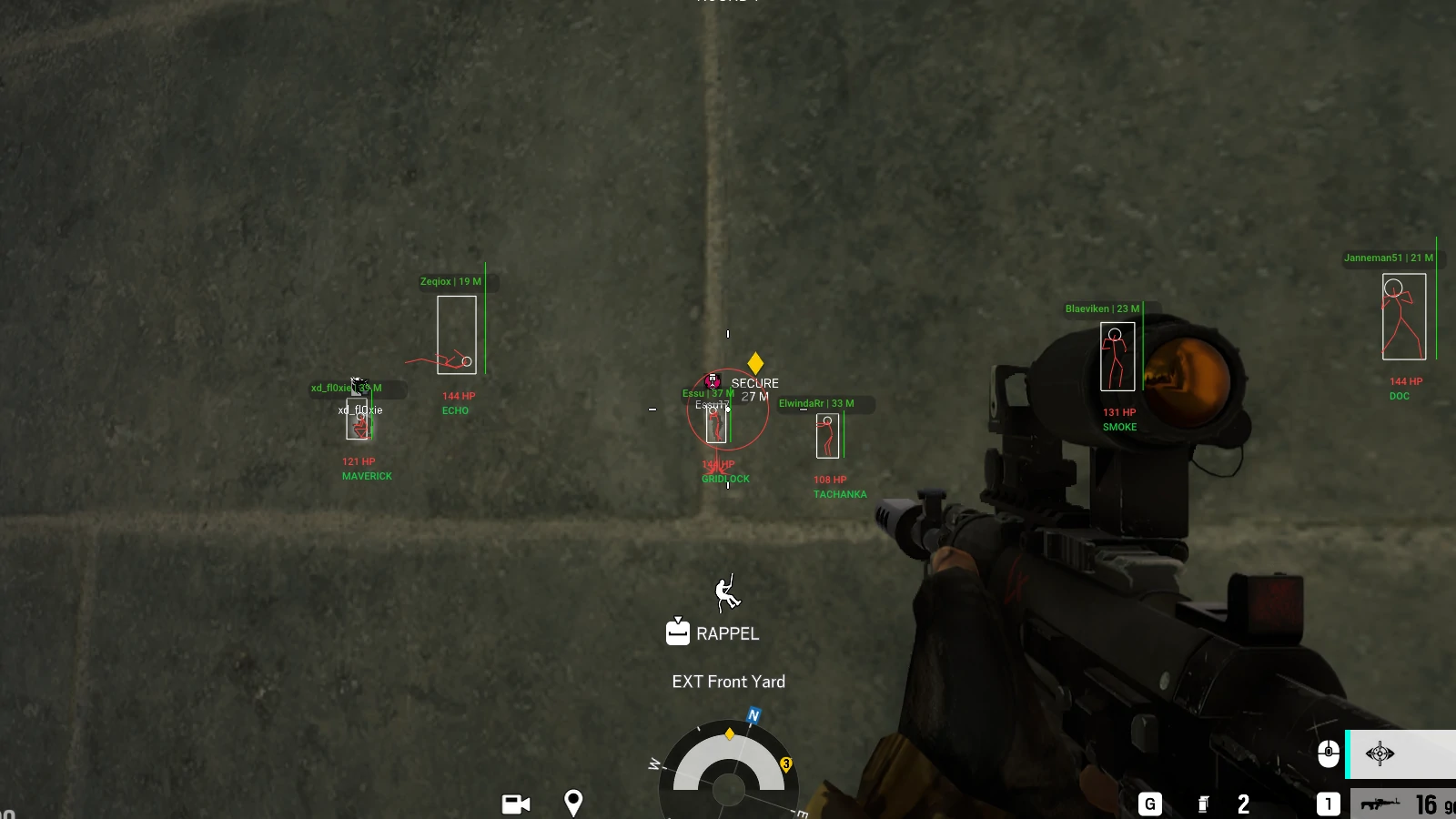
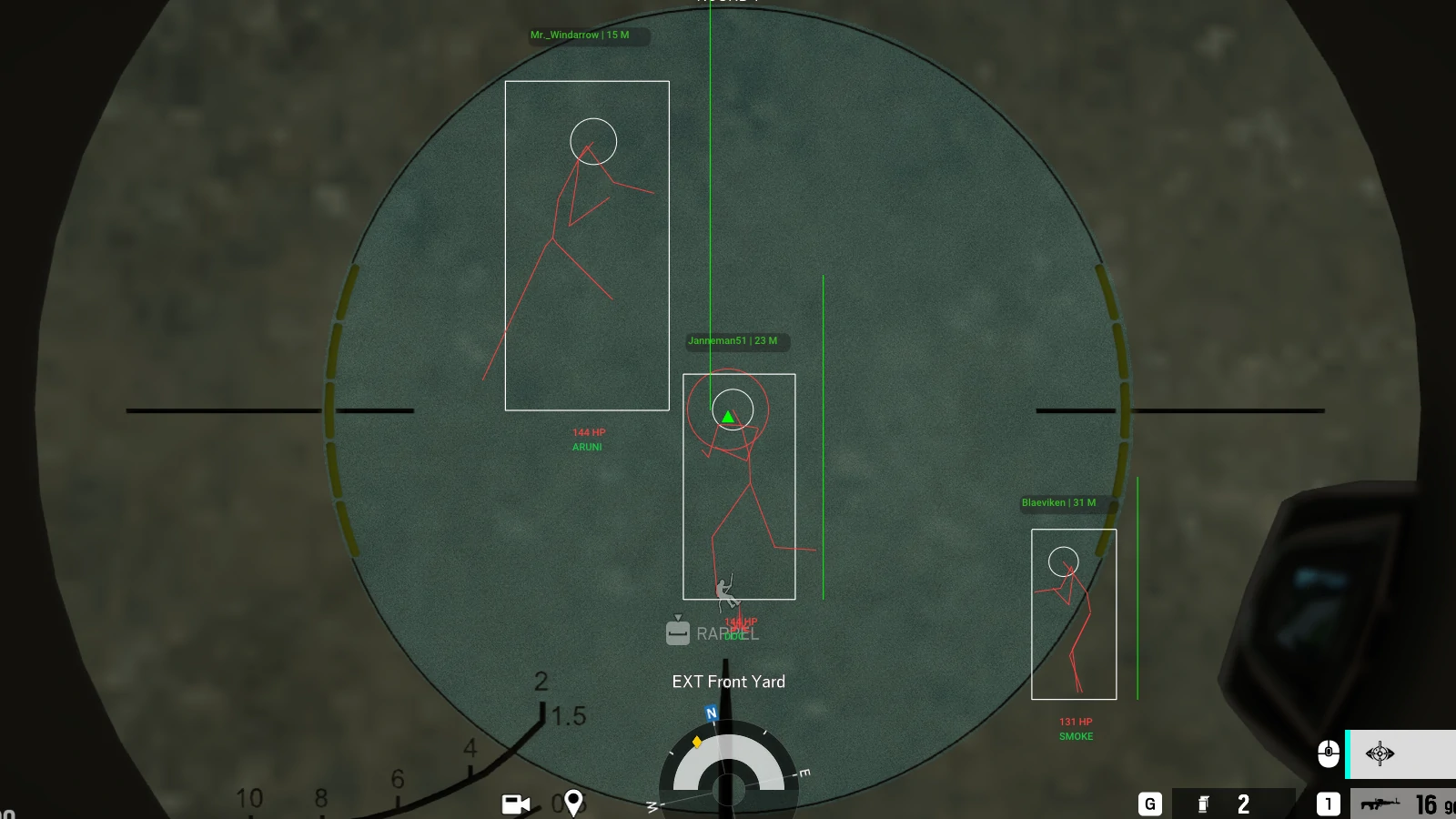
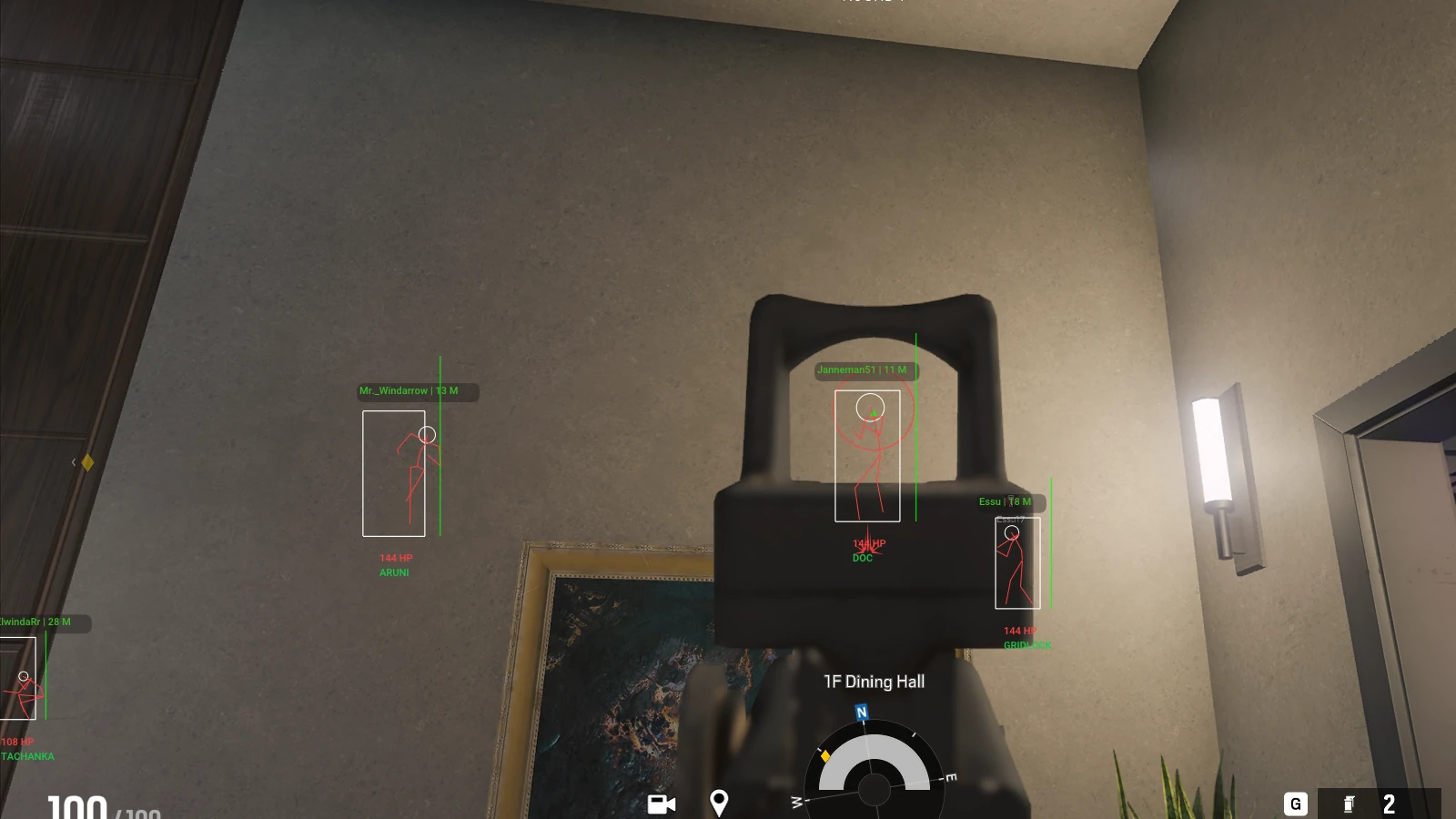
The baseline: skeleton overlays, bounding boxes, health bars, distance indicators, and operator names drawn through every wall, floor, and ceiling. In a game where one headshot kills, knowing an enemy's exact position behind a soft wall turns every weapon into a wallbang machine. The skeleton overlay is particularly valuable — it shows the head hitbox position during lean animations, giving you targeting data even when the player is behind cover.
Operator name display is more useful than it sounds. If the ESP shows "Pulse" on the other side of a wall, you know he can detect your heartbeat through that wall too — and you can pre-fire his known position before he peeks. If it shows "Caveira," you know she's running Silent Step and your team's sound cues are unreliable. Every operator name carries tactical implications that experienced players exploit.
Gadget ESP — The R6S-Exclusive Feature
This doesn't exist in any other mainstream FPS because no other game has Siege's gadget ecosystem. Gadget ESP renders every placed device through walls:
Kapkan's EDD traps on doorframes. Frost's Welcome Mats under windows. Lesion's Gu mines covering flanking routes. Bandit's Shock Wires electrifying reinforced walls. Mute's Signal Disruptors blocking hard breach and drones. Valkyrie's Black Eye cameras hidden in creative spots. Maestro's Evil Eye bulletproof cameras. Jäger's ADS units absorbing projectiles. Kaid's Rtila Electroclaws countering hard breach from a distance. Fenrir's Dread Mines (currently the most banned defender) triggering slow effects.
Without ESP, finding these takes droning, IQ's electronics scanner, Twitch's shock drone, or sacrificing a teammate to trigger them. With gadget ESP, every trap is marked before you enter the room.
Camera and Drone Detection
R6S has more camera types than any other shooter: default map cameras, Valkyrie Black Eyes, Maestro Evil Eyes, Echo's Yokai drones, Zero's Argus cameras, Solid Snake's Soliton Radar, Flores' explosive drones, and standard attacker drones. ESP marks every one of them — including hidden Valkyrie cameras that veteran players spend hours learning placement spots for.
Radar Hack
A persistent 2D minimap overlay showing all enemy positions in real time. Less visually intrusive than full ESP — no boxes or skeletons cluttering the screen — but provides the same positional awareness. Particularly effective in Siege because the game's standard compass and ping system give limited directional information. Radar fills the gap between "I heard footsteps somewhere left" and "there are two players in Kitchen and one rotating through Blue Stairs."
Bypassing BattlEye and R6 ShieldGuard
R6S doesn't run a stock BattlEye deployment. Ubisoft has layered at least six distinct anti-cheat systems on top of BattlEye's kernel driver, creating one of the more complex detection stacks in competitive gaming. Understanding what each layer does — and doesn't do — matters if you're evaluating what "undetected" actually means.
BattlEye — The Kernel Foundation
BattlEye (
BEDaisy.sys) has been in R6S since August 2016. It's a kernel-level (Ring 0) driver that loads at game launch — not system boot, which is a key difference from Vanguard. It installs as a Windows system service, only active during gameplay, and uses VMProtect to obfuscate its own binaries. Detection methods include signature scanning of running processes, memory scanning (both user-mode and kernel-mode), MSR register integrity checks, driver enumeration, and hardware fingerprinting via SMBIOS data, disk serials, MAC addresses, and GPU identifiers.BattlEye's detection depth in R6S is considered one of the more aggressive BattlEye deployments — more thorough than what runs in Hell Let Loose or Squad, though still less invasive than what Escape from Tarkov reportedly runs. The 2025 ACM paper "Battling The Eye" provided the first formal academic analysis of BattlEye's architecture and identified several design weaknesses that have since been patched.
QB System — The Cheat Creator Deterrent
Deployed late 2022, Ubisoft's in-house QB system was designed to make cheat development more difficult. It added binary obfuscation and encryption layers on top of BattlEye's scanning, forcing cheat developers to reverse-engineer additional protection before they could even begin building a working bypass. Several cheat creators publicly stopped supporting Siege after QB deployment — the engineering cost exceeded the market return.
Data Bans — ML-Powered Server-Side Detection
Deployed Y9S2 (May 2024). This is Ubisoft's machine learning system that analyzes server-side statistics: shot accuracy, headshot percentage, reaction times, K/D ratios, performance consistency across matches. It reduced average time-to-ban by half compared to BattlEye alone. The catch: it works on statistical aggregates, so a player who keeps their headshot rate within plausible human ranges — say, 55% instead of 95% — may avoid triggering it. Behavioral mimicry (randomized delays, accuracy variation) is the standard countermeasure.
R6 ShieldGuard — The Unified Umbrella
Launched with Siege X in June 2025, R6 ShieldGuard is Ubisoft's branding for the combined anti-cheat stack: BattlEye + QB System + Data Bans + MouseTrap (console MnK detection) + binary hardening + live security updates. The "live security" part is significant — new detection executables can be pushed to clients without a maintenance window, and updates never deploy mid-match. ShieldGuard claims 6,500+ permanent bans in its first month and averaged 11,000+ per month through Y10S2.
R6 ShieldGuard Secure Platform
The newest layer, announced for Year 11 (2026). Built around Secure Boot technology to verify the game environment before the client even launches. Initially deploying to "Top of the Ladder" (high-competitive Ranked) before broader rollout. This is significant for the DMA landscape — Secure Boot verification makes it harder (not impossible, but harder) to load unauthorized PCIe device drivers before the OS starts.
Ubisoft hasn't published specifics on what Secure Platform validates beyond "securing the game environment before you've even launched the game." If it follows the Vanguard/Ricochet model, expect UEFI boot chain verification, driver allowlisting, and potentially IOMMU enforcement in future seasons.
HWID Bans and Hardware Fingerprinting
BattlEye tracks hardware identifiers aggressively: SMBIOS data (motherboard Type 1/Type 2), disk serial numbers, MAC addresses, GPU serials, monitor HWIDs, keyboard/mouse serial numbers, MachineGuid registry entries, and Hardware Profile GUIDs. A banned player creating a new account on the same hardware is typically flagged within 24 hours. Phone number blacklisting prevents reuse on new accounts.
This is why HWID spoofing is considered essential companion tooling for R6S cheats. The spoofer modifies SMBIOS entries, disk serials, MAC addresses, and registry keys at kernel level — ideally loading before BattlEye does (which is feasible since BattlEye loads at game launch, not system boot). Year 11's Secure Boot integration aims to close this window by preventing unsigned drivers from loading before OS start.
The Numbers
Total cheating bans through early 2026: over 222,800. Monthly average during Y10S2: 11,000+ permanent bans. Post-Siege X F2P, matches with 4+ cheater reports rose from 1.8% to 2.5%. Cheating is concentrated in the upper ranks — Emerald, Diamond, and Champion are universally cited as worst-affected. The pro scene document "Save Siege" placed anti-cheat as the #1 priority, ahead of content, balance, and server quality.
DMA Hardware Cheats in Rainbow Six Siege
DMA (Direct Memory Access) represents a fundamentally different approach to cheating in R6S. Instead of running cheat software on the gaming PC — where BattlEye and R6 ShieldGuard actively scan — DMA uses a physical PCIe card that reads game memory from a completely separate second PC. No cheat files, no suspicious processes, no kernel modifications on the machine BattlEye monitors.
For R6S specifically, DMA setups enable read-only ESP overlays rendered on the second PC and displayed through a fuser device onto your main monitor. The gaming PC's memory is never modified — only read — which eliminates the memory integrity violations that BattlEye's kernel scanning catches. Add a KMBox or Makcu for input injection and you get aimbot functionality without any software footprint on the gaming PC.
BattlEye's architectural weakness against DMA is fundamental: it monitors the gaming PC for suspicious software, but DMA operates as hardware on a separate system. The DMA card needs proper firmware to disguise itself as a legitimate PCIe device (emulated firmware replaces the card's identity so BattlEye's device enumeration doesn't flag it), and the full setup requires a DMA card, second PC, firmware, and optionally a fuser + input device.
With R6 ShieldGuard Secure Platform rolling out Secure Boot requirements for competitive play, the DMA landscape in Siege is evolving. Secure Boot makes it harder to load unauthorized PCIe drivers pre-boot, but current emulated firmware with dedicated driver loading still passes standard Secure Boot environments. This is an active arms race — expect ShieldGuard to follow the same trajectory as Valorant's Vanguard, which already enforces IOMMU and UEFI boot verification.
Map Knowledge and Operator Synergies — Where Cheats Hit Hardest
R6S cheats don't operate in a vacuum. Their impact varies dramatically depending on which map you're playing and which operators are in the round. A few examples from the current Y11S1 ranked pool:
Oregon — Vertical Play Abuse
Oregon's two-floor structure with a semi-open basement makes it one of the most vertical maps in the pool. ESP reveals defender positions on the floor below, enabling Buck (skeleton key shotgun) or Sledge (hammer) to open the ceiling directly above a defender's head and fire down. Without ESP, you need drone information or audio cues to know exactly where to open the floor. With ESP, every vertical kill looks like a "good read" instead of what it is.
Coastline — Angle-Heavy, Sound-Dependent
Coastline's open layout and long sightlines make it one of the most aim-dependent maps. ESP matters less for wallbanging (fewer soft walls in key areas) but more for rotation tracking — knowing when defenders rotate between Hookah/Billiards and Kitchen/Service lets attackers time pushes perfectly. Radar hack is arguably more valuable than full ESP here because the information you need is movement, not static position.
Bank — Open Floor Plan, Gadget-Dense Defense
Bank's open lobby and server room create long engagement distances where aimbot precision matters most. The basement sites are notoriously gadget-heavy — Bandit tricking, Kaid Electroclaws, Mute jammers stacked on reinforced walls. Gadget ESP turns a complex hard breach attempt into a checklist: here's the Bandit battery, here's the Kaid claw, here's the Mute jammer. Destroy in order, breach clean.
Operator Synergies with Cheats
Certain operators amplify cheat effectiveness beyond the baseline. Valkyrie + camera ESP: you know exactly where her hidden Black Eye cameras are, and you can throw your own cameras knowing where hers aren't. Pulse + wallhack: his cardiac sensor already detects heartbeats through walls at 9 meters — add ESP and you have continuous tracking without needing to pull out the sensor (which disables your weapon). Caveira + silent aim: her Silent Step ability eliminates footstep audio, and Luison (her pistol) can down enemies in two shots — pair with triggerbot for guaranteed interrogation opportunities. Solid Snake (Y11S1) + ESP: his Soliton Radar already provides proximity intel, but ESP removes the range limitation entirely.
On defense, Jäger benefits from ESP on the attacking side — knowing which windows attackers are pushing lets you position ADS units to intercept utility before it lands. Smoke with ESP can time gas canister throws to deny plant attempts the moment an attacker reaches the defuser position — no guesswork on timing.
Frequently Asked Questions
Does BattlEye detect R6S cheats?
BattlEye detects many cheats — over 222,800 bans have been issued through early 2026, with 11,000+ per month during Y10S2. The combination of BattlEye, the QB System, Data Bans, and R6 ShieldGuard creates a multi-layered detection stack. That said, properly built external cheats with behavioral mimicry, and especially DMA hardware setups, have significantly lower detection rates than internal cheats that modify game memory directly. No cheat is guaranteed permanent — ShieldGuard pushes live updates without maintenance windows.
How does ESP work with R6S's destructible walls?
ESP renders player positions, gadgets, and cameras through all surfaces regardless of their destruction state. This is uniquely powerful in Siege because many of those surfaces are soft — meaning you can see a player through a wall and immediately shoot through it for a wallbang headshot kill. In games with non-destructible environments, ESP gives information but no immediate action path. In Siege, ESP + soft walls + one-shot headshot = the most lethal cheat combination in the genre.
Are DMA cheats undetectable in Rainbow Six Siege?
DMA hardware bypasses BattlEye's software-based scanning because no cheat code runs on the gaming PC. However, "undetectable" is never absolute. Server-side Data Bans analyze performance statistics regardless of how the cheat operates. R6 ShieldGuard's Secure Platform is adding Secure Boot requirements that may impact DMA firmware loading in future seasons. And DMA setups still require properly emulated firmware to avoid PCIe device enumeration detection. DMA is the hardest to detect, not impossible to detect.
What operators benefit most from ESP in Siege?
On attack: any operator with frag grenades or soft breach capability — Buck, Sledge, Ash, Zofia — because ESP reveals where to open walls for direct kills. IQ becomes redundant (her electronics scanner does what gadget ESP does, but worse). On defense: Pulse (his cardiac sensor already gives wall intel — ESP extends the range), Caveira (silent flanking with perfect enemy tracking), Smoke (perfectly timed gas denials).
Can I get HWID banned in Rainbow Six Siege?
Yes. BattlEye tracks SMBIOS data, disk serial numbers, MAC addresses, GPU serials, monitor HWIDs, and keyboard/mouse serial numbers. A banned player creating a new account on the same hardware is typically flagged within 24 hours. Phone number blacklisting prevents reuse. An HWID spoofer modifies these identifiers at kernel level. With ShieldGuard Secure Platform adding Secure Boot requirements for competitive play, the window for loading spoofer drivers before anti-cheat initializes is narrowing.
Explore BurgerCheats R6S Products
We build R6S cheats around the mechanics that make Siege unique — head-only aimbot with lean prediction, gadget ESP through every destructible surface, radar overlays, and DMA hardware support for the lowest possible detection profile. Check our current R6S products, pricing, and detection status:
Browse R6S Cheats in the Store →
Questions about BattlEye bypass, DMA compatibility, or setup? Our Discord team handles R6S questions daily. Check the status page for current undetected status across all products.
-
-
Total Members 5,533
-
Most Online 149
-
Newest Member laurin kind

-
-
Reviews
-

By Xulsty · Posted
Easiest cheese every to download and use for real, bought it like 4 times and loved it every time -

By sacisback · Posted
I needed to find an HWID spoofer and came across one here. It’s great—the technical support is fast as well, and they respond quickly through their ticket system. I haven’t had any issues using it; everything is automated, and there’s no risk of scam -

By Discord Review · Posted
+rep @admin really fast support and noce cutom service the delivery speed was fast he helped me with the settings you need to change an do and that in 10 min thats crazy. -

-

By 3ttuu · Posted
My firmware is working perfectly thanks to the kind explanations and help from the Burger Cheat admin. They were always very friendly and responded quickly to customers. If you're considering a purchase, I highly recommend it
-