
-
ARK: Survival Ascended Hacks & Cheats — Aimbot, ESP, Wallhack & Radar for Every Map
ARK: Survival Ascended hacks and cheats with aimbot, ESP, wallhack & radar. Undetected under BattlEye on every map from The Island to Lost Colony.
-
Featured Products
-
ARK: Survival Ascended Hacks — What Works on Official PvP, and What's Single-Player Only
ARK: Survival Ascended hacks split into two worlds that constantly get confused. Free console commands — god mode, GMSummon, fly, Ghost — only run in single-player or on unofficial servers where an admin switches console access on; on official PvP that access is locked, so they do nothing. The tools survivors actually buy for official PvP are external: aimbot, ESP, wallhack, radar, and recoil control that read and draw the game's memory without ever typing a command the server can log. Everything below is about that second category — what holds up under a kernel-level anti-cheat on live PvP, and what quietly gets you nowhere. And the same ARK: Survival Ascended cheats serve very different players: the PvP raider leaning on aimbot, ESP, and radar, the PvE tamer using ESP to find a level 150 Rex, and the solo grinder running speed and resource cheats to skip the farm.
You built a metal compound on Ragnarok's Highland plateau. Twelve Auto Turrets on the perimeter, a vault room three walls deep, and a mutation-stacked Rex army parked inside a Cryofridge. You logged off at midnight. By sunrise, your tribe log is a wall of red text: structures destroyed, creatures killed, inventory lost. Official PvP has no Offline Raid Protection. Everything you own sits on the server whether you're watching it or not.
ARK: Survival Ascended rebuilt the original survival sandbox in Unreal Engine 5 with Lumen lighting, Nanite geometry, and dynamic water physics. Nine maps are live — from The Island's jungle coasts to Aberration's bioluminescent caves to Lost Colony's sci-fi frontier. It is one of the most-played survival games on Steam, and its sharpest competitive format — Small Tribes, capped at six players with no alliances — was built specifically to stop mega-tribes from running the server.
BattlEye runs as a kernel-level driver on every official server, and the developer enforces permanent hardware bans for hacking. The game costs real money, the grind demands real time, and the anti-cheat carries real consequences. That's the environment these features operate in.
ARK: Survival Ascended Aimbot — Locking Fabricated Snipers on a Charging Giga
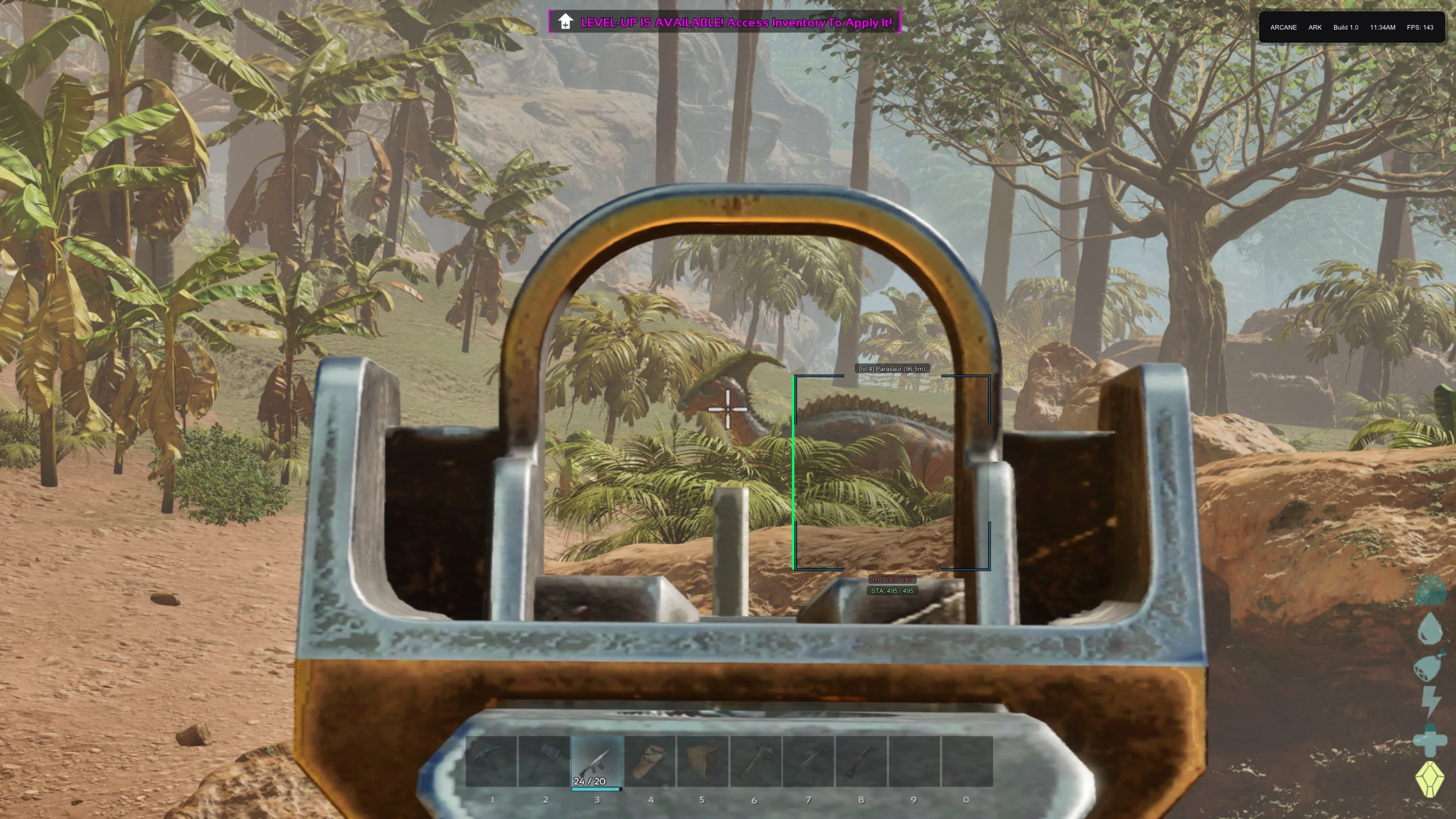
An aimbot in ARK: Survival Ascended automates target acquisition for ranged weapons including the Fabricated Sniper, Longneck Rifle, and Compound Bow. The system locks crosshair placement onto selected hitboxes — headshot bones for maximum damage multipliers or body center mass for reliable tracking against fast-moving creatures and mounted riders. Target filtering separates players from the hundreds of wild creatures that populate every map.
You spent fourteen hours taming a level 150 Giganotosaurus on Ragnarok. You bred it through six generations of mutations to stack melee damage. You logged off at 2 AM. By 6 AM, your tribe log says "Your Giganotosaurus — Level 382 was killed by Human — Level 105." That level 105 had a Fabricated Sniper and perfect aim. In ARK, one headshot from an Ascendant-quality Fabricated Sniper deals enough damage to drop a rider off their mount. The aimbot ensures that headshot lands while you're panicking on a turret tower at 2 AM, trying to defend against three Pteranodon riders diving from different angles.
The difference between PvE and PvP targeting matters here more than in any other survival game. In PvE, bone-lock on a Giganotosaurus head while firing tranq darts from a Longneck means the knockout lands faster — fewer darts, less risk of the creature enraging. In PvP, switching target priority to players-only ignores the thirty tamed Stegosauruses a raiding tribe is using as turret soakers and locks directly onto the rider carrying the C4. If you're running DayZ hacks under the same BattlEye driver, the target filtering concept is familiar — but ARK's creature density makes the filter mandatory rather than optional.
ARK Survival Ascended Aimbot Settings — PvP vs PvE Target Priority
Your PvP aimbot configuration should prioritize players over creatures. Set target priority to human hitboxes first, mounted riders second, wild creatures third. FOV at 30–45 degrees keeps lock-on within the arc you're already tracking — wide enough to catch a Pteranodon swooping from your peripheral vision, tight enough that it doesn't snap to a Parasaur 90 degrees behind you and flag behavioral detection.
PvE demands the opposite hierarchy. You want the Longneck aimed at whatever you're taming — not at the tribe member standing next to it. Bone selection shifts from headshots (lethal) to body center mass (torpor application). A level 150 Quetzal knockout tame takes over three hours. Missing tranq darts because your crosshair drifted to a passing Argentavis turns a three-hour tame into a four-hour chase.
FOV and Aim Bone Selection for Dino Fights
Boss fights in ARK bring twenty tamed creatures into a locked arena against the Broodmother, Megapithecus, or Dragon. You're mounted on a Yutyrannus, buffing your Rex army with Courage Roar, while firing a Fabricated Pistol at the boss between roar cooldowns. Bone-lock to the boss's head maximizes your personal damage contribution during Alpha Dragon — a fight where every point of DPS matters because the Dragon's fire breath can wipe an entire Rex line in seconds.

ARK: Survival Ascended ESP — Reading Tribe Logs Before They're Written
You're crouched on the volcanic ridge above a rival tribe's compound on The Center. Metal walls, a behemoth gate, and the tip of a Giganotosaurus tail clipping through a ceiling tile. That's what ARK gives you by default — walls and guesswork. You have no idea how many players are inside, what level that Giga actually is, or how many Auto Turrets line the interior. Committing twelve C4 charges and your best tames to breach that gate without intel is a coin flip between a successful raid and losing everything.
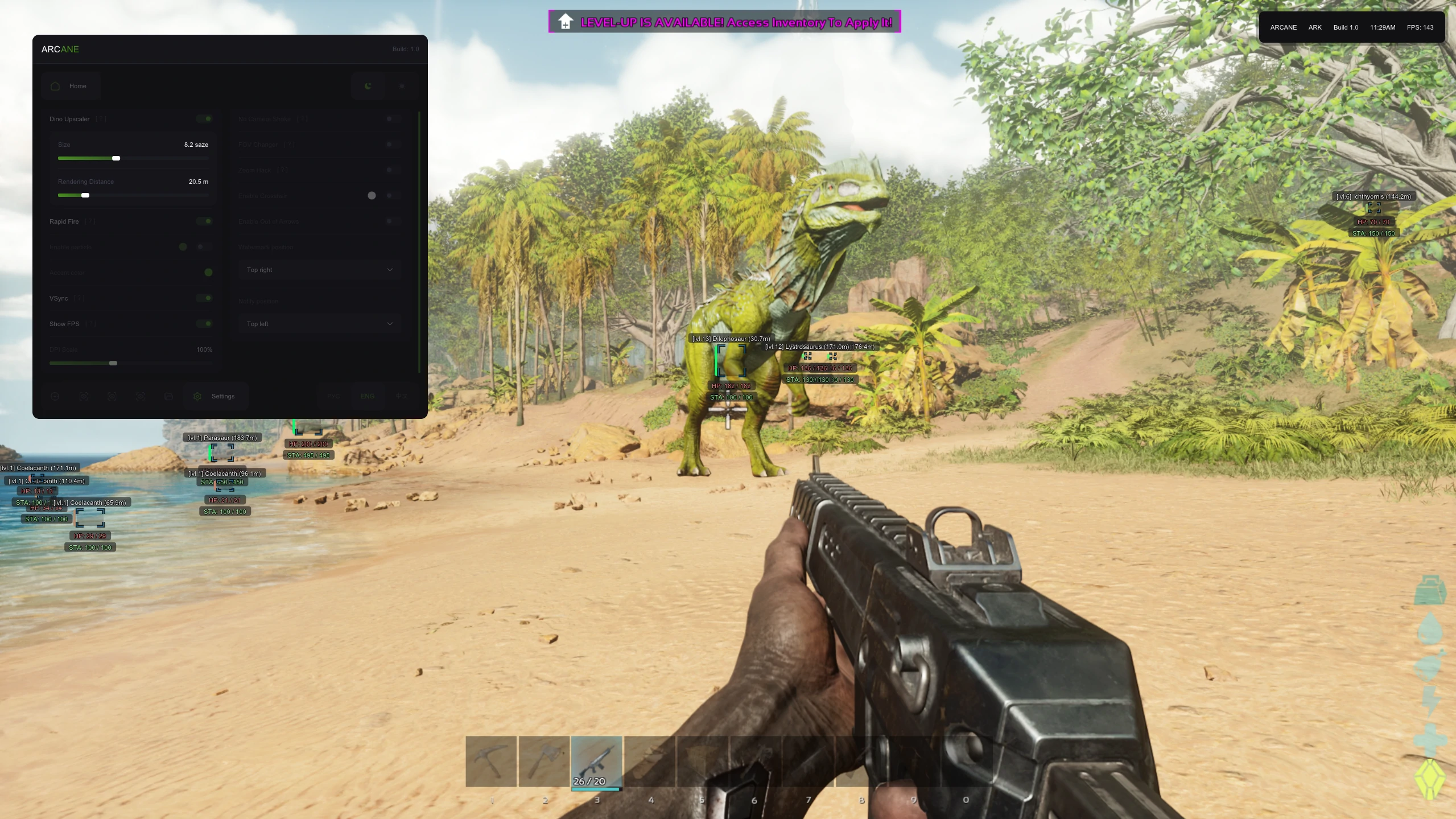
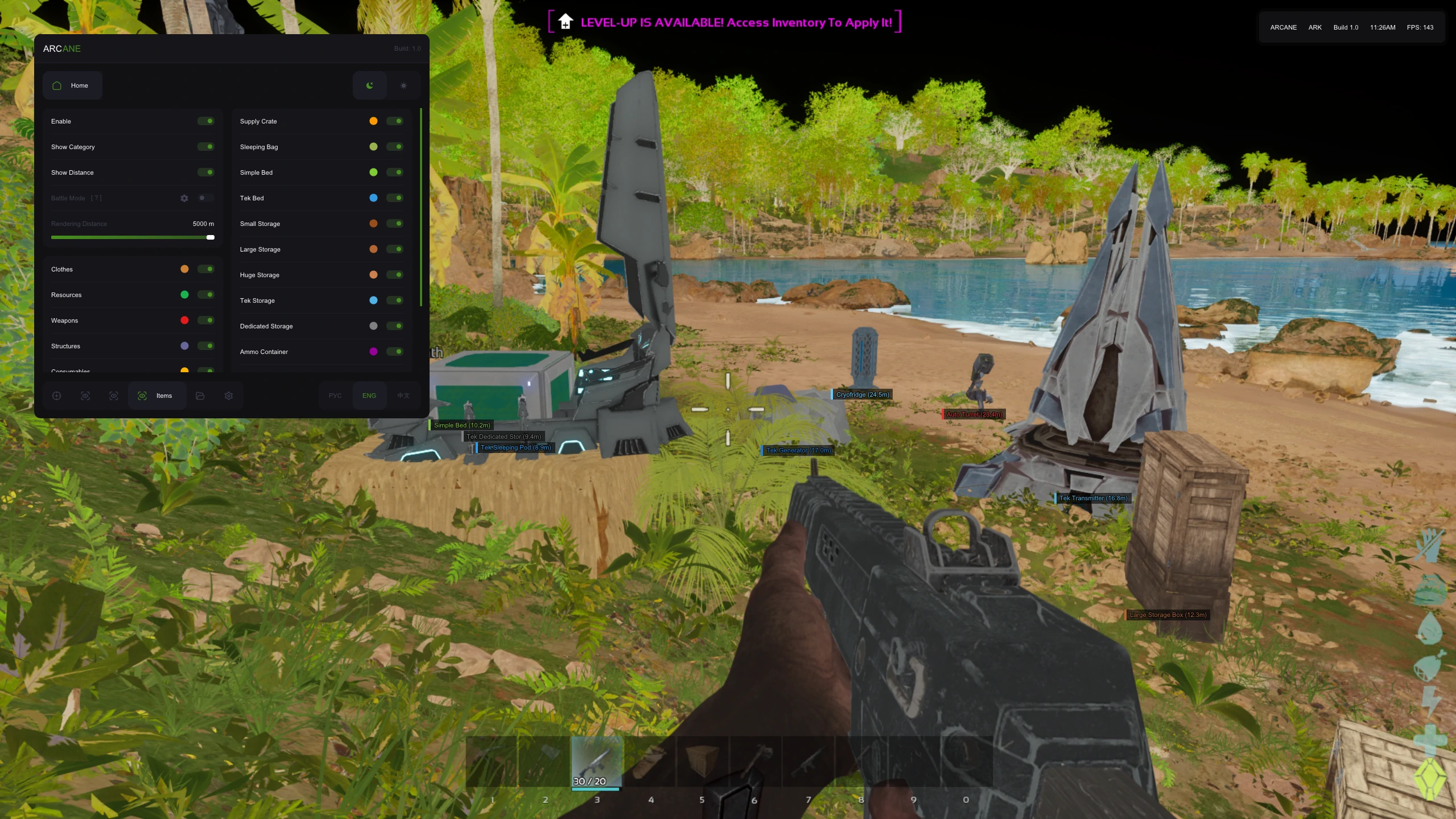
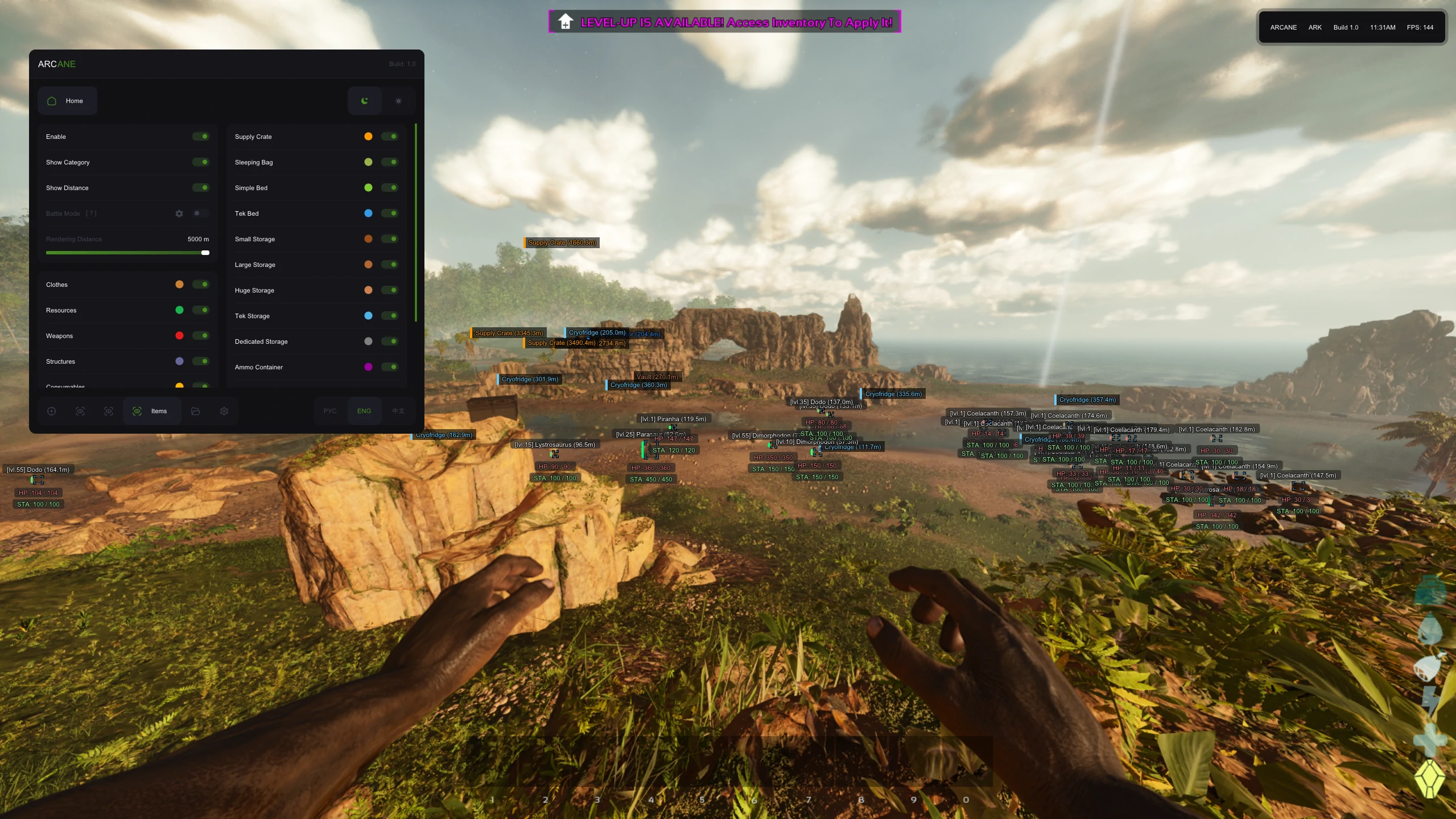
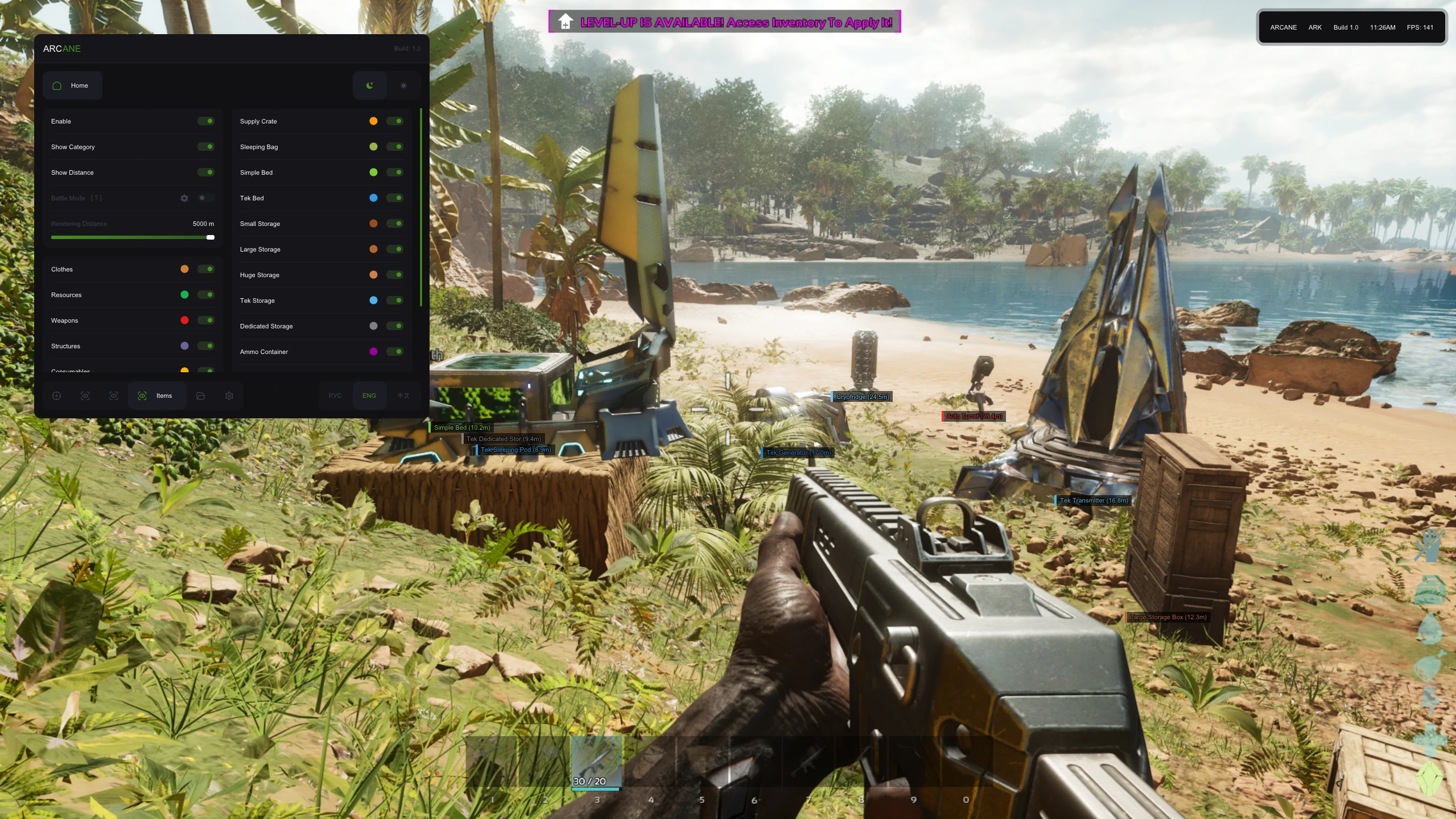
ESP overlays strip that blind spot completely. The system displays real-time positional data for players, creatures, structures, and items through terrain and obstacles. In ARK: Survival Ascended, this includes creature species and level, player tribe names, dropped supply crate quality tiers, and resource node locations — information normally hidden behind dense jungle canopy, cave walls, and underwater terrain. The tail belongs to a level 382 mutation-stacked Giga. Four players are online inside the compound. Eleven Auto Turrets cover the gate approach. Now you know whether to breach or quietly extract your scouting party.
What makes ESP uniquely valuable in ARK is the taming economy. Every wild creature displays a level between 1 and 150 on official servers, but you can't see that level until you're close enough to read the nameplate — which, for aggressive creatures like Giganotosauruses or Yutyrannus, means close enough to die. ESP shows creature levels at render distance. A level 150 Rex is worth three hours of knockout taming and weeks of breeding investment. A level 15 Rex is worth nothing. ESP turns a blind search across the whole sprawl of The Island into a targeted extraction. That information advantage connects directly to how Escape from Tarkov cheats on BattlEye-protected servers handle loot intel — except in ARK, the "loot" breathes, fights back, and takes hours to secure.
ARK Survival Ascended ESP Settings — Filtering Hundreds of Creatures Down to What Matters
ARK has hundreds of creatures spread across its nine maps. Without filtering, your screen becomes a neon overlay of Dodo names and Parasaur levels stretching to the horizon. Entity filtering is not optional — it's survival. Set creature filters to display only high-value tames: Rex, Giganotosaurus, Quetzal, Wyvern, Rock Drake, Yutyrannus, Therizinosaurus. Add Ankylosaurus and Doedicurus if you're on a resource farming run. Disable everything else.
Player filtering should display tribe name and distance at all times on PvP servers. On Small Tribes, where the six-player cap means every encounter is personal, knowing that the dot 300 meters north belongs to the same tribe that raided you last week changes how you approach a metal run on Aberration's Spine.
Player and Tame Distance Markers on The Island
The Island's geography funnels traffic through predictable corridors — the river between Weathertop and the Redwoods, the path from South Beach to the volcano, the underwater caves connecting East and West zones. Distance markers on ESP let you track player movement through these corridors from a mountaintop base. You see a group of three moving north toward the volcano with tamed Argentavises — they're heading to the metal-rich rocks around the caldera. You know exactly when they'll be loaded down with metal ingots and vulnerable on the return trip.
Why Wallhack Changes Everything in Offline Raid Defense
You log in to a tribe log full of destruction notifications. Walls breached, turrets drained, tames killed. But the raiders are still on the server — you can see the damage is fresh, and your remaining Auto Turrets are firing at something you can't see. They're inside your base, behind the metal walls of your crafting room, looting your vault while your turrets shoot at a soaker Stegosaurus parked outside the front gate. ARK's metal and Tek structures are completely opaque. You can hear footsteps on the other side of your own walls and have zero idea where the threat actually is.
Wallhack renders structures and terrain mesh transparent, revealing players and creatures behind solid surfaces. In ARK: Survival Ascended, this penetrates metal walls, Tek barriers, cave rock faces, dense Redwood canopy, and underwater structures — every environment where ARK's map design deliberately limits visibility to create ambush conditions. The system turns your own base from a blind box into a glass house where you can track every raider's position in real time.
The second pain point wallhack addresses is meshing. Exploiters clip beneath the terrain mesh to attack structures from underground, where turrets can't target them and players can't see them. Meshing has plagued ARK since its original release — the developer's anti-mesh system produces so many false positives that it kills more legitimate players than actual meshers. Wallhack reveals those under-map positions instantly. You see the player crouched beneath your foundation layer on Extinction, planting C4 against the underside of your generator room. That visibility turns a silent, invisible raid into a fight you can actually respond to.
Cave Penetration — Seeing Through Aberration's Bioluminescent Zone
Aberration is built entirely underground. Three vertical biome layers — Fertile, Bioluminescent, and Elemental — stacked on top of each other with narrow passages connecting them. Cave bases are the meta on Aberration because the chokepoints are naturally defensible. Wallhack reveals players moving through the Bioluminescent Zone tunnels below your Fertile Lake base before they reach your entrance. You see the Rock Drake rider descending through the vertical shaft that connects the zones — a path that normally gives zero warning until they're already at your front door.
Underwater Structure Visibility on The Center
The Center has some of the deepest underwater cave systems in ARK, and tribes build entire bases inside submerged caverns that are invisible from the surface. Even with scuba gear and a Basilosaurus, finding these bases requires swimming blindly through dark water. Wallhack marks structure outlines through the ocean floor, exposing hidden underwater vaults and breeding rooms that would otherwise require hours of systematic diving to locate.
ARK: Survival Ascended No Recoil — Longneck Rifle to Assault Rifle Spread Control
No recoil eliminates weapon kick patterns during sustained fire, keeping crosshair placement stable across consecutive shots. ARK: Survival Ascended applies this across its full weapon roster — from the Longneck Rifle's sharp vertical jump on each shot to the Assault Rifle's horizontal spray drift during extended PvP engagements. The correction applies per-frame, compensating before the visual kick registers on screen.
You're defending a hatchframe breach on your metal base. Three raiders in Flak Armor just blew through the ceiling with C4 and dropped into your crafting room. You're firing an Assault Rifle at close range — the weapon climbs hard after the first five rounds, pulling your crosshair above their heads. No recoil keeps every bullet on center mass through the full magazine. In a game where Flak Armor absorbs significant damage, wasting half your magazine on ceiling shots is the difference between dropping all three and getting piked in the face.
Weapon-Specific Recoil Patterns — Pump Shotgun vs Compound Bow
The Pump-Action Shotgun has severe vertical kick between shells, which matters during turret-drain pushes when you're firing at defenders between soaker rotations. No recoil keeps your follow-up shell aimed at the same target. The Compound Bow has minimal recoil but requires precise hold-time for full draw — stabilization during the draw cycle keeps your aim on a fleeing rider's mount rather than drifting to empty sky. The Fabricated Sniper benefits most at extreme range where even slight vertical deviation puts your shot into the cliff face behind a target 200 meters away on Ragnarok's highlands.
PvE recoil correction matters less for combat but directly improves taming efficiency. The Longneck Rifle firing tranq darts kicks hard enough to lose your aim point on a creature's head between shots. Missing the headshot hitbox on a Giganotosaurus means your torpor application drops — and on a creature that enrages below 20% taming effectiveness, that lost torpor efficiency can cost you the entire three-hour taming attempt.
How Radar Tracks Server Transfers Before Raids Hit
Your Small Tribes server has been quiet for three days. Your tribe of six has been running metal on Ragnarok's volcano, breeding Rexes for the Alpha Dragon fight, and nobody has raided anybody in a week. Then six dots appear simultaneously at the blue Obelisk — 400 meters northwest of your base. They weren't there thirty seconds ago. They transferred in from another server. They brought tames. On official ARK servers, the Obelisk and supply drop terminals are the only entry points for server transfers, and a coordinated transfer raid is the single most devastating event in the game.
Radar provides a minimap or full-screen overlay showing real-time positions of players and creatures across the server. In ARK: Survival Ascended, this is uniquely valuable for monitoring Obelisk activity — server transfers are the primary attack vector for organized groups that breed armies on external servers and transport them in for a single overwhelming strike. Radar that flags new player dots appearing at Obelisk coordinates gives your tribe minutes of early warning instead of zero.
Beyond raid detection, radar serves as a taming scanner across ARK's enormous maps. Ragnarok alone is one of the largest maps in the game. Finding a max-level 150 Rex for your breeding line means covering thousands of spawn points. Radar highlights creature positions across the map grid, turning a two-hour blind search into a five-minute targeted flight on an Argentavis. For SCUM hacks with BattlEye compatibility, radar fills a similar scouting role — but ARK's map scale and creature density make it a progression tool rather than just a combat tool.
Obelisk and Supply Drop Monitoring
Each ARK map has three Obelisks (red, blue, green) and periodic supply drop beacons that can also function as transfer terminals. Radar configured to alert on player clusters near these coordinates acts as a server-wide alarm system. If three or more players appear within 50 meters of any Obelisk within a ten-second window, that's a transfer raid staging — not a coincidence. Your tribe has time to cryo-pod your best tames, log your valuables into the vault, and mount a defense before they even reach your render distance.
How BattlEye's Kernel Driver Detects Cheats — And Where It Fails
BattlEye protects ARK: Survival Ascended through a kernel-mode driver that loads the moment the game launches. It pairs that driver with a user-mode client injected into the game process and a server-side layer that watches behavior, so detection runs at three levels at once. The driver scans for known cheat signatures against a server-synced database, monitors injection attempts, blocks direct memory editing, and flags connections to known cheat-distribution hosts.
That's the architecture shared by every BattlEye title — Arma Reforger cheats under BattlEye, DayZ, Escape from Tarkov, and Rainbow Six Siege all run on the same driver framework. What makes ARK's implementation distinct is the enforcement layer above it. Many competitive community servers stack their own third-party anti-cheat plugins on top of BattlEye, catching behavioral patterns — impossible movement, illegal damage values, sub-minimum taming times — that a client-side scanner never sees. That supplemental layer exists because the ARK community concluded that BattlEye alone is insufficient.
The community calls BattlEye "Battle Blind" for a reason. Detection waves arrive on a cycle measured in months — paid cheats operate undetected between waves, get flagged in a ban wave, update their signatures within days, and return to undetected status. Organized cheating networks adapt between these cycles faster than BattlEye's backend updates propagate. The result is a predictable pattern where amateur cheaters using free or outdated tools get caught quickly, while subscription-based tools maintained by active developers ride the gap between detection waves.
Why Server Admins Run Third-Party Detection Alongside BattlEye
The developer's response to the cheating problem included a crossplay incident that proved BattlEye's limitations at scale. Shortly after launch, the Windows Store version of ARK: Survival Ascended lacked proper BattlEye enforcement, and cheaters exploited the platform gap to bypass detection on crossplay servers. The developer temporarily disabled Windows Store crossplay on the official PvP network — a blunt fix that locked legitimate players out of their friends' servers because BattlEye couldn't secure the alternate client.
Server admins on competitive community clusters took matters into their own hands. Their plugins monitor behavioral patterns that BattlEye doesn't flag — impossible movement speeds, damage values exceeding weapon caps, instant structure placement, and taming completion times below physical minimums. These server-side checks catch what client-side scanning misses. Official servers, which the developer hosts directly, run BattlEye alone with no supplemental protection.
HWID Bans and the Cost of Getting Caught
ARK's official Code of Conduct lists HWID bans as a non-appealable enforcement action. BattlEye collects hardware fingerprints — motherboard serial, storage drive identifiers, network adapter MAC address, and BIOS firmware data — creating a device-level ban that persists across new Steam accounts. On a free-to-play BattlEye title, an HWID ban costs you a new hardware spoof and a fresh account. On ARK: Survival Ascended, it costs you the price of the base game plus whatever DLC you owned, and — far more painful — the character progression and tame inventory that doesn't transfer to a new account. The replacement cost creates a risk calculus that doesn't exist in the free-to-play BattlEye ecosystem.
ARK: Survival Ascended Speed Hack — A Single-Player and Unofficial-Server Tool, Not an Official-PvP One
Speed is where honest providers and scams split. Movement velocity is one of the few things ARK's servers police directly — push a player or mount past its normal speed on official PvP and the server-side check flags it fast. So a speed hack is a single-player and unofficial-server tool, not something that survives official BattlEye PvP. Any store promising undetected speed on official servers is selling you a ban, not a feature.
Where it earns its place is the grind on single-player and boosted unofficial clusters. Your base is in the Highlands on Ragnarok; the nearest metal-rich zone is the volcano caldera, eight kilometers northeast. On an Ankylosaurus — the best metal harvester in the game — that trip takes over fifteen minutes each way, and you need dozens of runs to fill your industrial forges for a full base expansion. That is hours of walking the same path, watching the same Raptors scatter out of the way. Off official servers, speed modification hands those hours back.
Speed modification raises player or mounted-creature movement velocity beyond default values. ARK's maps are enormous — crossing one on foot burns real minutes — so a fifteen-minute Ankylosaurus metal run collapses into a short loop, and a cross-map flight on an Argentavis compresses to a fraction of the time. On single-player or an unofficial cluster, those savings compound across the hundreds of farming trips ARK's crafting economy demands. On official PvP, none of it is worth the flag — which is exactly why it stays a single-player feature.
Mounted Speed vs On-Foot Traversal Across Ragnarok
Ragnarok is the largest official map in ARK: Survival Ascended, with biomes ranging from Viking Bay's temperate coasts to the Murdersnow ice region to the Wyvern Trench — a canyon filled with elemental Wyvern nests that is the only source of Wyvern eggs. Flying from your base to the Wyvern Trench, stealing an egg, and outrunning the pursuing Wyvern is a twenty-minute round trip under normal speed. Speed modification on your Pteranodon or Argentavis collapses that window, reducing exposure time in the trench where wild Wyverns deal fire, lightning, ice, and poison damage that can kill your mount mid-flight.
On-foot speed benefits boss preparation more than combat. Collecting Artifacts from ARK's caves requires running through winding corridors filled with aggressive creatures. The Swamp Cave on The Island, the Lava Cave, and the Tek Cave each take 20–40 minutes to complete. Speed modification cuts those runs down and reduces the exposure window where a Megalosaurus or Purlovia can ambush you in a narrow passage with your best gear equipped.
Undetected ARK Survival Ascended Hacks — What Zero Flags Means When You Paid for the Game
You've been running features on your Small Tribes server for months. Your tribe controls the volcano metal spawns on Ragnarok, your Rex breeding line is twelve generations deep with mutation-stacked melee, and your base has survived coordinated raid attempts. Then a BattlEye detection wave hits. Your account is permanently banned. Your HWID is flagged. Every creature, every structure, every engram point — gone. On a free-to-play game, you make a new account and start over. On ARK: Survival Ascended, you're buying the base game again, plus the DLC if you want your favorite map back. Months of breeding and base building do not transfer.
Undetected status means the software has not triggered BattlEye's signature database, behavioral heuristics, or server-side monitoring during its current operational period. For ARK: Survival Ascended, that status carries weight proportional to what you stand to lose. The status page provides real-time detection state, and the development cycle prioritizes updates within hours of every ARK patch — because BattlEye can push new signatures alongside game updates, and any delay in adapting creates a detection window.
ARK's non-appealable ban categories go beyond hacking. The Code of Conduct bans promoting or assisting others in using hacks, which means even discussing tools in global chat risks enforcement action. That policy environment makes verification more important than in titles where bans are temporary or game-specific. BattlEye issues both game-specific bans (ARK only) and global bans (every BattlEye title). A global ban on ARK would lock you out of Rust hacks for survival PvP, DayZ, Escape from Tarkov, and every other BattlEye-protected game in your library.
Stream Proof for ARK Content Creators
ARK has one of the most active content creator scenes in survival gaming. Streaming a Small Tribes wipe or a boss fight to an audience means your overlay needs to stay off the broadcast feed. Stream proof routes the visual layer through a process that OBS and similar capture software cannot detect, keeping ESP markers and aimbot FOV indicators visible on your monitor while your stream output shows clean gameplay. For a game where content creators regularly pull thousands of live viewers during raid events, that separation is non-negotiable.
FAQ — ARK: Survival Ascended Cheats
My tribe just got offline raided and I lost a mutation-stacked Rex army worth 200+ breeding hours — can ESP warn me before raiders breach the outer wall?
ESP displays raider positions, creature mounts, and approach vectors in real time, giving you reaction time even if you log in mid-raid. You'll see player dots moving toward your base perimeter before they reach turret range, including their tribe name and the species of any tames they're riding. Combined with radar's Obelisk monitoring, you can detect a transfer raid staging before the attackers even reach your render distance.
Does the aimbot work with tranq darts on the Longneck Rifle for taming, or only with damage weapons?
The aimbot locks onto any target regardless of ammunition type — tranq darts, shocking tranq darts, and standard rounds all benefit from bone-lock precision. For knockout taming, set aim bone to head for maximum torpor application per dart. This is especially valuable on high-level Giganotosauruses and Quetzals where missing headshots extends an already multi-hour taming process and risks triggering the Giga's enrage threshold.
I play on a competitive Small Tribes server with an admin running ARK Guardian alongside BattlEye — does undetected status cover third-party anti-cheat plugins?
Undetected status refers specifically to BattlEye's detection systems — signature matching, behavioral heuristics, and kernel-level scanning. Third-party plugins like ARK Guardian use server-side behavioral analysis that operates independently: monitoring movement speeds, damage values, taming completion times, and structure placement rates. These checks run on the server rather than the client, which means they detect impossible game-state outcomes rather than scanning for software signatures.
Can wallhack reveal players who are meshing under the terrain on Ragnarok or Extinction?
Wallhack renders terrain mesh transparent, making players hidden beneath the map boundary visible regardless of their depth below the surface. On Ragnarok, common mesh spots exist along the Highland cliff edges and the underwater cave transitions. On Extinction, the Wasteland terrain near the Sanctuary border has known mesh entry points. Seeing these positions lets you either reposition your defenses above the mesher's location or document the exploit for a report.
ARK maps are enormous — does radar cover the full map or just render distance?
Coverage depends on the radar implementation. Some systems operate within an extended render distance radius around your character, while others pull from the full server grid. For practical use on a map as vast as Ragnarok, even extended render distance radar covers the territory immediately relevant to your base defense and farming routes. Full-grid radar is more useful for tracking Obelisk transfer activity across the map.
If I get HWID banned on ARK: Survival Ascended, does the BattlEye global ban affect my other BattlEye games like DayZ and Escape from Tarkov?
BattlEye issues two categories of bans. A game-specific ban restricts your hardware fingerprint to that single title — you lose access to ARK: Survival Ascended but DayZ and Escape from Tarkov remain unaffected. A global ban locks your hardware across every BattlEye-protected game in your library. Which category applies depends on the severity and type of violation detected. Because ARK is a paid game with paid DLC on top, even a game-specific ban carries a higher replacement cost than most BattlEye titles.
That metal compound on Ragnarok doesn't have to be a blind box. Every feature covered above — from bone-lock aimbot on Fabricated Snipers to entity-filtered ESP across 400+ creature species to radar tracking Obelisk transfers before raiders hit render distance — runs beneath BattlEye's kernel driver with zero flags on record.

-
-
Total Members 5,755
-
Most Online 149
-
Newest Member ejder0234

-
-
Reviews
-

By nineyt. · Posted
I've had a great experience not only with jjboy, but burger themselves. They have great staff that get back to you on time, and solve pretty much any issue you end up running into. -

By 10_jacob_01 · Posted
Howdy! I've been purchasing products from Burger cheats since 2025 and they've had the best ranges of selection for multiple products! Next cheat full and Lite (EFT) - major fan! honestly one of the best I've used and it has the features for pvp and pve, some tailored for those pve mains like myself, customizable UI, very modular and super user friendly, absolutely would recommend it to others! Collapse (EFT) - Great all around and it's nice and very straight forward, I do enjoy the UI of this one Ancient (EFT) - A good beginner one for people just getting into EFT cheesing. and lastly Vortex (War Thunder) - This has been my go too every time I want to just go ham in war thunder, I absolutely love it! Overall with burgercheats they've provided such clear fool proof instructions I simply cannot thank them enough, as they were my first service provider and will always be my go to service provider via myself or recommending to others! - A very happy Customer!! -

By sieto215 · Posted
I’ve had a really good experience with the service so far. The website is easy to use, everything is well organized, and the AI assistant is surprisingly helpful and actually gives useful answers. What impressed me most was the support. Whenever I had a question or needed help, I got a proper response instead of just a generic answer. The support was friendly, helpful, and really tried to solve the issue. Overall, I’m very satisfied with the website, the tools, the AI assistant, and especially the customer support. Definitely a very positive experience and something I would recommend. -

By EnteMitTalente · Posted
great product, paypal purchase went flawless with fast response and @admin helped me solve my tech issues -

By _swappy · Posted
I have gotten one of the best marketplace experience here. I personally have bought apex legends cheat here several times already and have recommended a few of my friends as well. In my personal opinion it is the best marketplace in this domain as of right now.
-