
-
SCUM Cheats — Undetected Aimbot, ESP, and Wallhack for BattlEye Servers
BattlEye and PlaySafe ID bypass with full ESP overlay, precision aimbot, and Puppet-type detection across every bunker and sector on SCUM's 225 km² island.
-
Featured Products
-
-
Why Surviving SCUM's Island Demands More Than Aim
You're prone on a ridgeline in sector B3 with an SVD Dragunov, crosshairs steady on a player looting a military checkpoint 280 meters below. You squeeze the trigger — and miss. Not because of bullet drop. Not because of wind. Your character hasn't eaten protein in two in-game days, and the resulting Strength deficit means your arms can't stabilize the rifle. While you rack the bolt for a follow-up shot, a Skinny Puppet — the silent variant that sprints without warning — closes the last fifteen meters behind you. This is why SCUM cheats that ignore the game's metabolism system are useless — and why the ones built for it change everything.
SCUM's Body Simulation Changes Everything About Combat
SCUM is the only survival game where your dinner determines whether your next bullet connects. Every character sheet tracks individual nutritional values from saturated fat percentage to Vitamin D levels, and every one of them affects whether you can hold a rifle steady, sprint away from a Beeper before it detonates, or survive a gunshot wound long enough to bandage. Characters who gain weight from excess calories develop visible body fat and slower movement. Characters with protein deficiency lose the Strength needed to control automatic weapon recoil. Forget to eat entirely, and the resulting Dexterity crash means your aim-down-sight speed drops to the point where a hostile player draws first every single time.
SCUM Information Asymmetry Across 225 km²
Across the island's 225 km² of Adriatic coastline, abandoned bunkers, and Sentry-patrolled military airfields, the core challenge is never raw aim. It's information. How many Puppets are stacked behind that bunker door? Is the Sentry patrolling the tarmac facing east or west? Does the SUV in the gas station parking lot have a working engine or is it a stripped shell missing all four tires? On a server with up to 64 other players, every engagement is shaped by what you can and can't see — and in a game where death costs Fame Points and zero FP means permanent character deletion, walking into an ambush blind is the fastest way to lose weeks of skill progression.
Most SCUM hacks and cheats pages describe generic aimbot and ESP features as if SCUM were a standard FPS. It isn't. The tools that matter in SCUM are the ones that understand the difference between a Regular Puppet and a Beeper, that know why your character's metabolic state affects weapon handling, and that can read the island's layered threat environment — Puppets, Sentries, players, loot, and vehicles — simultaneously. That's what separates situational awareness from information overload in DayZ's BattlEye-protected survival environment and every other game in this genre.

How BattlEye and PlaySafe ID Lock Down SCUM's Official Servers
SCUM doesn't rely on a single anti-cheat — it runs a dual-layer system that combines kernel-level software scanning with identity-based access control, making it one of the most aggressive anti-cheat implementations in the survival genre. Any successful BattlEye bypass has to operate below both layers simultaneously.
SCUM BattlEye — Kernel-Level Detection at the Driver Layer
BattlEye installs as a Windows system service with a kernel-mode driver that scans both user-mode and kernel-mode activity in real time. Unlike user-level anti-cheat solutions that only monitor surface processes, BattlEye's kernel access lets it inspect memory operations, detect injected DLLs, flag suspicious system calls, and identify known cheat signatures through heuristic pattern matching. The system auto-updates detection rules from remote servers without requiring a game patch, meaning today's undetected approach can trigger tomorrow's ban wave without warning. Bans are permanent, non-negotiable, and enforced globally across all BattlEye-protected servers — including Tarkov's BattlEye kernel-level protections and every other title using the same service.
SCUM PlaySafe ID — Identity Verification on Official Servers
The second layer is PlaySafe ID, an experimental identity verification system active on select official servers across multiple regions. PlaySafe ID uses bank-grade KYC (Know Your Customer) verification to tie each player's account to a verified real-world identity. The practical effect: a banned player can't simply create a new Steam account and rejoin. Each ban is tied to a person, not just an account. Early results have been described as promising by the development team, and server coverage has expanded to include regions across multiple continents.
SCUM Private Servers — A Different Detection Environment
Private server administrators can disable BattlEye entirely, and PlaySafe ID only applies to official servers. This creates a fragmented detection environment: official servers run full dual-layer protection, while private servers range from BattlEye-enabled with active admin spectating to completely unprotected. The distinction matters for configuration — features that would draw attention on a watched private roleplay server might go unnoticed on an official server where no admin is spectating, and vice versa.
SCUM ESP — Reading the Island Through Walls, Bunkers, and Puppet Hordes
A Military Airfield sits between you and the sector's bunker entrance. Two Sentries patrol the tarmac. Three Armored Puppets shamble inside the hangar. A player-built base hides in the tree line two hundred meters east. And somewhere inside the guard tower, a keycard sits on a desk — the only item worth the risk. Without a wallhack showing what's behind every wall and a radar tracking every moving entity, you walk into overlapping kill zones. With full ESP, you plan a route through every threat layer before taking your first step.
SCUM Player ESP — Names, Distance, Health, and Loadout
Player ESP functions as a real-time radar for every human on the server, tagging each one with name, distance, current health percentage, and equipped weapon. On a 64-player server spread across 225 km², this means knowing whether the player 400 meters away is carrying an AKM or an improvised spear — the difference between a lethal threat and a scavenging newcomer. Distance readouts let you calculate whether your SVD Dragunov can reach them or whether they're outside effective range, and health indicators tell you whether they're fresh from a Safe Zone resupply or limping from a Puppet encounter with a gunshot wound they haven't bandaged.
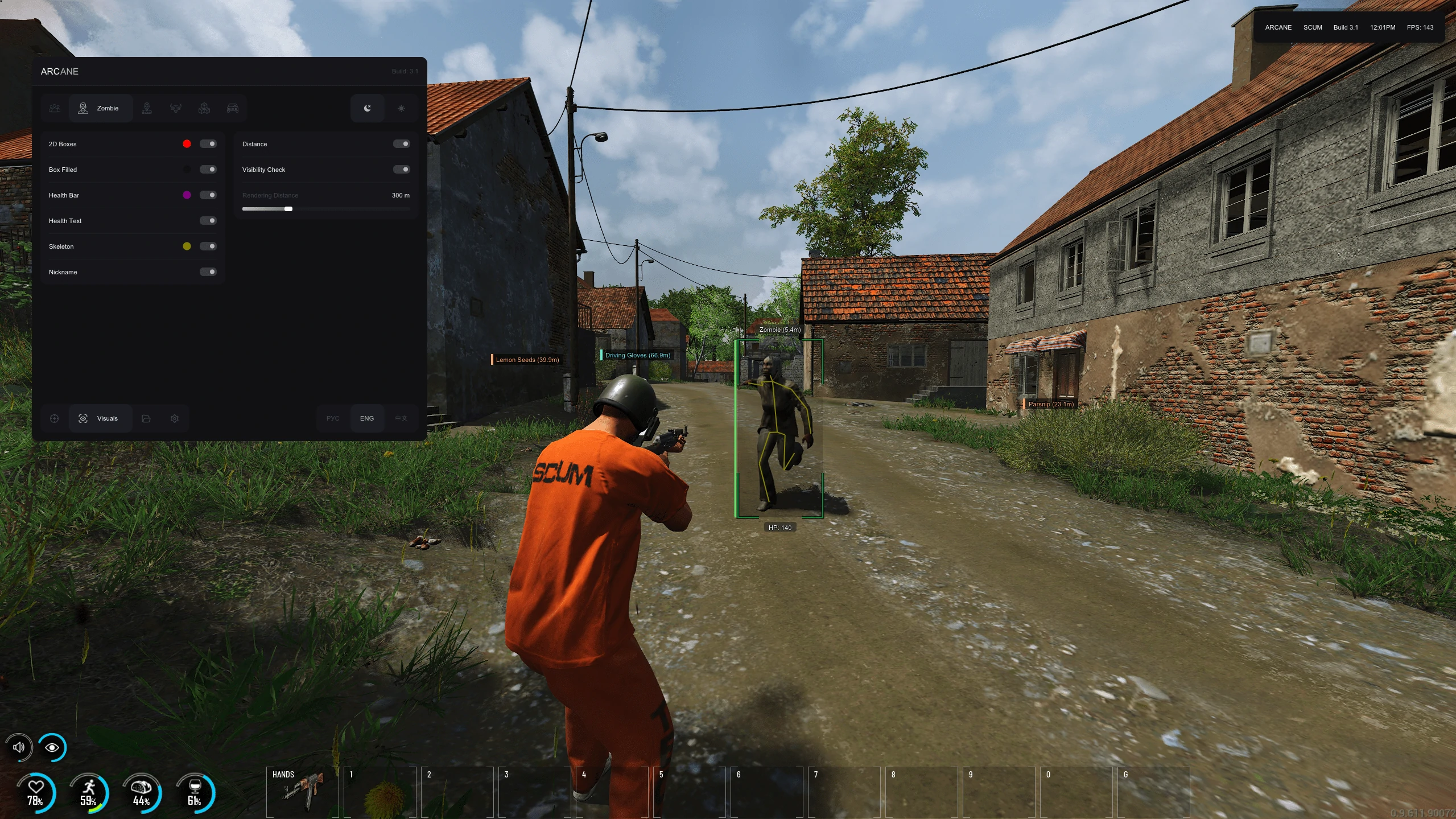
SCUM Puppet ESP — Why Type Identification Saves Your Life
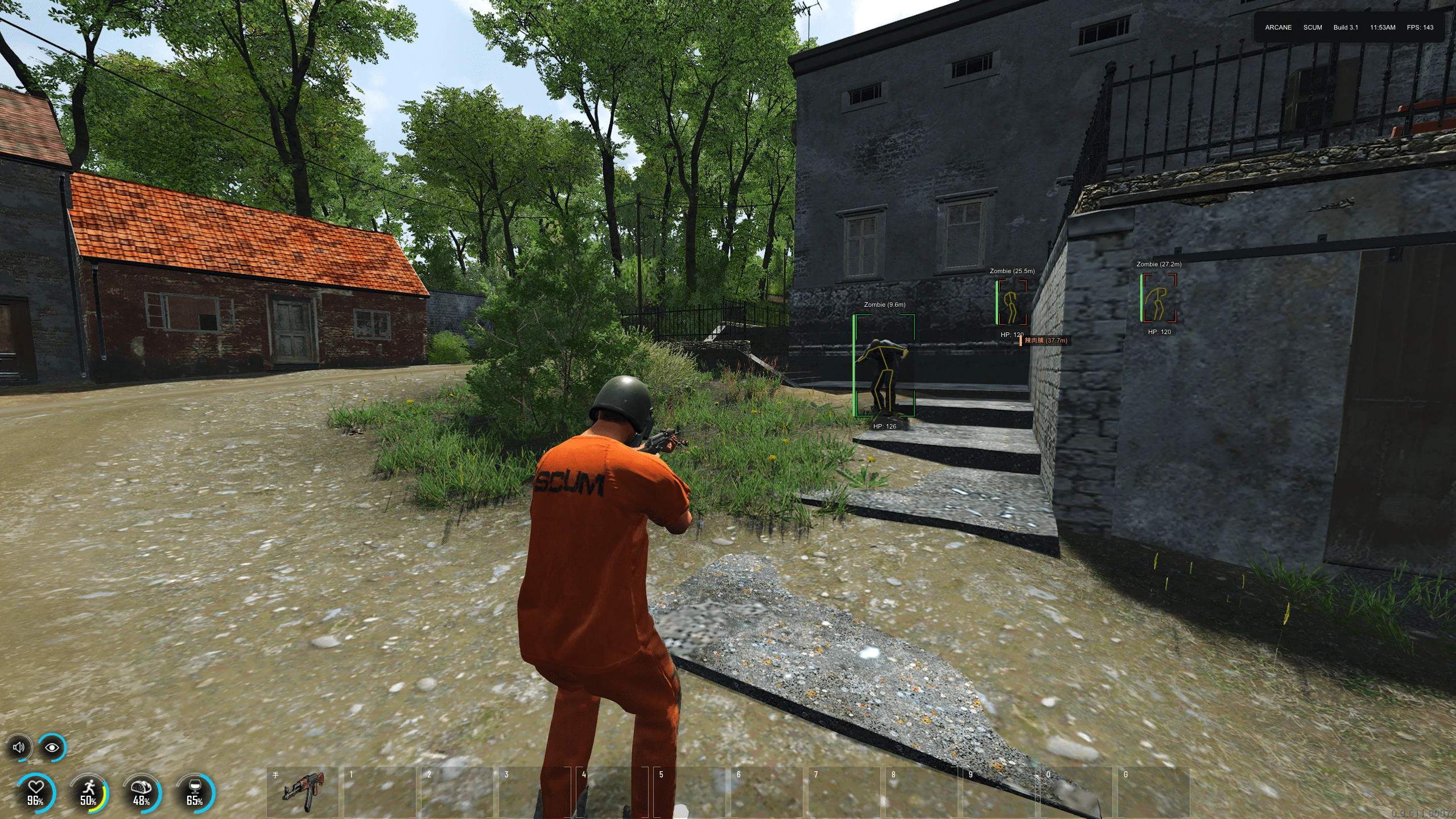
SCUM runs at least seven Puppet variants, and confusing them kills you. ESP tags each type with a distinct color and label, turning a crowd of identical silhouettes into a readable threat hierarchy:
Regular Puppets are standard roamers — low threat individually, manageable in groups with headshots. Skinny Puppets are the silent killers: they sprint at full speed and attack without any audio warning. Fat Puppets absorb more damage and don't stumble from body shots. Military and Armored Puppets wear body armor and guard bunker interiors — headshots are the only efficient approach. Lurkers hide in bunker corridors and swarm toward any sound, making suppressed weapons essential. Mr. Brenner is the boss Puppet in Abandoned Bunkers — completely indestructible, requiring immediate retreat when spotted. And Beepers — the suicide variant — emit a high-pitched beeping and explode on contact for an instant kill.
That last type is why SCUM ESP and wallhack capability aren't optional in bunkers. A Beeper looks identical to a Regular until it's within detonation range. ESP marks it at distance, giving you time to shoot it before the three-second countdown begins. In a dark bunker corridor where sound bounces off concrete walls, the visual tag is the only reliable warning you get.
SCUM Sentry and Mech ESP — Patrol Routes and Aggro Radius
Sentries are bipedal mechs armed with machine guns and missile launchers. They guard military installations, airfields, and bunker perimeters. ESP displays their position, facing direction, patrol path, and aggro radius — the invisible sphere around them where detection triggers their "FREEZE" warning. With this information, you can plot approach routes through shared blind spots between overlapping Sentry patrols, time your movement to cross gaps in their rotation, and avoid triggering the instant-fire response that some critical-location Sentries use instead of the warning sequence.
SCUM Loot ESP — Filtering Signal from Noise Across the Map
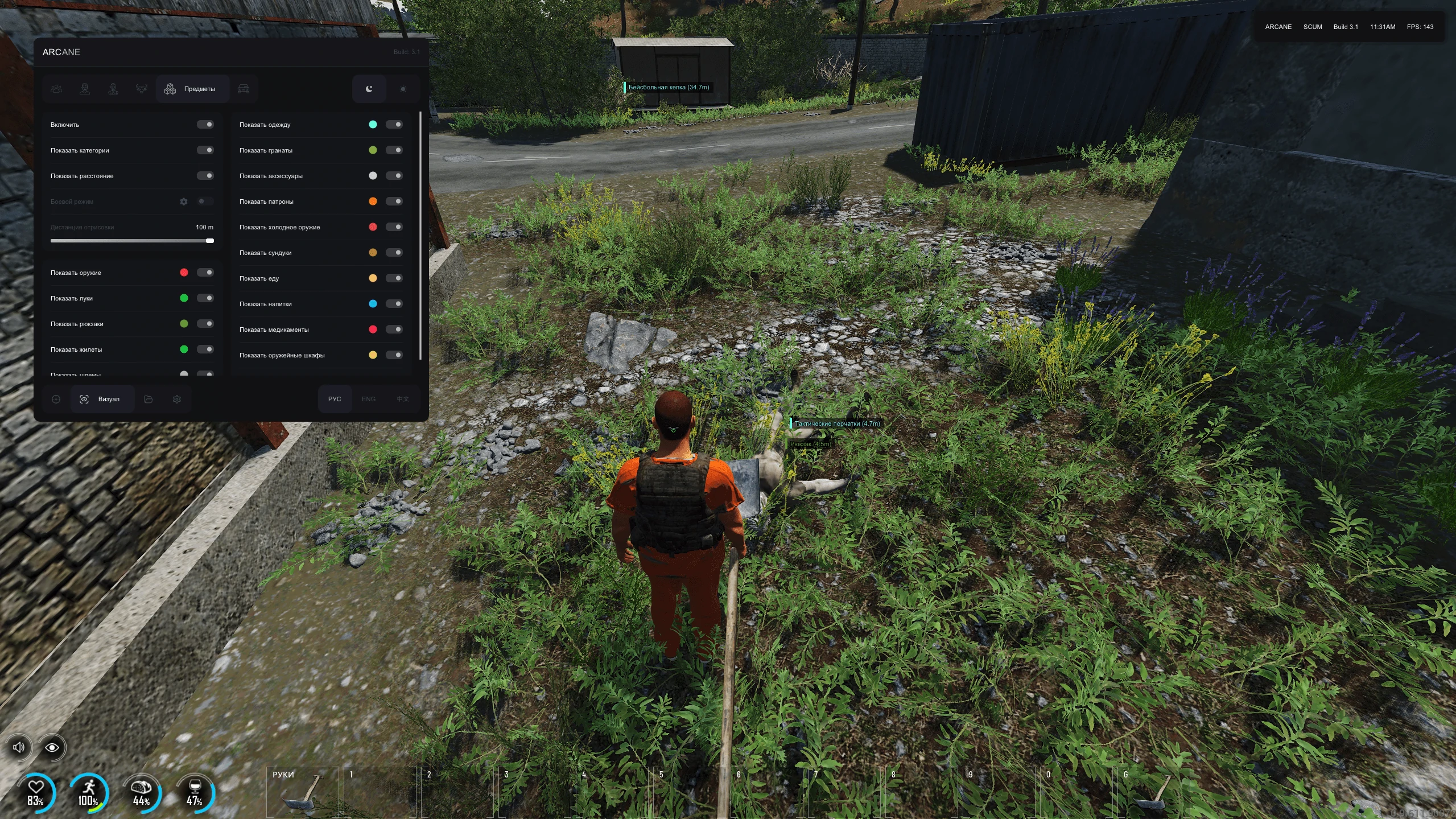
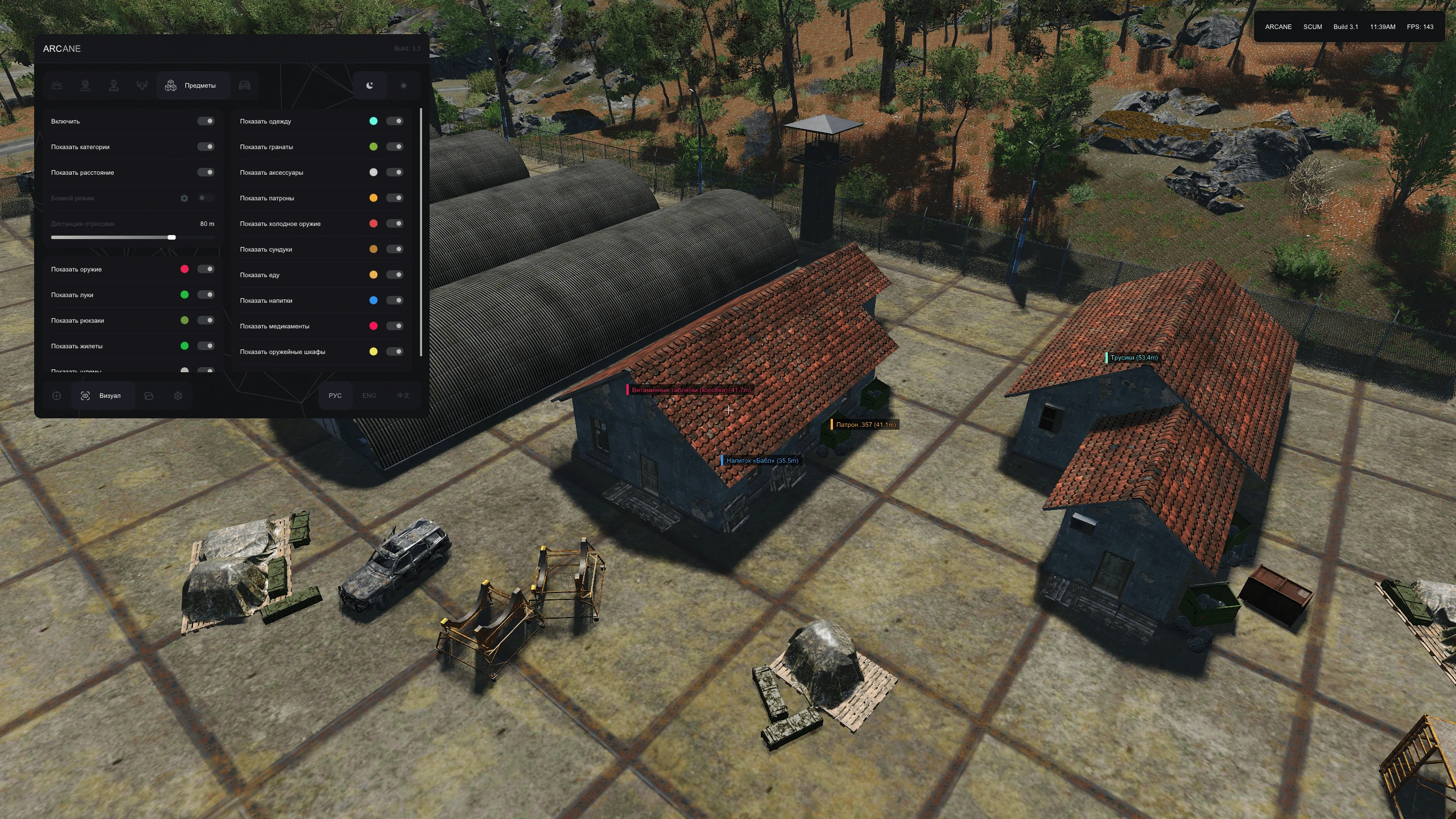
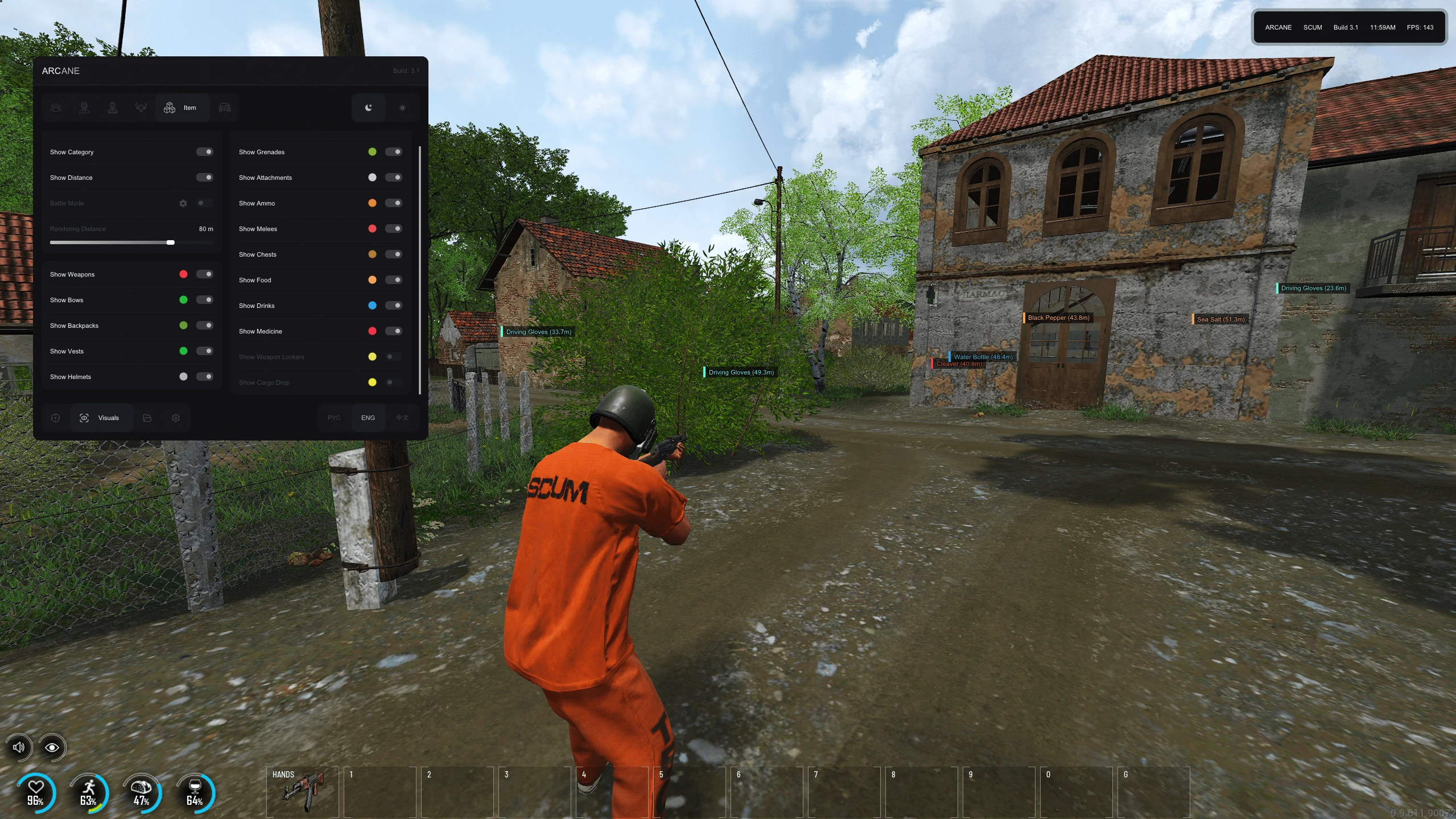
SCUM's loot tables populate hundreds of items per sector: clothing, food, ammunition, weapons, crafting materials, medical supplies, vehicle parts, and more. Without filtering, the screen becomes unreadable. Loot ESP lets you configure exactly what shows — keycards for bunker access, BCU Modules for permanent Intelligence upgrades, .50 BMG ammunition for Sentry fights, surgical kits for treating compound fractures, and specific weapon attachments. Vehicle ESP overlays every vehicle spawn with status indicators, letting you tell a repairable SUV from a stripped chassis before you walk twenty minutes to reach it. Resource ESP highlights craftable materials — the stones, sticks, and fibers that mean the difference between an improvised spear and going empty-handed — across military simulation titles like Arma Reforger where loot scarcity defines the early game.
SCUM Aimbot — Precision Tuned for Metabolism-Affected Ballistics
Most aimbot tools assume a static character model — aim, shoot, hit. A proper SCUM aimbot can't work that way. Your character's current metabolic state directly alters ballistic performance in ways that change how aimbot compensation needs to work.
SCUM Metabolism and Weapon Handling — The Hidden Variables
Four core attributes — Strength, Constitution, Dexterity, and Intelligence — govern combat mechanics, and all four are affected by nutrition, activity, and body composition. Low Strength from protein deficiency increases weapon sway and recoil, making automatic fire from an AKM or Tommy Gun scatter wider. Depleted Dexterity from dehydration or caloric deficit slows aim-down-sight speed and reload time. Low Constitution reduces stamina, meaning your character's breathing becomes labored during sustained combat, adding another sway layer. Even body fat percentage matters: a character who's been overeating shows increased weapon sway compared to one at optimal body composition.
The aimbot compensates for these character-specific variables automatically, adjusting for the increased weapon sway that comes from your character's current physical state rather than assuming a baseline performance level that your metabolism has already degraded.
SCUM Aimbot — Aim Bone, FOV, and Engagement Distance
Aim bone targeting controls which body part the aimbot locks onto. In SCUM, this choice matters more than in most games because of the detailed hit zone system — headshots deal dramatically more damage than body shots against both Puppets and players, and armored body parts on Military Puppets can absorb multiple rounds while the exposed head drops them in one or two shots. For PvE bunker crawling where ammunition conservation determines how deep you can push, head targeting is the default. For PvP fights where targets move unpredictably and wear varying armor, chest targeting offers a larger reliable hit zone.
FOV (field of view) configuration determines the cone in which the aimbot will acquire targets. Tight FOV — 30 to 60 degrees — suits open-field sniping where you're already aiming in the target's direction and need subtle correction. Wide FOV — 120 to 180 degrees — handles bunker interiors where Puppet waves spawn from every direction inside a Killbox and a Beeper can appear behind you without warning.
SCUM Smooth Aim and Trigger Bot
Smooth aim controls how quickly the crosshair moves to target, creating natural-looking aim transitions instead of instant snapping. Against Puppets in PvE, low smoothing is safe — the AI doesn't analyze your aim patterns or report suspicious behavior. Against human players in PvP, high smoothing is essential because killed players can spectate their death via killcam, and unnatural snapping from target to target is the fastest way to generate a player report. Trigger bot fires automatically when your crosshair passes over a valid target, ideal for holding an angle on a bunker entrance or a base wall breach where reaction speed determines who walks away with the loot.
Bunker Raids and Killbox Survival — Feature Configurations for SCUM's Deadliest Encounters
SCUM's bunkers are the highest-risk, highest-reward content in the game — multi-level underground installations filled with Armored Puppets, Lurkers that swarm toward sound, and loot tables that include military-grade weapons, BCU Modules, and rare ammunition. But the Killbox takes that risk and compresses it into a fifteen-minute countdown where everything that can kill you arrives at once.
SCUM Killbox Mechanics — Timer, Gas, Bombs, and Puppet Waves
A Killbox is a sealed arena inside certain bunkers, activated by keycard. Once triggered, a fifteen-minute timer starts. Gas begins rising from the lowest level, slowly reducing safe floor space. Puppet waves spawn from multiple entry corridors — Regulars first, then Armored variants, then Lurkers drawn by your gunfire, and occasionally a Beeper whose detonation can kill you instantly or clear a cluster of other Puppets depending on positioning. Between waves, bombs appear at fixed locations throughout the arena that must be defused with wire cutters within a time window. Successfully defusing all bombs and surviving the full timer unlocks locked cabinets containing high-tier loot — military weapons, rare attachments, medical supplies, and keycards for deeper bunker levels.
The stress comes from simultaneous demands. You're watching the gas timer, tracking Puppet spawns from three directions, identifying which Puppet in the wave is the Beeper that needs to die first, navigating to bomb locations before their individual timers expire, and managing ammunition that has no resupply until the event ends. It's SCUM's version of a boss fight, except the boss is the clock and the room itself.
SCUM Killbox Feature Configuration — ESP and Aimbot for Wave Survival
SCUM ESP with wallhack overlay transforms a chaotic Killbox run into a readable sequence. Bomb locations appear through walls before you enter each corridor, letting you plan a defusal route that avoids backtracking through gas-filled sections. Puppet spawn points light up the moment a new wave triggers, showing direction and count before the first Puppet rounds the corner. Beepers get priority color coding — red markers against the white or green of standard Puppet tags — because identifying the explosive threat in a crowd of identical silhouettes is the difference between surviving the wave and losing your character to permanent death when your Fame Points can't cover the respawn.
Aimbot in a Killbox runs wide FOV — 120 degrees minimum — because waves arrive from behind, from side corridors, and through doorways you've already cleared. Target priority follows a survival hierarchy: Beepers first (explosive, instant-kill), Lurkers second (fast, sound-tracking, swarm in packs), Armored Puppets third (high health but predictable), Regulars last (low individual threat). Head targeting conserves ammunition — a critical concern when you entered with four magazines and the timer reads nine minutes remaining.
SCUM Abandoned Bunkers — Mr. Brenner and the No-Fight Zone
Abandoned Bunkers add a threat that can't be fought. Mr. Brenner — the boss Puppet — patrols specific corridors and is completely indestructible. No weapon in the game damages him. The only option is avoidance: hearing his audio cue, checking ESP for his location, and routing around him to reach BCU Module stations and high-value loot rooms. ESP shows Mr. Brenner's position and movement direction in real time, turning a terrifying hide-and-seek encounter into a navigable puzzle. Without it, you round a corner into a Puppet that kills you regardless of your loadout, your skill level, or your metabolic state.
Whether you're pushing Killbox events or routing around Mr. Brenner in Abandoned Bunkers, SCUM cheats configured for bunker content turn the game's deadliest PvE encounters into a readable challenge — check the status page to verify current availability before your next bunker run.
SCUM Sentry Encounters — Surviving the Island's Robotic Guardians
Nothing else in the survival genre works like SCUM's Sentries. These aren't turrets bolted to a wall or scripted enemies with fixed patrol loops. They're three-story bipedal mechs armed with twin machine guns and missile launchers, roaming military installations with detection algorithms that factor in movement speed, noise level, and line of sight.
SCUM Sentry Detection — The Freeze-or-Fight Decision
When a Sentry spots you, it yells "FREEZE." You have roughly three seconds. Comply by raising your hands — the F3 or F4 emote — and the Sentry holds fire, giving you a narrow window to back away slowly before it re-engages patrol. Refuse or hesitate, and it opens fire with sustained machine gun bursts that shred through anything short of heavy vehicle armor. At critical military installations — airfields, certain bunker perimeters — some Sentries skip the warning entirely and fire on sight.
The resource calculation behind fighting a Sentry is brutal. Destroying one requires approximately twenty to twenty-five rounds of .50 BMG ammunition fired from an M82A1 Barrett — the rarest anti-materiel rifle in the game, found only in high-security military locations. That's a significant portion of your .50 BMG supply on a server where ammunition doesn't respawn quickly. Every Sentry fight is a cost-benefit analysis: is the loot behind this mech worth the ammunition you'll burn getting through it?
SCUM Sentry ESP — Patrol Paths, Aggro Radius, and Safe Approach Angles
ESP overlays the Sentry's position, facing direction, and aggro radius — the invisible detection sphere that triggers the "FREEZE" warning or immediate fire response. With two or three Sentries patrolling a military airfield, their aggro radii overlap in complex patterns that shift as they walk their routes. ESP lets you identify the gaps: the thirty-second window where Sentry A faces north while Sentry B rounds the eastern hangar, creating a corridor through both detection zones wide enough to sprint to the control tower, grab the Cargo Drop crate, and extract before the patrol cycle closes.
For players who choose to fight, ESP reveals the Sentry's remaining health during the engagement — critical when each .50 BMG round is irreplaceable and you need to know whether to commit your last five rounds or disengage and preserve ammunition for the next encounter. Against paired Sentries, it also shows whether the second mech has detected you yet, letting you down one before the other rotates into firing position. SCUM hacks that include Sentry-specific ESP make the difference between a calculated engagement and a wasted ammunition stockpile.
Movement and Traversal Across 225 km² — Speed, Teleport, and Vehicle Features
SCUM's island is 225 km² — roughly four times the size of most survival game maps. On foot, crossing two grid sectors takes twenty to forty minutes of real time depending on terrain, detours around Sentry-patrolled zones, and Puppet encounters along the road. Vehicles spawn damaged and require individual parts — battery, spark plugs, tires, engine components — to make functional. On competitive official servers, the few working vehicles are typically claimed by dominant clans within hours of a server wipe.
SCUM Speed and Teleport — Solving the Map Scale Problem
A speed hack reduces cross-island travel from forty minutes to single digits. A Cargo Drop appears in sector C3 — you're in sector A1 with no vehicle. On foot, the crate will be looted and the players who claimed it will be long gone before you cross the halfway point. Speed lets you close that distance while the fight over the drop is still active, arriving in time to third-party the engagement from a position no one expected.
Teleport takes it further: instant relocation to any coordinate on the 225 km² map. Jump to a bunker entrance before Puppet respawns fill the corridors. Relocate to a Safe Zone trading outpost to offload loot without the twenty-minute hike across open terrain where any player with a scoped rifle and a ridgeline advantage can end your run. Move between base locations to check for overnight raid damage without spending an entire session walking between checkpoints. In other survival titles such as Rust, map traversal is measured in minutes. In SCUM, it's measured in half-hour increments — and every minute exposed on the road is a minute where a Sentry patrol, a Puppet horde, or another player's crosshairs can end a session's worth of progress.
SCUM Vehicle ESP — Finding What Actually Runs
SCUM's modular vehicle system means most vehicles you encounter are empty chassis. Vehicle ESP — one of the most underrated features in any SCUM hacks package — cuts through the guesswork by marking every spawn point on the map and indicating repair status — whether a car needs one part or six, whether the tires are intact, whether the fuel tank has enough to reach the next sector. On a server where intact vehicles are as contested as military weapons, knowing where a repairable quad sits in an overlooked farm compound is the kind of information advantage that saves an hour of walking.
SCUM PvE vs. PvP — Optimal Feature Configuration by Game Mode
SCUM plays as two fundamentally different games depending on context. In bunkers and Killbox events, you fight AI Puppets with predictable spawn patterns and Sentries with mechanical patrol routes. In open-world PvP — base raids, Cargo Drop fights, territory skirmishes — you fight adaptive human players who check their flanks, pre-aim corners, and report suspicious behavior through spectate and killcam systems. Running the same SCUM cheats configuration for both — same wallhack range, same aimbot FOV, same ESP filters — is like wearing a hazmat suit to a gunfight: technically equipped, practically wrong.
The table below maps each major feature setting to its optimal configuration for SCUM's two primary scenarios, with game-specific reasoning for why the settings differ. Server type matters too — the distinction between Hell Let Loose and similar BattlEye-protected games and unprotected private servers affects how aggressively you can configure detection-sensitive features.
Feature Setting Bunker Raid / Killbox (PvE) PvP Territory Warfare Why Different ESP Entity Filter All Puppet types ON (Beeper = red priority), Sentries ON, Loot ON (keycards, BCU Modules, .50 BMG ammo), Players OFF or low-priority Players ON (name, distance, weapon, health), Vehicles ON, Bases ON, Puppets OFF or minimal Bunkers are Puppet-dense with no players; open-world is player-threat-dominant — mixing both creates visual clutter that slows reaction time ESP Render Distance Short-medium (50–100m) — bunker corridors are tight, and long-range markers clutter the screen underground Long (200–500m) — SCUM's open terrain allows rifle engagements at distances where unaided eyes can't distinguish a player from a bush Engagement distances differ by 5–10x between bunker CQB and open-field sniping; render distance should match the scenario Aimbot Target Priority Beeper → Military Puppet → Lurker → Regular — explosive Beepers are instant-kill threats that must die before they reach detonation range Nearest player → lowest-health player — in PvP, the closest threat and the easiest elimination take priority Puppet priority follows a survival hierarchy (explosion risk first); PvP priority follows tactical logic (nearest threat first) Aimbot FOV Wide (120–180°) — Puppet waves spawn behind you in Killbox events, requiring near-360° response capability Narrow (30–60°) — focused on known player positions, reducing the chance of acquiring a non-target and producing suspicious snap-aim Puppets attack from all directions simultaneously; players approach from predictable angles based on terrain and cover Aim Bone Target Head — Puppets die in 1–2 headshots regardless of variant, conserving irreplaceable ammunition in a bunker with no resupply Chest / upper body — larger hit zone against erratically moving player targets, more reliable through varying armor levels Ammo conservation is critical in bunkers (no resupply mid-run); hit reliability matters more in PvP where targets strafe and crouch Smooth Aim Intensity Low smoothing — Puppet AI doesn't analyze your aim patterns, report you, or watch killcams High smoothing — killed players can spectate via killcam, and unnatural snapping generates player reports Puppets can't report you; human players can and will — especially on RP servers with active admin oversight Speed / Movement Normal speed — bunker corridors are too narrow for speed modification, and Sentry detection algorithms flag abnormally fast-moving targets Situational — burst speed for Cargo Drop races across open terrain, normal speed when approaching bases where other players might observe Sentry detection factors in movement speed; PvP speed creates tactical advantage for positioning but also creates suspicion if observed Stream Proof Mode OFF — bunker PvE doesn't attract spectators or admin attention ON — PvP kills trigger spectate mode, and RP server administrators actively monitor player behavior through screen-capture tools Detection risk in PvP comes from human observation, not just anti-cheat software — 65+ RP servers run active admin spectating Staying Undetected on SCUM's Official and Private Servers
Keeping SCUM cheats and hacks undetected requires understanding three distinct threat vectors — and knowing which one applies to the server you're playing on. The configuration that keeps you safe on an official server can get you caught on a private one, and vice versa.
SCUM BattlEye Detection — Software-Level Avoidance
BattlEye's kernel-mode driver scans continuously for memory modifications, injected code, known cheat signatures, and suspicious system-level behavior. It auto-updates detection rules without requiring a game patch, meaning a method that passes today's scan can trigger a ban wave tomorrow. The practical implication: any tool interacting with SCUM's process needs to operate below BattlEye's scanning layer or use approaches that don't match known signature databases. Detection status changes without notice, which is why verifying current status before every session matters more in BattlEye-protected titles than in games running less aggressive anti-cheat solutions.
SCUM PlaySafe ID — Identity-Layer Protection
On official servers running PlaySafe ID, getting banned doesn't just lock your Steam account — it locks your verified identity. Creating a new account doesn't help because PlaySafe ties enforcement to the person, not the profile. This raises the stakes for official server play specifically: a single detection event has permanent consequences that extend beyond one account. On private servers where PlaySafe ID doesn't apply, the risk profile drops to standard BattlEye detection plus whatever admin-side monitoring the server operator runs.
SCUM Admin and Social Detection — The Human Factor
Private and roleplay servers introduce a detection vector that no anti-cheat software creates: human observation. SCUM's community includes over sixty-five active roleplay servers where administrators spectate players in real time, review killcams, and investigate reports from other players. On these servers, a killcam showing your crosshair snap from one target to another faster than human reflexes allow will generate a ban from the admin — no BattlEye involvement needed.
Stream-proof mode hides all visual overlays — ESP markers, wallhack outlines, aimbot indicators — from screen capture and spectator tools, ensuring that an admin watching your screen through spectate mode sees only the vanilla game. Smooth aim with conservative FOV settings produces aim transitions that look natural under observation. Feature restraint — using ESP for awareness without acting on impossible information, like pre-aiming a corner where a player is visible only through walls — keeps your behavior within the range of what a skilled player could plausibly do. Staying undetected on SCUM's private servers isn't just about bypassing software. It's surviving the social detection that the community-driven server ecosystem creates.
Getting Started — From First Spawn to Full Configuration
SCUM's learning curve is the single biggest barrier for new players — the metabolism system, skill progression, inventory management, crafting, and character creation all demand understanding before you can survive your first hour. Setting up undetected SCUM cheats shouldn't add another layer of complexity to an already overwhelming game.
SCUM First-Session Configuration Recommendations
For players focused on PvE and bunker content, start with Puppet ESP enabled (all types, Beeper highlighted in red), Loot ESP filtered to keycards, BCU Modules, and medical supplies, and aimbot configured with wide FOV and head targeting for ammunition conservation. Sentry ESP should be active whenever you're above ground near military installations. This configuration strips away the information overload that makes SCUM's early game punishing without turning off the survival challenge that makes the game worth playing.
For players focused on PvP on official servers, start with Player ESP (name, distance, weapon, health), Vehicle ESP, and smooth aimbot with narrow FOV and chest targeting. Stream-proof mode should be on by default. Conservative settings first — you can always increase aggression after learning the server's social dynamics, but you can't undo a ban from a PlaySafe ID-enabled server. The best SCUM hacks for PvP are the ones that never trigger a second look from spectating players or admins.
For players on private roleplay servers, minimal visual features are safest. ESP for situational awareness only, no aimbot or movement modifications, and stream-proof mode always active. RP servers have the most aggressive human detection because administrators are watching — and on these servers, being caught means losing access to the community, not just the account.
SCUM Configuration Updates After Major Patches
SCUM's development team pushes regular updates that can change game mechanics, anti-cheat behavior, and entity types. When a major patch lands — new Puppet variants, new weapon classes, map expansions, or anti-cheat adjustments — configurations may need updating to reflect changed entity IDs, modified detection parameters, or new loot table items. Checking the status page and changelog before your first session after a patch ensures your configuration matches the current game state rather than a version that no longer exists.
Ready to configure your undetected SCUM tools? Explore the full range of available SCUM tools and check current status before your next session on the island.
Frequently Asked Questions
Does ESP differentiate between Puppet types like Beepers and Mr. Brenner in SCUM's bunkers?
Yes — ESP tags each Puppet variant with a distinct color and label, so you can identify an incoming Beeper from a standard Regular before it reaches detonation range. Beepers look identical to Regular Puppets without ESP, but their instant-kill explosion makes early identification critical in dark bunker corridors. Mr. Brenner — the indestructible boss Puppet — also receives a unique marker, letting you route around his patrol path instead of walking into an unwinnable fight.
How does SCUM's BattlEye plus PlaySafe ID dual-layer anti-cheat affect detection risk?
BattlEye runs as a kernel-level driver on all SCUM servers, scanning memory operations and system calls in real time. PlaySafe ID adds identity verification exclusively on select official servers — meaning bans on those servers are tied to your verified identity, not just your Steam account. Private servers with BattlEye disabled have no automated detection, though admin spectating and player reports remain active. The dual-layer system makes official servers the highest-risk environment, while private servers vary based on admin activity.
Can the aimbot account for SCUM's metabolism-affected recoil and character attribute stats?
The aimbot compensates for your character's current physical state automatically, adjusting for the increased weapon sway from low Strength, the slower aim-down-sight speed from depleted Dexterity, and the additional sway from excess body fat percentage. Because SCUM ties combat mechanics to metabolic condition — a connection no other survival game makes — the compensation adapts to your character's nutritional state rather than assuming a fixed baseline that your metabolism has already altered.
Does vehicle ESP show which cars in SCUM actually have working parts versus stripped shells?
Vehicle ESP highlights all vehicle spawns with status indicators that show repair condition, letting you distinguish between a fully functional SUV and a chassis missing its engine, battery, and tires. On servers where intact vehicles are controlled by large clans and every working car is a strategic asset, knowing which spawns are repairable before walking twenty minutes to reach them saves time measured in half-hour increments across SCUM's 225 km² map.
What features help with SCUM's Killbox bunker events — the timed bomb defusal with rising gas and puppet waves?
ESP highlights bomb locations through walls so you can plan a defusal route before entering gas-filled corridors, while showing the direction and type of each incoming Puppet wave. Aimbot with wide FOV and Beeper-priority targeting handles threats spawning behind you while you focus on wire-cutter timing and cabinet looting within the fifteen-minute window.
-
-
Total Members 5,755
-
Most Online 149
-
Newest Member ejder0234

-
-
Reviews
-

By nineyt. · Posted
I've had a great experience not only with jjboy, but burger themselves. They have great staff that get back to you on time, and solve pretty much any issue you end up running into. -

By 10_jacob_01 · Posted
Howdy! I've been purchasing products from Burger cheats since 2025 and they've had the best ranges of selection for multiple products! Next cheat full and Lite (EFT) - major fan! honestly one of the best I've used and it has the features for pvp and pve, some tailored for those pve mains like myself, customizable UI, very modular and super user friendly, absolutely would recommend it to others! Collapse (EFT) - Great all around and it's nice and very straight forward, I do enjoy the UI of this one Ancient (EFT) - A good beginner one for people just getting into EFT cheesing. and lastly Vortex (War Thunder) - This has been my go too every time I want to just go ham in war thunder, I absolutely love it! Overall with burgercheats they've provided such clear fool proof instructions I simply cannot thank them enough, as they were my first service provider and will always be my go to service provider via myself or recommending to others! - A very happy Customer!! -

By sieto215 · Posted
I’ve had a really good experience with the service so far. The website is easy to use, everything is well organized, and the AI assistant is surprisingly helpful and actually gives useful answers. What impressed me most was the support. Whenever I had a question or needed help, I got a proper response instead of just a generic answer. The support was friendly, helpful, and really tried to solve the issue. Overall, I’m very satisfied with the website, the tools, the AI assistant, and especially the customer support. Definitely a very positive experience and something I would recommend. -

By EnteMitTalente · Posted
great product, paypal purchase went flawless with fast response and @admin helped me solve my tech issues -

By _swappy · Posted
I have gotten one of the best marketplace experience here. I personally have bought apex legends cheat here several times already and have recommended a few of my friends as well. In my personal opinion it is the best marketplace in this domain as of right now.
-