
-
MW3 Cheats and Hacks: Aimbot, ESP, Wallhack & Unlock All Tool
Undetected Modern Warfare 3 cheats for 6v6, Ground War, and Ranked. Aimbot, ESP, unlock all tool, and an HWID spoofer tuned for the game's Ricochet anti-cheat. 24/7 Discord support.
-
Featured Products
-
Modern Warfare 3 is the third entry in the rebooted Modern Warfare line — a fast, close-quarters shooter on the current Call of Duty engine, and the one that launched its entire core 6v6 map pool remastered from the original Modern Warfare 2. That's why players still load into Highrise, Terminal, and Skidrow long after they first learned the angles. Beyond 6v6 it spans Ground War, Ranked Play on the competitive pool, and an open-world Zombies mode (MWZ) built around extraction runs across Urzikstan. It's also one of the most-searched Call of Duty titles for cheats — players come looking for Modern Warfare 3 cheats, a reliable MW3 aimbot, ESP and wallhack, and an unlock all tool — because the camo grind is long, the lobbies are cross-play, and the anti-cheat is one of the strictest in the genre.
That anti-cheat is Ricochet, a kernel-level system that watches memory but, more tellingly, watches how you move — so a lock that's too clean flags before the shot even lands. It also means MW3 hacks split into two jobs with opposite settings: multiplayer is a timing problem that wants conservative, human-looking aimbot smoothing, while Zombies is a survival problem against the Aether Storm clock that wants heavy ESP and a wide FOV. Same launcher, opposite configs — and because a Ricochet flag rides the shared COD HQ system across Warzone and the Black Ops titles in a single ban-wave window, every feature below is tuned against that cross-title blast radius first, gameplay second.
Modern Warfare 3 Hacks — Two Toolkits, One Ban Graph
Modern Warfare 3 hacks cover the standard shooter toolkit — aimbot, ESP, wallhack, radar, no-recoil — plus an unlock all tool for the camo and blueprint grind that outlives the player count. The detail that separates a safe setup from a banned one is the anti-cheat underneath: Ricochet is a kernel-level system that watches memory and, more importantly, watches how you move. A perfectly clean aimbot lock is exactly what it flags. So the working rule for MW3 is that "undetected" is a status, not a property — you tune each feature against Ricochet's behavioral model first, check the live status page before you buy, and run a spoofer so a flag on one title doesn't follow your hardware onto the next.
The sections below break each feature down the way it actually behaves in this game — projectile-free but timing-sensitive aimbot math, map-by-map ESP value from Terminal's tarmac to Skidrow's stairwell, the unlock all tool that survives profile audits, and the cross-title ban graph that makes a spoofer non-optional.
Modern Warfare 3 Aimbot — Bone-Lock On Highrise Rooftops Without Tripping Timing
MW3 aimbot locks a single bone — head or upper chest by default — to the nearest valid target inside a configurable FOV cone, with smoothing curves that mimic human input delay. The smoothing isn't there for aim feel. It exists because Ricochet's input-timing model treats any mouse trajectory mathematically straighter than typical human jitter as evidence of automation. A perfectly clean lock is exactly what trips the wave.
The Highrise office window is the textbook scenario. You're holding the corner desk angle with the SVA 545, watching the helipad stairs, and an enemy rotates from the south side. A raw lock-on aimbot snaps directly to the chest hitbox almost instantly. The timing layer flags that trajectory because no human running the SVA 545 muzzle-climb pattern produces that curve. The same aimbot with smoothing tuned to the SVA 545's vertical recoil profile produces output indistinguishable from a high-end human player.
MW3 Aimbot Settings — Highrise Rooftop & Terminal Tarmac
Highrise rewards mid-range bone-lock at the chest with smoothing biased toward vertical lift — the SVA 545 climbs more than it walks, and the smoothing curve has to match that asymmetry. Terminal is the opposite. The tarmac sightline from the south plane to the north control tower is a sustained 60-to-90 meter engagement that wants head-bone selection with a tighter FOV cone, since the Striker SMG dominates the indoor approach and your aimbot only has to clean up the ranged crosses.
FOV And Smoothing — Tuning Against Timing Analysis
A wider FOV cone gives the aimbot more candidates to snap between, which compounds timing risk — rapid bone-to-bone shifts during a single trigger pull are exactly what the Ricochet input-timing layer logs as a signature. The defensive configuration narrows FOV to between four and eight degrees during ranked queues, with smoothing values high enough to add a forty-millisecond correction delay on the SVA 545 recoil. Pubs on Skidrow can run twelve to eighteen degrees without the same scrutiny, because Ricochet weights ranked-queue lobbies more heavily than casual TDM. You can read about the same trade-off inside Warzone's larger lobbies in our Warzone aimbot under the same Ricochet driver writeup.
Silent Aim Versus Lock-On In Ranked Control
Ranked Control on the CDL map pool turns silent aim into the safer choice for two reasons. The camera never moves toward the target, so streamed clips reviewed by opposing teams reveal nothing visible. And the bullet adjustment happens inside the engine rather than at the input layer, which Ricochet's mouse-trajectory analysis has fewer hooks into. Lock-on aimbot in Hardpoint hill rotations still has its place — the camera reveal doesn't matter when nobody is recording your hill cap — but Search and Destroy demands silent aim throughout.

Modern Warfare 3 ESP — Every Crate, Operator, And Weapon In One Filter Tree
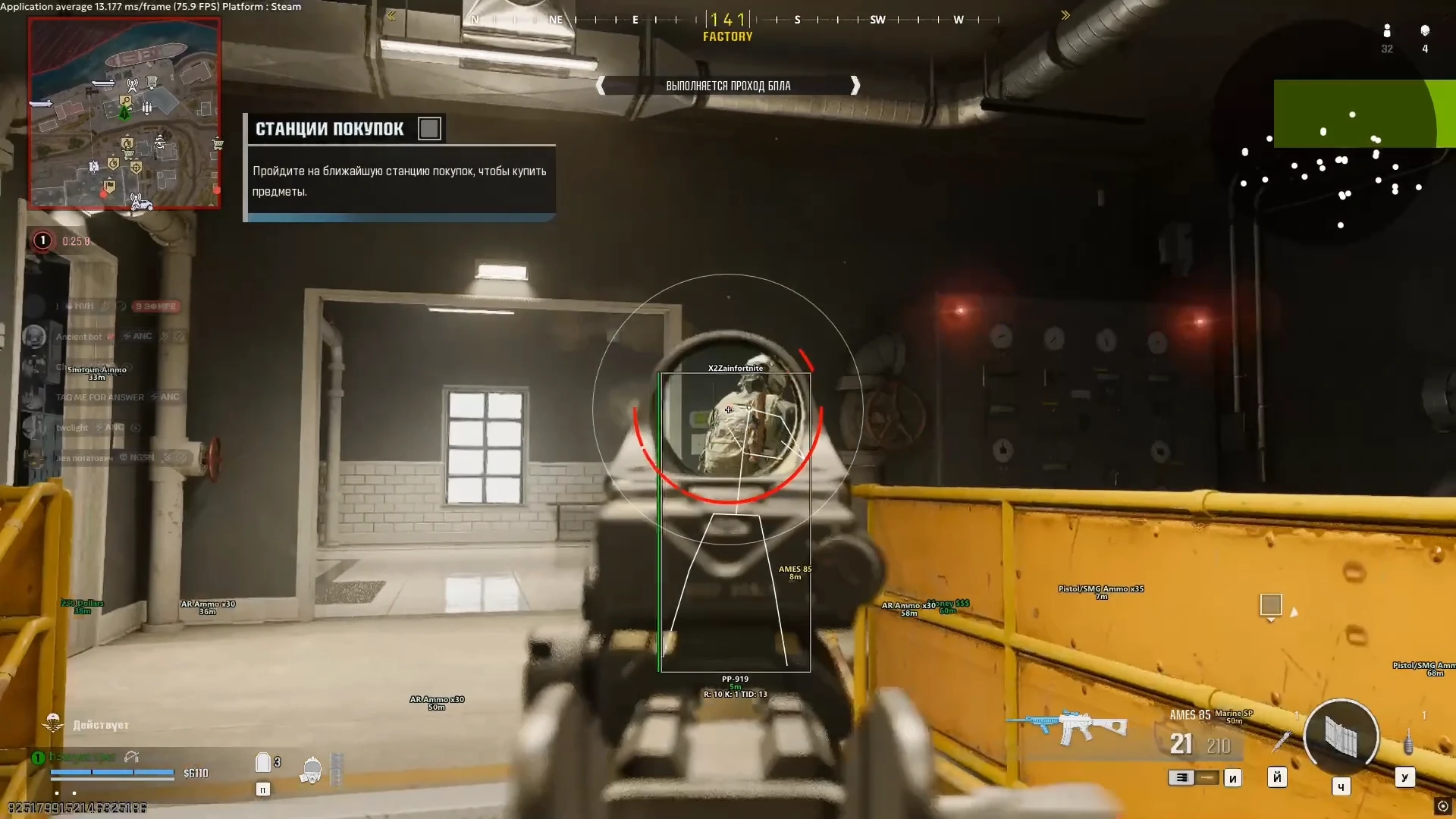
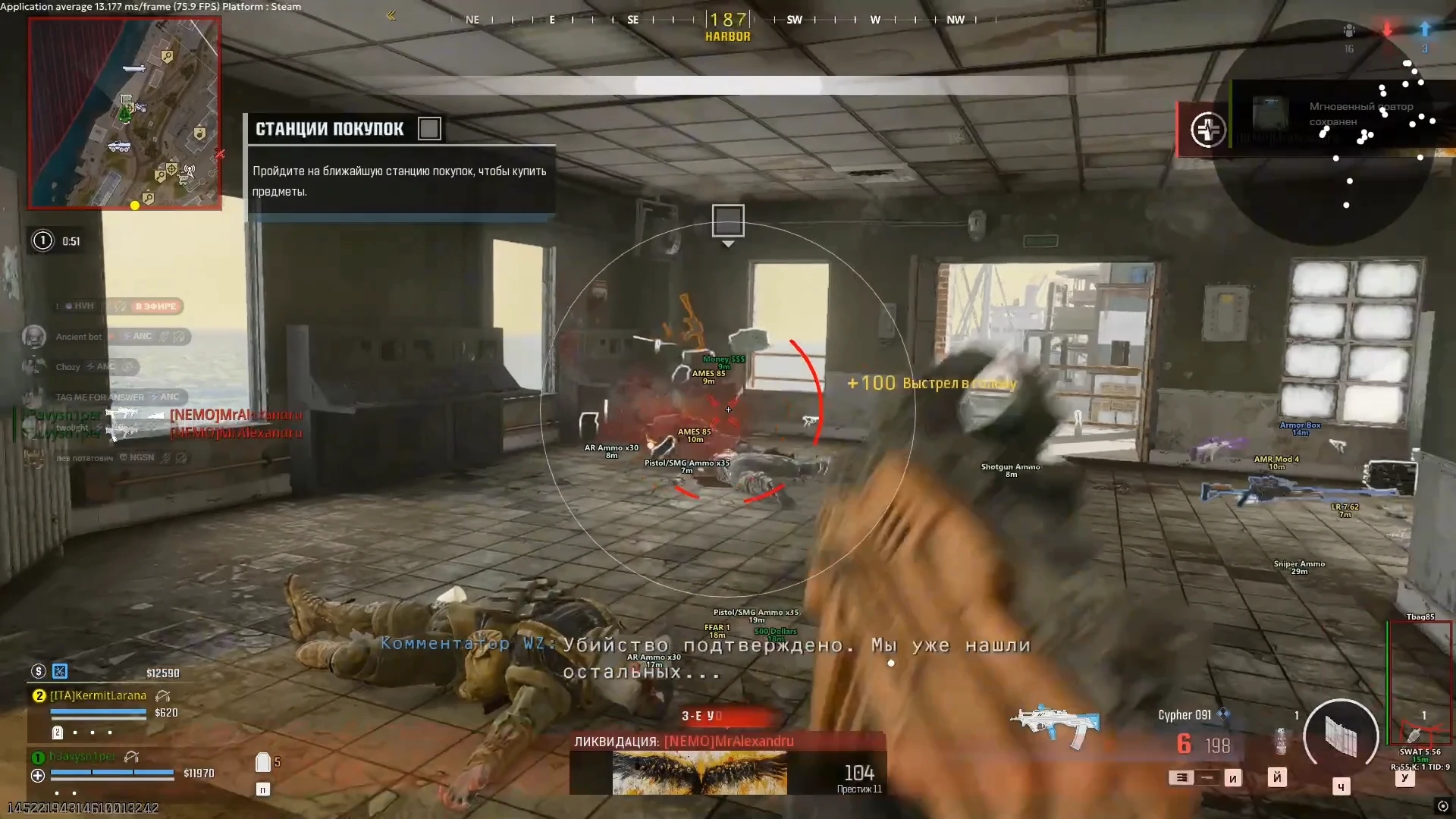
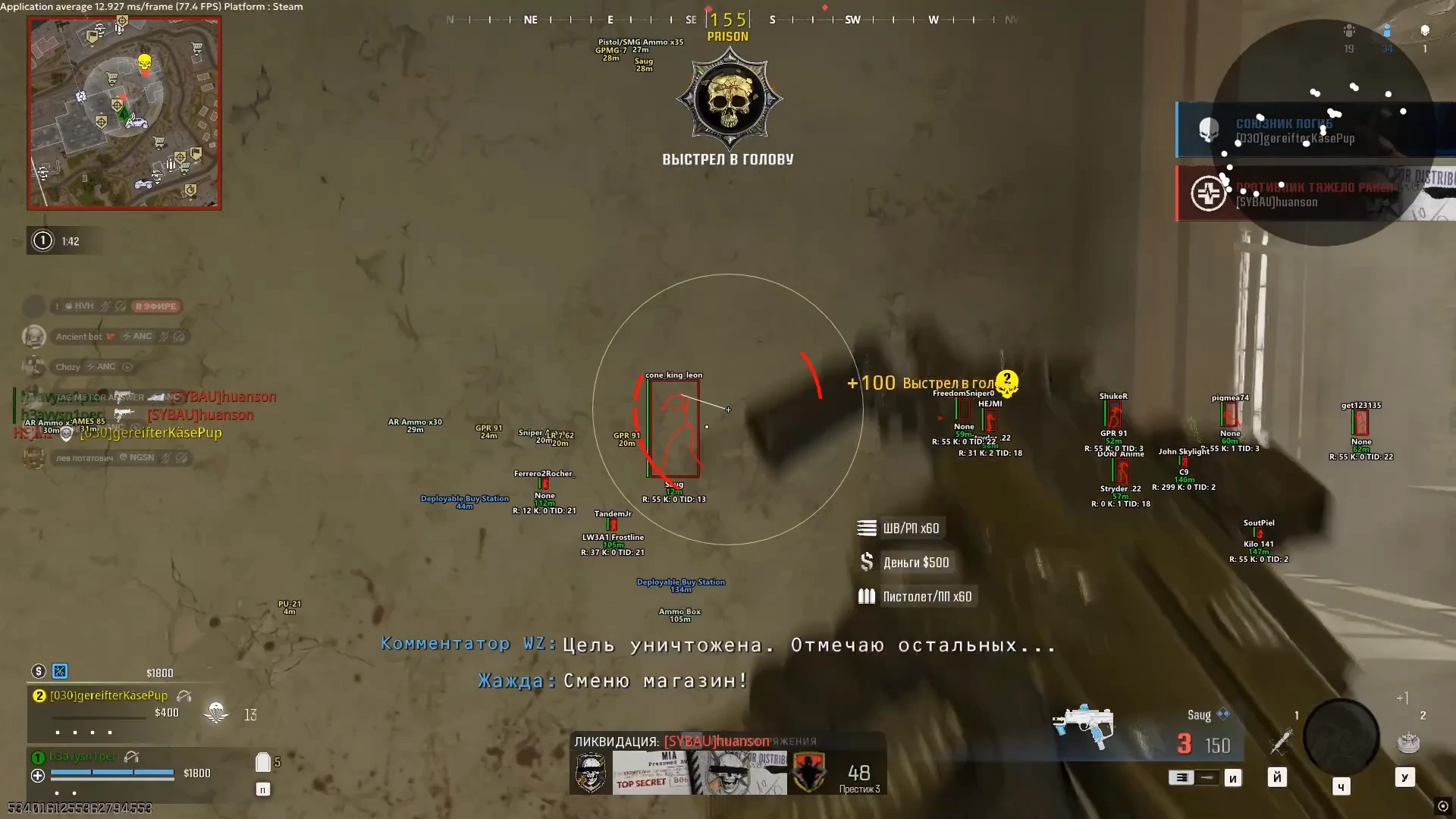
The Terminal tarmac sightline runs about eighty meters from the south plane to the gate-twelve control tower. Operators routing across that lane are bare red dots without overlay, and at that distance, a teammate marker bleeding over an enemy box turns into a friendly-fire incident inside two seconds. MW3 ESP is a filtered overlay rendering enemy boxes, health bars, distance markers, and weapon names, with a separate filter layer for the Zombies entity list so the screen doesn't drown in noise when you switch modes.
Terminal Sightlines — Filtering Operator Boxes At 80m
Distance markers on Terminal need to start drawing at sixty meters, not earlier — closer than that and the player box itself is enough. The health bar layer matters more at range, because at eighty meters with the SVA 545, an enemy at low health is a one-burst kill while an enemy at full health is a three-burst commit during which you're exposed. Weapon-name readouts let you decide whether to take the duel or rotate — an MTZ Interceptor across the tarmac is a different fight from a Striker, even though the player box looks identical.
Distance, Health, And Loadout Readouts
The three readout layers stack but should never all be on simultaneously inside ranked. Distance and weapon name are enough for Control and Hardpoint. The health bar in ranked is the layer most likely to surface on a streamed kill cam — an enemy on the receiving end of a perfectly timed pre-aim with their exact health value showing is the kind of clip CDL teams send to opposing coaches. Pubs runs all three. The Zombies filter layers in Schematic drops, Aether contract circles, and the Storm radius on top — covered in the MWZ section below.
Modern Warfare 3 Wallhack — Skidrow Corridors And The Stream-Sniper Problem
The Skidrow stairwell push is a decades-old timing puzzle. The original version of this map taught a generation of players exactly where the apartment-window pre-aim slots are, and the MW3 rework preserved those sight lines. You're climbing the stairs, and a vet who hasn't moved off this map since the original release is holding the second-floor doorway with the Rival-9 pointed at the exact pixel your head clears the railing.
Map memory closes that gap one way: by knowing every angle from the other side. Wallhack closes it the other way. The two aren't equivalent — map memory takes a thousand hours, and wallhack takes one loader injection — but the outcome on Skidrow's apartment corridor is the same. You see the player holding the doorway through the wall, and the pre-aim turns into a counter-pre-aim. MW3 wallhack renders walls, dumpsters, vehicles, and stairwell flooring as semi-transparent so enemies behind them resolve as outlined silhouettes. This is distinct from ESP: ESP draws an icon over an entity the engine already knows about, while wallhack exposes geometry the engine would normally occlude from your camera frustum.
Skidrow Apartments — Pre-Aiming The Stairwell
The second-floor stairwell on Skidrow has four pre-aim slots that have been holy ground since the original release: the doorway from the laundry side, the broken-window angle from the south apartment, the railing peek from the north balcony, and the long lane down to the courtyard fountain. Wallhack with the wall-transparency layer on resolves a defender holding any of those four into a visible silhouette while you're still on the lower flight. The push then becomes a deliberate counter-angle — you take the slot the defender doesn't expect because you can see which one they're sitting on. The same overlay logic carries into Black Ops 6 wallhack against the same Ricochet build, but the maps are completely different and the pre-aim catalog is a separate history.
Stream-Proof Visibility For Live Broadcasts
Stream-proof wallhack rendering routes the overlay through a layer that common broadcast and capture software cannot read. The principle is simple at the surface and specific in implementation: the cheat injects into a render pass that Ricochet allows but capture software does not enumerate. For MW3 specifically, the issue is that clips of the classic map matches get reposted faster than any other Call of Duty content type — the nostalgia audience clips everything — so a non-stream-proof overlay on a Skidrow clutch turns into a public ban-evidence package within hours of upload.
Modern Warfare 3 Unlock All Tool — Every Camo, Blueprint, And Operator Without The Grind
The MW3 unlock all tool flips the locked-state flag on camos, attachments, blueprints, operators, calling cards, Zombies Schematic prerequisites, and reticles inside the COD HQ profile blob — so you own the full unlock list without the hundreds of hours the intended path demands. It matters more than aim or ESP on a maintenance-era game because the grind never shrank, only the supply of grind partners did: Interstellar camo still gates behind mastery on every base weapon, and the lobbies that remain are nostalgia traffic on Shipment. An unlock all tool is the only realistic way to finish that camo tree now.
It runs in a separate process from the aim and ESP loaders because the risk profile is fundamentally different. Aim and ESP live or die during the match against the kernel driver. The unlock tool writes directly to your account-level profile, and the publisher audits profile-state diffs across the ban-graph backend at the account layer — which means a clean HWID at the moment of the write is the gating factor, not the moment of the match. That is the actual technical reason a properly built MW3 unlock all tool survives audits that cheaper tools don't.
Camo Unlocks — Gilded, Forged, Priceless, Interstellar
Multiplayer's mastery chain runs Base → Gilded → Forged → Priceless → Interstellar, completed weapon by weapon across the full MW3 arsenal, with Interstellar as the final galaxy camo. Zombies runs its own separate chain ending in Borealis — the two are different systems and the unlock tool treats them as different flags. Unlocking in order matters because the COD HQ profile diff treats out-of-order writes — Interstellar flipped on without the tiers underneath it — as a higher-confidence audit signal than ordered writes. The unlock tool sequences the writes to match a believable mastery progression, which is why it survives audits other tools don't.
Zombies Schematic Prerequisites Without The Exfil Grind
Zombies Schematic unlocks normally require completing a successful exfil with the Schematic item in your rucksack. The unlock all tool writes the Schematic-unlocked flag directly, bypassing the exfil requirement, which is the only reasonable way to recover from a Tier 3 wipe that lost three Schematics in the rucksack. The trade-off is the same as the camo side — bulk Schematic writes without sequenced exfil records are a high-confidence audit signal, so the tool stages writes across multiple sessions rather than dumping the full list in one pass.
How Ricochet Actually Detects MW3 Cheats — And Where It Misses
Ricochet runs as a kernel-level (ring-0) driver that loads only while a protected Call of Duty title is running and unloads when you close it. For MW3, the two layers that matter are a memory-monitoring pass that watches the game process for known cheat-loader patterns — including the literal token Trigger Bot — and an input-behavior model that flags mouse trajectories and recoil corrections too consistent to be human. Defeat one and the other still flags the account. The heavier hardware-attestation layer that pairs TPM and Secure Boot arrived later and applies to the newest titles, not to MW3 — so on this game, the behavioral model is the wall you actually have to beat.
The Memory Pass And The Timing Model
The memory pass is the oldest and the layer most cheat developers focus on. The driver pages through the game process address space looking for byte patterns that match catalogued loaders. Modern cheats counter this by encrypting the loader in place and only decrypting code regions during execution windows the scan misses. The timing model is the newer problem. Ricochet samples mouse input deltas and weapon recoil-correction deltas across every active engagement, and any account whose recoil correction on the SVA 545 muzzle climb consistently lands inside a sub-fifty-millisecond window gets pushed onto a watchlist. Cheats that survive are the ones whose smoothing curves mimic human input variance — not the ones that lock fastest.
How A False-Positive Exploit Once Framed Legit Players
Two enforcement stories get conflated, and the difference matters. The publisher periodically runs large ban waves against actual cheaters and rank abusers — those waves are exactly what you'd expect, keyed to flagged loaders. Separately, there was a false-positive episode: bad actors discovered that planting a flagged token like "Trigger Bot" into another player's path — a message, a friend request, a name — could trip Ricochet against a completely legitimate account. The publisher patched it and restored the affected accounts, describing the count as small. The useful takeaway isn't the headline number, it's the posture: Ricochet errs toward action rather than toward false negatives, so the cheats that last are the ones whose authors update loader and signature obfuscation faster than the driver ships revisions — and you can pull the current state from the live Ricochet detection status page rather than from forum hearsay.
Why Cross-Title HQ Bans Hurt More Than Ricochet Itself
A Ricochet flag inside MW3 multiplayer doesn't stop at MW3. Permanent enforcement is bound to your account and applies across past, present, and future Call of Duty titles on every device tied to it — so a flag propagates from MW3 to Warzone and the Black Ops titles inside a single wave window. The same cross-title logic sits behind Battlefield 6's kernel-level anti-cheat against the same recoil-pattern problem, though that propagation graph is contained inside a rival publisher's ecosystem rather than the COD HQ layer. The practical consequence for an MW3 player is that the ban blast radius is several titles wide, not one.
Undetected Modern Warfare 3 Hacks: One HWID, Several Titles, One Ban Graph
A few days after a Ricochet flag on Skidrow, the same PC surfaces on a fresh Black Ops install and the launcher refuses the login. The ban followed the hardware, not the title. That is the practical shape of a Ricochet hit on MW3 multiplayer — it doesn't end at MW3. Permanent enforcement binds to your account and every device associated with it, and propagation across the shared COD HQ titles completes inside a single ban-wave window.
The HWID Spoofer rewrites the hardware identifiers the launcher reads at load: disk volume serial, motherboard model and revision string, and primary MAC address. Without rewriting them, a hardware-clean reinstall still resolves to the same machine fingerprint that flagged the previous account, and the cross-title ban graph re-attaches you instantly. A spoofer is therefore a baseline requirement on MW3, not an add-on — and the implementation specifics for the current build sit inside our Ricochet HWID spoofer for the COD HQ ban graph writeup.
Stream-Proof Overlay For Broadcast Workflows
MW3 content lives under a unique reposting pattern. Nostalgia clips of the classic maps get aggregated by compilation channels within hours of upload, which means a single visible cheat overlay in a Skidrow clutch reaches an audience orders of magnitude larger than the streamer's own concurrent viewership. Stream-proof rendering routes the overlay through a capture-path layer that common broadcast and screen-capture software does not enumerate. The principle is generic across cheats; the MW3-specific risk is the reposting velocity — every Highrise rooftop clutch on a streamed account is potential ban-evidence inside the compilation feed.
When DMA Becomes The Honest Answer
Software cheats on MW3 sit inside the Ricochet driver's visibility envelope by definition — the driver loads at ring-zero, scans memory regions the cheat has to touch, and times input the cheat has to inject. DMA hardware moves the cheat outside that envelope entirely. The engine's memory layout organizes player entity data into structures that a PCIe DMA card can read across the bus without producing any signal Ricochet's scanner can observe. It is overkill for MW3 alone, but practical if you run tools across several actively enforced titles — the implementation details for that path are inside our DMA firmware tuned for the Call of Duty memory layout reference.
Modern Warfare 3 Cheats Config: Why Your Ranked Setup Wipes Your Zombies Run
Same player, same SVA 545 loadout, two different lobbies, and the optimal cheat configuration inverts between them. Ranked Control on the CDL map pool wants slow aimbot smoothing, a four-to-eight-degree FOV cone, ESP stripped to enemy names only, no triggerbot at all, and the unlock tool dormant — every setting tunes against Ricochet's input-timing weighting on ranked queues. The same loadout queued into a Tier 3 Zombies contract wants the opposite stack: wide aimbot FOV against elite spawns, the full ESP filter tree on, triggerbot acceptable because the Ricochet weighting on PvE input is materially lower, and the unlock tool active for Schematic recovery. The fix is mode-specific profile loadouts saved as named presets, switched at the launcher before queueing — the same matrix applies in adjacent titles inside the wider Call of Duty hub for cross-title cheat coverage.
MW3 loadout setup by mode — what each one actually demands:
Mode Aimbot smoothing Aimbot FOV ESP filter Triggerbot Unlock tool Why this combo Ranked Control (CDL) high (mimic delay) narrow 4–8° names only off dormant Timing model harshest on ranked; coaches review kill cams Ranked Hardpoint high narrow 4–8° names only off dormant Hill rotations create predictable trajectory bait Pubs (Skidrow / Highrise) medium medium 12–18° boxes + health + weapon off normal Nostalgia-vet stream-snipers; visibility beats timing Zombies (MWZ) Tier 3 medium wide 20–30° maximum + USBs + bosses acceptable normal Storm boss spawns flank; PvE weighting low Shipment camo grind low wide 30°+ names only optional aggressive Volume kill farming; unlock-tool risk dwarfs aim risk
MWZ Zombies Hacks — Surviving The Aether Storm
Zombies Schematic farming is a deadline problem, not a damage problem. A Tier 3 run goes wrong in a specific sequence: you commit to a contract circle, the Aether Storm radius reaches your objective, your exfil chopper site falls inside that radius, and the boss hasn't spawned because you're still missing a Calibration Data USB. The exfil is gone and the reward you came for is still locked. Summoning Greylorm requires four Calibration Data USBs whose locations rotate every match, and the Storm closes exfil routes faster than the hordes can wipe you — so the cheat has to solve a map-scale timer, not just a target.
That means the Zombies stack is the inverse of the ranked stack: heavy ESP filters tuned for contracts, Mercenary outposts, USB pickups, and the Storm radius itself, plus a wide-FOV aimbot with elite-target priority so it locks Stormcallers and Disciples before regular Tier 3 zombies. Schematic priority is set by exfil-window cost, not raw power — a revive companion and a melee one-shot free up ammo and reduce what a failed exfil costs, while heavy armor turns Storm projectile spam from a wipe condition into a damage tax. The elite-target principle carries into the Black Ops 7 Zombies hacks for the next round-based loop, applied to a survival format rather than an open-world exfil.
MW3 Cheats FAQ
Will using a cheat on MW3 also get me banned from Warzone or Black Ops?
Yes. Permanent Ricochet enforcement binds to your account and every device tied to it, and applies across the shared Call of Duty titles — MW3, Warzone, and the Black Ops entries. A flag inside MW3 multiplayer propagates within hours, often within a single ban-wave window. The HWID Spoofer offsets that risk by rewriting disk serial, motherboard ID, and MAC before each session.
Does Ricochet actually detect aimbot, or does it just look at memory?
Both. Ricochet pairs a memory-monitoring pass — looking for known tokens like Trigger Bot — with an input-behavior model that flags inhumanly consistent mouse trajectories and sub-fifty-millisecond recoil corrections. The SVA 545 recoil pattern is one of the most common trip wires; players running zero-correction scripts get caught by the timing model even when the loader hides its memory footprint.
My Tier 3 Aether Storm run keeps wiping at the exfil — does ESP actually help on Greylorm?
Yes, but only with the Zombies filter layer active and the multiplayer filter off. Greylorm needs four Calibration Data USBs whose locations shift every match, and ESP surfaces those before the Storm closes the route. A combat ESP setup tuned for Skidrow corridor work overlays too many entity icons in Tier 3, and you lose track of the Aether contract ring while fighting Stormcallers.
Is the MW3 unlock all tool safer than aimbot or ESP?
Different risk profile, not strictly safer. Aim and ESP load into the running game process and live or die by Ricochet detection during the match. The unlock all tool writes directly to your COD HQ profile blob — quieter at runtime, but the publisher audits profile diffs across the ban-graph backend. A clean HWID before the unlock session is essential because audit flags follow the hardware, not the title.
Do MW3 cheats still get patched now that the final season has shipped?
Yes — the cheat-side cadence outpaces the game-side cadence now. Ricochet ships independent driver updates through COD HQ, and the loader gets a refresh every time Ricochet does, not every time MW3 does. A maintenance-mode game is actually a more stable cheat target than one in active live-service — the memory layout stops moving and only the anti-cheat keeps shifting.
-
-
Total Members 5,755
-
Most Online 149
-
Newest Member ejder0234

-
-
Reviews
-

By nineyt. · Posted
I've had a great experience not only with jjboy, but burger themselves. They have great staff that get back to you on time, and solve pretty much any issue you end up running into. -

By 10_jacob_01 · Posted
Howdy! I've been purchasing products from Burger cheats since 2025 and they've had the best ranges of selection for multiple products! Next cheat full and Lite (EFT) - major fan! honestly one of the best I've used and it has the features for pvp and pve, some tailored for those pve mains like myself, customizable UI, very modular and super user friendly, absolutely would recommend it to others! Collapse (EFT) - Great all around and it's nice and very straight forward, I do enjoy the UI of this one Ancient (EFT) - A good beginner one for people just getting into EFT cheesing. and lastly Vortex (War Thunder) - This has been my go too every time I want to just go ham in war thunder, I absolutely love it! Overall with burgercheats they've provided such clear fool proof instructions I simply cannot thank them enough, as they were my first service provider and will always be my go to service provider via myself or recommending to others! - A very happy Customer!! -

By sieto215 · Posted
I’ve had a really good experience with the service so far. The website is easy to use, everything is well organized, and the AI assistant is surprisingly helpful and actually gives useful answers. What impressed me most was the support. Whenever I had a question or needed help, I got a proper response instead of just a generic answer. The support was friendly, helpful, and really tried to solve the issue. Overall, I’m very satisfied with the website, the tools, the AI assistant, and especially the customer support. Definitely a very positive experience and something I would recommend. -

By EnteMitTalente · Posted
great product, paypal purchase went flawless with fast response and @admin helped me solve my tech issues -

By _swappy · Posted
I have gotten one of the best marketplace experience here. I personally have bought apex legends cheat here several times already and have recommended a few of my friends as well. In my personal opinion it is the best marketplace in this domain as of right now.
-