
-
Gray Zone Warfare Cheats — Undetected Aimbot, ESP & Radar for Lamang Island
Forty-dollar deployments end in two seconds when LAF headshots through jungle canopy. Gray Zone Warfare cheats with aimbot, full ESP, radar & wallhack — EAC plus Denuvo dual bypass, zero flags.
-
Featured Products
-
-
MADFINGER Games sold over a million copies of Gray Zone Warfare in its first week of Early Access. The pitch was straightforward — a PvE-first extraction shooter set on Lamang Island, 42 square kilometers of Southeast Asian jungle, triple-canopy forest, military compounds, and a faction system that splits every server into three rival PMC groups: LRI, MSS, and CSI. You pick one at character creation, and that choice locks your base camp, your vendor task chains, and who counts as an enemy in Warfare mode.
The reality landed differently. LAF soldiers — the game's primary AI enemy faction — headshot through foliage at 200 meters with accuracy that the community has compared to literal aimbots since launch week. Half the kill reports on r/GrayZoneWarfare are players accusing each other of cheating; half of those turn out to be AI. MADFINGER runs a dual-layer anti-cheat — EAC at user level plus Denuvo Anti-Tamper on the game binary — and the Spearhead update landing this month added dedicated wallhack detection on top. For anyone who has lost a full loadout to a contact they never saw coming, this guide breaks down how Gray Zone Warfare cheats actually function against a ballistic simulation that tracks bullet drop per caliber, armor penetration through NIJ-rated plates, and an AI that punishes you harder than most human opponents.
Gray Zone Warfare Aimbot — Hitting What Fort Narith's AI Can't Miss
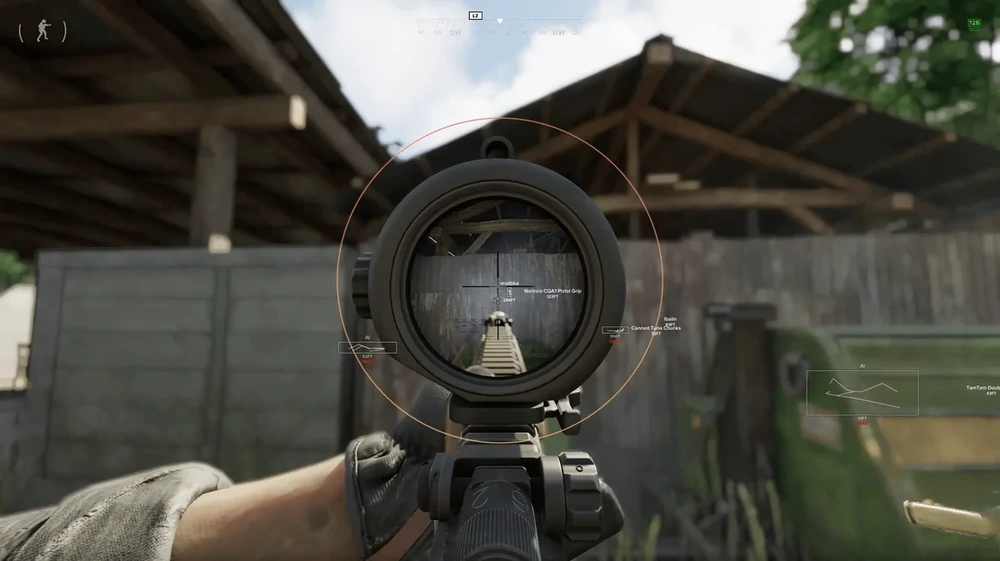
Gray Zone Warfare aimbot locks onto player and AI targets with adjustable FOV, bone selection, and smooth aim calibrated to UE5.5's ballistic engine. The system compensates for bullet drop per caliber — the AKM's 7.62x39mm loses elevation faster than the M700's 7.62x51mm NATO at identical distances — while maintaining aim velocity curves that stay within EAC's behavioral baseline for each weapon's expected recoil profile.
Half the kill reports on the GZW subreddit are players accusing each other of cheating, and roughly half of those are actually LAF soldiers doing what they were programmed to do. The AI in Gray Zone Warfare aims better than most veteran FPS players — headshots through triple-canopy jungle at distances where the Mosin's iron sights blur into the tree line. That confusion between human and artificial precision is exactly why aimbot calibration here works nothing like it does in Tarkov's extraction pressure or any other shooter on the market.
Gray Zone Warfare Aimbot Settings — Ballistic Compensation per Caliber
Gray Zone Warfare aimbot settings account for the game's full ballistic simulation: bullet velocity, drop curve, and armor penetration class. The AKM's 7.62x39mm round drops roughly 14cm at 200 meters. The M700 firing 7.62x51mm NATO holds within 6cm at the same range. Bone lock on center-mass punches through Level III NIJ plates with AP ammunition; switching to headshot targeting against unarmored LAF patrols at Fort Narith's compound saves rounds and clears rooms in half the time.
Engagement distances inside Fort Narith shift from 15-meter corridor fights to 300-meter rooftop overwatch within the same deployment. The aimbot reads your optic's zeroing value and adjusts compensation in real time as the range delta changes. A Mosin zeroed at 100m engaging a target at 250m from the compound's eastern wall gets frame-by-frame holdover correction — no manual adjustment, no Kentucky windage.
Joint Ops vs Warfare — Two Targeting Profiles
Joint Operations servers spawn over 1,000 AI entities across Lamang. Wide FOV at 90–120° catches LAF patrols flanking from blind angles in the jungle — the priority is volume and reaction speed against enemies that snap-aim through foliage. Warfare flips the equation. Forty-eight human players spread across 42 km² means every engagement is deliberate. Tight FOV at 20–40° locks only targets you're already tracking, keeping aim movement within the velocity range that EAC's behavioral sampling considers normal for the weapon you're holding.

Gray Zone Warfare ESP — Every PMC, LAF Patrol, and Loot Cache on Lamang
Tiger Bay's northern compound stretches across four city blocks of warehouses, docks, and vendor task buildings. Your Handshake task objective is somewhere inside — an intelligence folder in one of fourteen possible rooms. Three LAF soldiers patrol the ground floor on a 45-second loop. An MSS two-man squad landed at the southeast LZ ninety seconds ago; their Little Bird's rotors are still fading over the canopy. You need to find the folder, avoid the patrol, and decide whether those MSS operators are heading your direction or running their own task chain two blocks south.
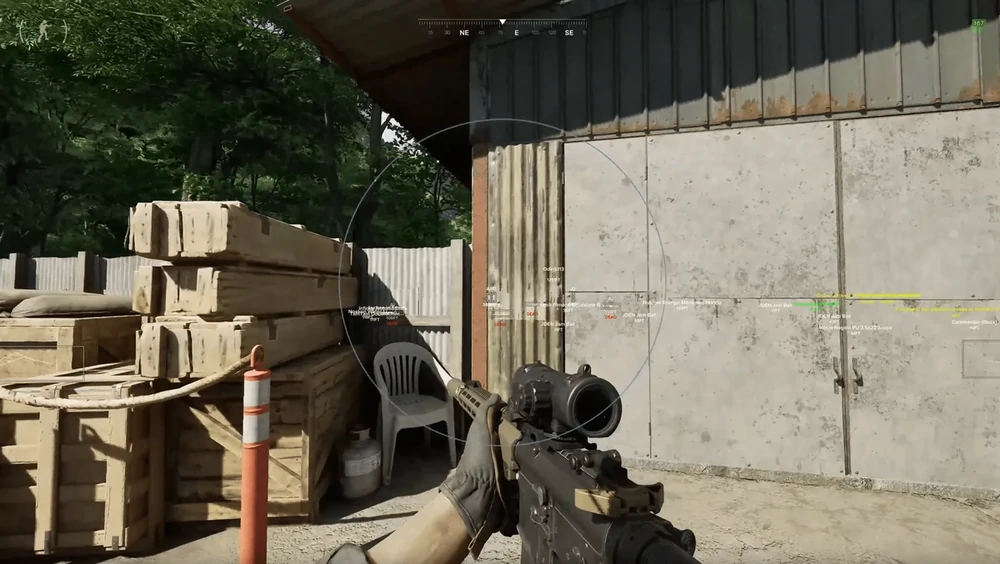
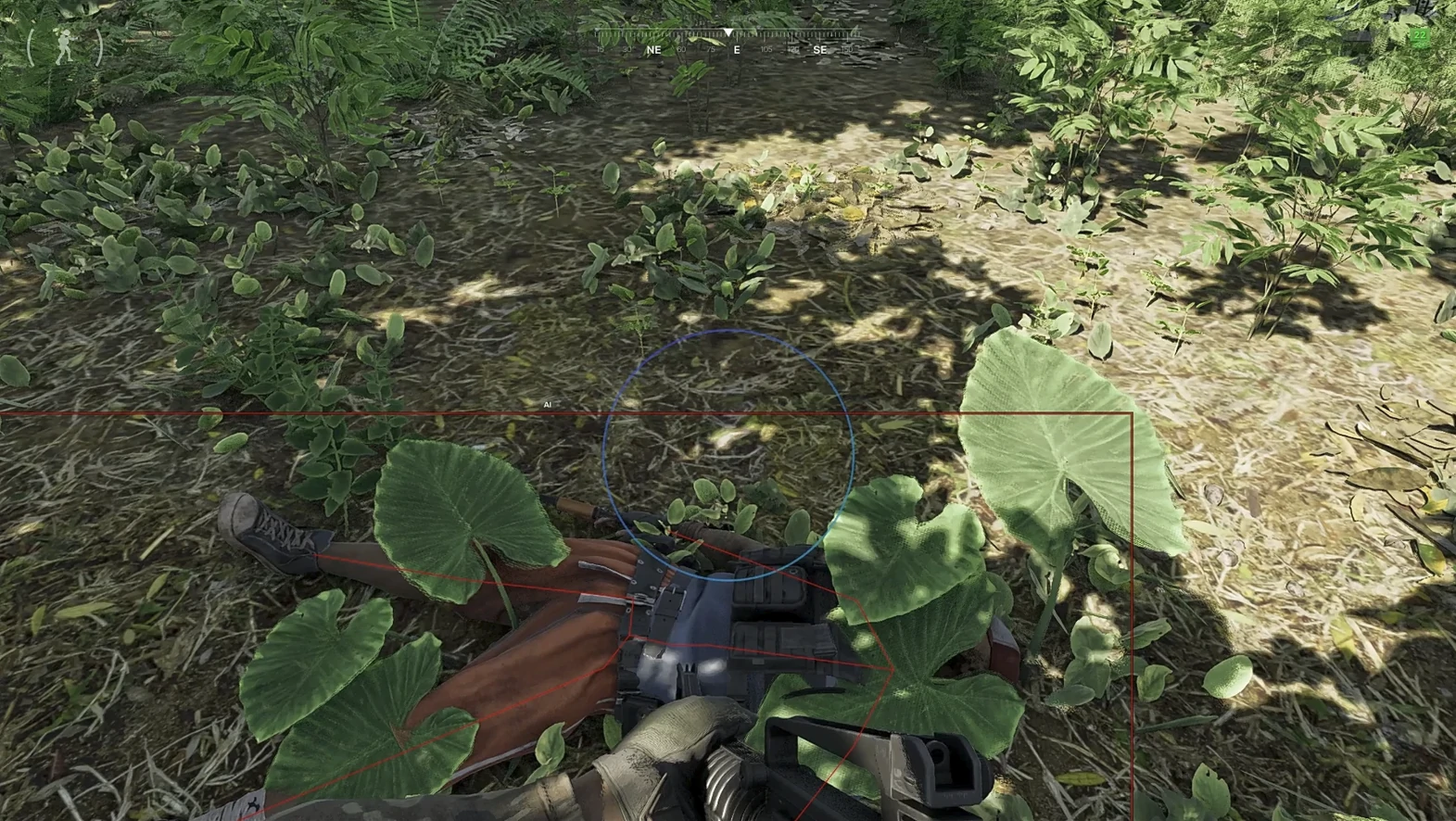
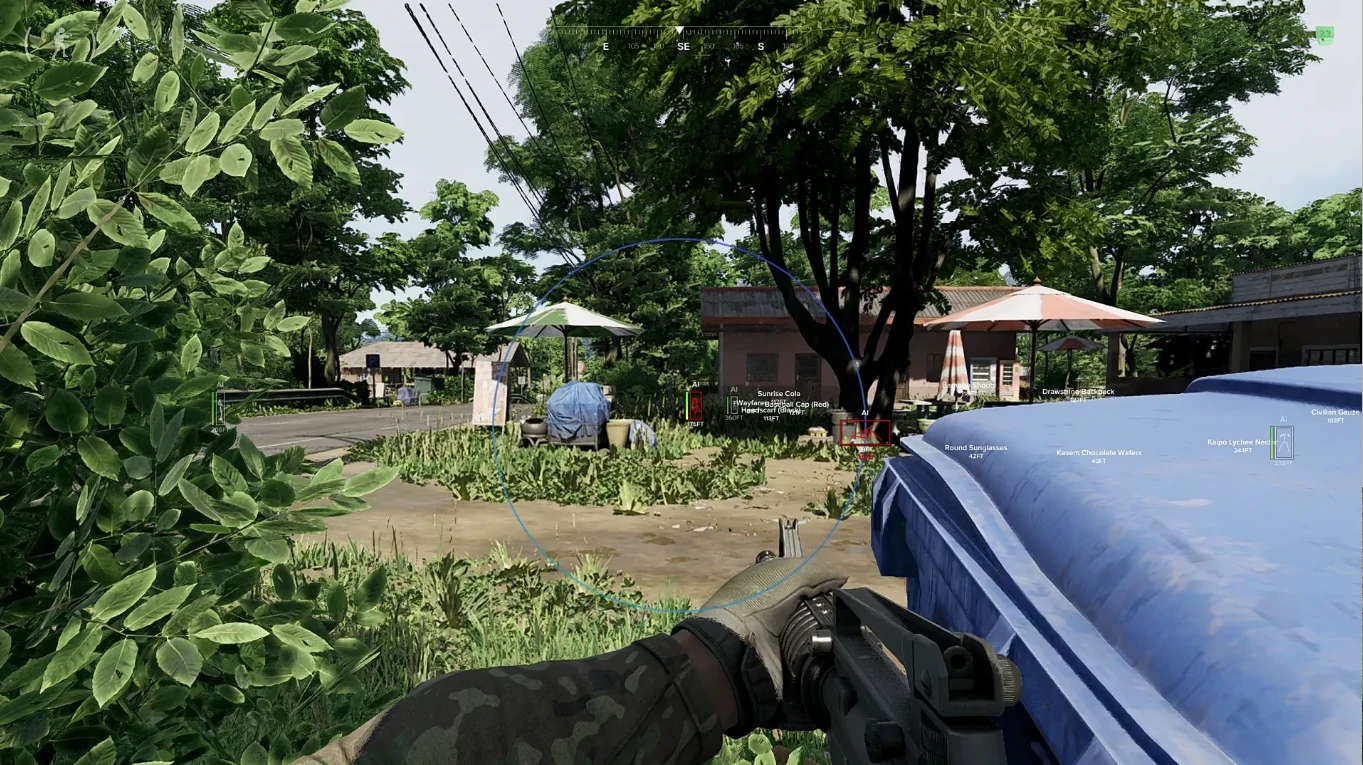
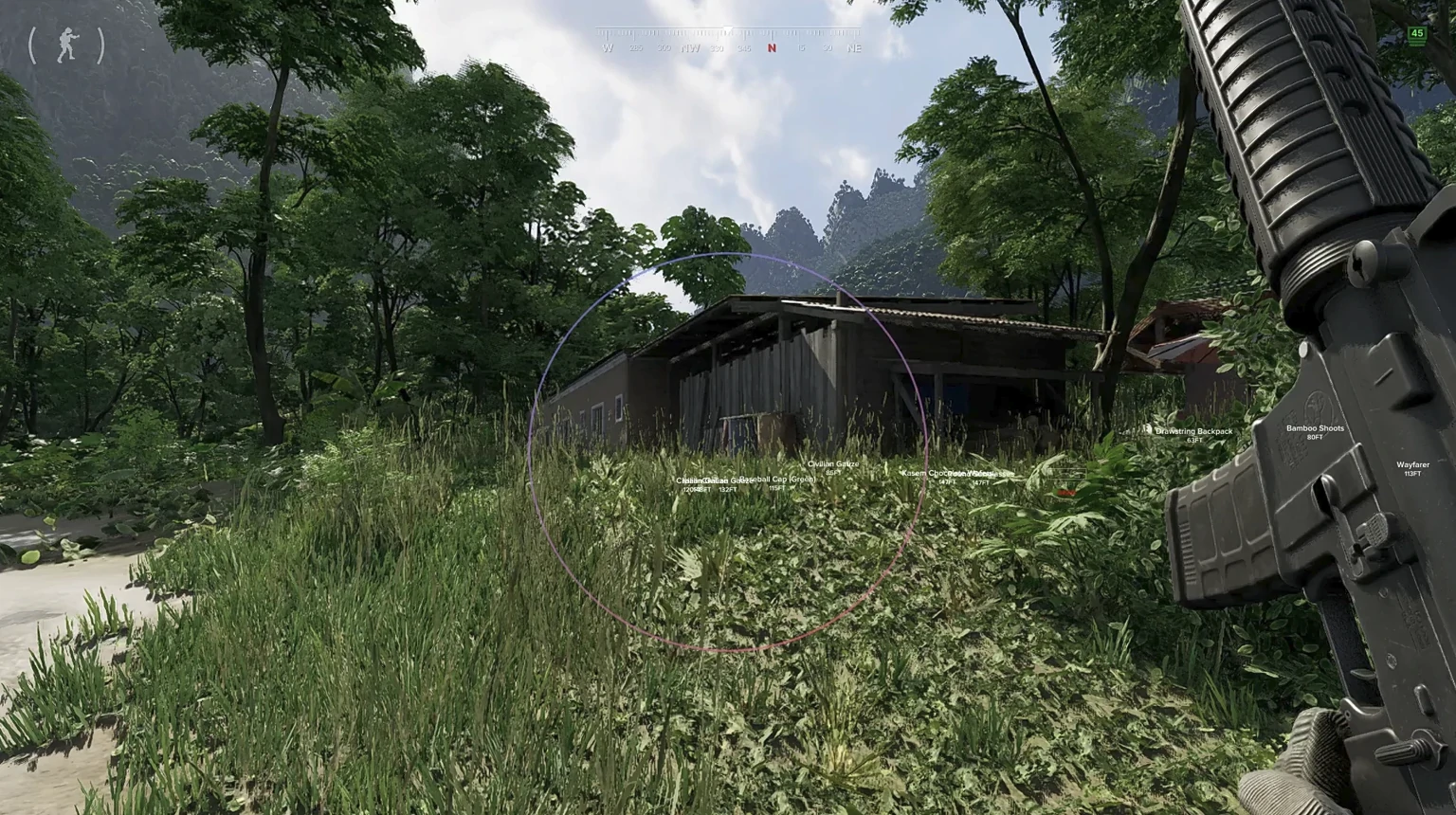
Forty-two square kilometers of triple-canopy jungle with over 1,000 AI entities and up to 48 players per server — GZW ESP overlays faction-tagged player positions, AI patrol routes, loot containers, vendor task objectives, and extraction helicopter ETAs through terrain and foliage across the entire Lamang Island render distance. Entity filters separate hostile PMCs from same-faction allies, distinguish LRI from MSS from CSI operators by color, and flag LAF patrol leaders independently from regular soldiers.
Loot ESP and Task Objective Filtering
Vendor reputation is the progression currency in GZW — Handshake, Gunny, Lab Rat, Artisan, Turncoat, Banshee, and Vulture each gate better gear behind reputation thresholds. Task objective ESP renders the exact location of fetch items, kill targets, and delivery points through walls and terrain. A Handshake task that normally takes 25 minutes of building-by-building searching at Tiger Bay compresses to a direct walk-in when the objective marker renders through three floors of concrete.
Loot filtering works the same way the extraction economy demands — high-value spawns at Fort Narith, Midnight Sapphire, and Pha Lang Airfield render through structures while low-tier gear stays invisible. The difference between looting efficiently and looting randomly is the difference between a 40-minute deployment with a full backpack and a 40-minute deployment where you extract with a SurKit and two magazines. In a game where Dark and Darker's dungeon extraction mechanics apply to a 42 km² jungle island, every unnecessary room you enter is another chance to walk into an LAF patrol or a rival faction ambush.
Gray Zone Warfare ESP Stream Proof — Faction Identification Without the Overlay
GZW's creator program features operators like Welyn, JesseKazam, and GigabeefTV — all active during the Spearhead launch window. Streaming with a visible ESP overlay on a game where MADFINGER developers actively watch featured content is a fast path to a manual review. Stream-proof rendering isolates the overlay to a capture layer invisible to OBS, Streamlabs, and Discord screen share. The faction color tags — critical for distinguishing a friendly LRI operator from an MSS hostile in Warfare — stay visible on your monitor while your broadcast shows clean gameplay. For a game with an active developer-streamer relationship similar to Rust's EAC-protected streaming community, that layer separation is the difference between content creation and a ban clip.
How EAC and Denuvo Actually Coexist Inside Gray Zone Warfare
GZW's anti-cheat is not one system. It is two. MADFINGER integrated Easy Anti-Cheat at launch in April of the game's Early Access debut, then layered Denuvo Anti-Tamper on top during the Winds of War update. The critical detail that most coverage gets wrong: EAC inside Gray Zone Warfare runs at user level — not kernel level. It sits in the same privilege ring as your Steam overlay, monitoring process memory at runtime, flagging known injection signatures, and reporting to EAC's server-side validation pipeline. It does not load a kernel driver at boot. It does not persist after you close the game.
Two independent detection surfaces updating on separate schedules create the practical bypass requirement. EAC pushes signature updates tied to Steam client patches. Denuvo Anti-Tamper verifies binary integrity on launch and at runtime checkpoints, preventing modification of the game executable itself — and it updates independently when MADFINGER ships a new game build. Satisfying one layer while failing the other still results in a flag. Unlike Apex Legends' EAC configuration, which runs as a single-layer solution, GZW's dual architecture means every bypass must account for both systems simultaneously.
The Ban Wave That Caught Controller Players
Three weeks after launch, MADFINGER executed the largest ban wave in GZW's history. Community estimates put the number between 5,000 and 6,000 accounts — roughly a third of the active playerbase at the time. The backlash was immediate. A significant portion of those bans turned out to be false positives: controller software like reWASD and DS4Windows was flagged as aim-assist injection. MSI Afterburner running in the background triggered signatures that matched known cheat loaders.
MADFINGER opened an appeal process through the official Discord and support portal. Many bans were reversed. The incident revealed two things about GZW's detection sensitivity: EAC's signature matching in this title is aggressive enough to flag legitimate software that hooks into input pipelines, and the server-side validation layer does not always distinguish between malicious injection and benign system tools. That calibration matters for anyone running third-party software alongside the game.
What the Spearhead Update Changed in Detection
The Spearhead update shipping this month explicitly mentions improved wallhack detection. MADFINGER has not disclosed specifics — their stated policy is intentional opacity about anti-cheat measures. The developer post reads: "We won't be going into further detail about the specific anti-cheat measures we've implemented." Community speculation includes server-side validation of client-reported line-of-sight data and statistical analysis of player engagement patterns relative to obscured targets. What is confirmed: tools calibrated before Spearhead need re-validation against the new detection surface.
GZW Wallhack — Seeing Through Lamang's Triple-Canopy Jungle
Lamang Island's vegetation density is the highest in any active extraction shooter. Triple-canopy jungle covers the majority of the 42 km² map — three distinct layers of foliage between you and whatever is moving 60 meters ahead. LAF patrols walk predefined routes through this cover with full awareness of your position. CSI operators moving between Ban Pa and Fort Narith use the same canopy as concealment. The result is a combat environment where the first person to see the other wins, and the jungle decides who that is roughly 80% of the time.
GZW wallhack renders player models, AI enemies, and destructible cover through the game's dense foliage, concrete structures, and terrain geometry. Entity filtering separates hostile PMCs from same-faction allies and AI patrols by faction tag. Distance-based rendering adjusts to Lamang's varied engagement distances — from the 8-meter corridors inside Fort Narith's bunker complex to the 400-meter jungle clearings between Ban Pa and the Pha Lang Airfield perimeter.
Fort Narith's Multi-Floor Compound
Fort Narith is GZW's highest-value loot location and its most dangerous. The compound spans multiple buildings across several floors, with LAF soldiers stationed on every level and boss-tier enemies guarding key rooms. Wallhack turns the compound from a floor-by-floor clearing exercise into a priority map — you see which rooms hold the LAF commander, which hallways have patrol overlaps, and which stairwells a rival faction squad is ascending from the motor pool entrance. The alternative is rounding a corner into three LAF soldiers who registered your footstep audio two seconds before you entered their line of sight.
Faction Differentiation Through Walls
In Warfare mode, killing a same-faction player triggers Aggressor Status — a one-hour penalty timer that marks you hostile to everyone, including your own faction. Wallhack with faction tagging prevents that mistake. LRI, MSS, and CSI operators render in distinct colors through cover, making the split-second friend-or-foe decision before you break concealment rather than after. At Midnight Sapphire's resort complex — 30-plus rooms across multiple wings — knowing that the two operators on the second floor are friendly LRI while the solo player in the basement is MSS changes the engagement plan from "clear everything" to "ignore the friendlies, flank the basement." The tactical calculation that games like Squad's ballistic simulation demand in open terrain, GZW demands inside buildings where every wall hides a potential faction contact.
Radar for Helicopter Routes and Extraction Zone Control
Solo deployments and four-man squad runs are different games on the same island. A solo operator dropping into Lamang needs information to avoid contact — every firefight risks losing a loadout with no squadmate to recover your gear. A four-man squad needs information to hunt — rival faction PMCs carrying completed vendor task items are the highest-value targets on the server. Radar serves both profiles, but the configuration and the information you extract from it change completely based on whether you deployed alone or with a team.
Real-time positional data across a configurable range — GZW radar projects a 2D minimap overlay showing all players, AI patrols, and active extraction helicopters within detection radius. Faction tagging distinguishes LRI, MSS, and CSI operators by color. Helicopter ETA tracking renders incoming Little Birds at landing zones before the game's audio engine puts rotor noise within earshot — a detection window that no other extraction shooter offers because no other extraction shooter uses AI-controlled air transport as its sole extraction mechanic.
Joint Ops Radar — Patrol Avoidance and Task Routing
Joint Operations spawns over 1,000 AI entities across seven distinct enemy factions. Radar in this mode is a route planner. LAF patrols follow predefined paths between checkpoints — radar shows their movement vectors and loop timing, letting you thread between patrols instead of fighting through them. On a Handshake delivery task that routes through three LAF-controlled zones, the difference between using radar and not is the difference between zero-contact completion and three firefights that eat your medical supplies and attract more patrols with gunfire audio.
Warfare Radar — Faction Tracking and LZ Security
The extraction helicopter takes roughly 90 seconds to arrive after you call it. Those 90 seconds at an open LZ are the most vulnerable moment in any GZW deployment. Radar turns that window from a blind wait into a managed risk — you see every player within range, their faction tags, their movement direction, and whether they're converging on your LZ or running their own route. If an MSS two-man is 300 meters out and closing, you cancel the call and reposition. If the nearest player is 800 meters in the opposite direction, you hold position and board clean.
The helicopter tracking element has no equivalent in the extraction genre. In Tarkov, extraction points are static map locations. In GZW, extraction requires calling a physical helicopter that flies a visible route across the island. Radar picks up that helicopter's position before audio range confirms it, giving you lead time to clear the LZ perimeter or abort if the flight path crosses a hostile zone. That information layer exists because GZW's extraction mechanic is fundamentally different from every other game in the category.
GZW Hacks — Staying Undetected After the Spearhead Anti-Cheat Update
You deploy into Warfare with a loadout assembled across four hours of vendor task grinding — an AK-12, Level III chest plate, six SurKits, and a backpack carrying three completed Turncoat delivery items. EAC flags your session during extraction. Account suspended. The $39.99 you paid for Gray Zone Warfare is gone. Worse: EAC shares HWID fingerprints across its entire game portfolio. Your Rust account, your Apex Legends account, your Fortnite account — every EAC-protected title tied to your hardware now carries that flag.
Surviving detection in GZW means satisfying two independent systems updating on different schedules. EAC pushes signature updates through Steam client patches. Denuvo Anti-Tamper updates independently with game binary changes. The Spearhead update specifically targets wallhack detection, making configurations calibrated before the patch potentially flagged under the new ruleset. Tools that bypass both layers must update for each system independently — an EAC-only update does not require a Denuvo re-validation, but a game binary update does.
No Recoil Thresholds for GZW Weapons
The AKM's recoil pattern pulls hard vertical through the first eight rounds of automatic fire — compensation at 70–80% flattens the climb while preserving enough micro-movement in the aim path to stay within EAC's behavioral sampling range. The M4A1's recoil is tighter and more controlled at baseline; compensation above 50% on this weapon produces unnaturally flat spray patterns that statistical analysis can isolate. The SVD's semi-auto kick is minimal — compensation at 30–40% is sufficient and virtually invisible in replay data. Each weapon needs its own threshold because EAC's behavioral baseline is weapon-specific, not universal.
HWID and the Cross-Game Ban Cascade
GZW is a $39.99 buy-to-play title. A banned account is not a free reroll — it is real money. But the hardware fingerprint is the larger problem. EAC collects motherboard serial, MAC address, drive identifiers, and GPU signatures. A hardware ban on GZW propagates across every EAC title sharing that HWID database. The spoofer initializes before EAC's client loads, masking the real hardware profile with generated identifiers that rotate per session. For a paid game in an ecosystem where a single HWID flag cascades to a dozen titles, the spoofer is not optional. It is the first layer of financial protection.
DMA hardware bypasses operate outside the game PC entirely — a dedicated PCIe card reads memory from a second machine, keeping zero cheat software on the system EAC monitors. The GZW DMA market is active and growing precisely because EAC's user-level architecture cannot scan hardware it does not have permission to inspect. The tradeoff is cost and complexity: a DMA setup requires dedicated hardware, a second PC, and firmware configured for GZW's specific memory structure. For operators weighing software versus hardware bypass, the status page tracks current compatibility and update timing for both approaches.
Gray Zone Warfare Cheats — FAQ
LAF soldiers at Fort Narith headshot me through two floors of concrete — was that the AI or a cheater?
Almost certainly the AI. GZW's LAF faction has been documented headshot-killing players through foliage and solid structures since launch week. The community has compared their accuracy to literal aimbots, and MADFINGER has acknowledged AI difficulty as a tuning priority. The Spearhead update introduces seven distinct AI factions with redesigned behavior — but LAF accuracy through cover remains a known issue. Check the killfeed for the LAF faction tag before reporting a cheater.
I play Joint Operations exclusively — does aimbot still matter when there are no human opponents?
More than in PvP, arguably. Joint Ops spawns over 1,000 AI entities across Lamang, many with accuracy that exceeds average human reaction time. The aimbot's ballistic compensation handles the AKM's drop at 200 meters, the Mosin's holdover at 300, and the SVD's zeroing offset at Fort Narith's elevated positions — calculations that matter against AI enemies who do not miss and do not hesitate. Bone lock on center-mass with AP rounds clears LAF patrols in half the engagement time of manual aim.
Does ESP show which faction other players belong to, or just that they are human?
Faction-tagged. LRI, MSS, and CSI each render in distinct colors through walls and terrain. In Warfare mode, killing a same-faction player triggers Aggressor Status — a one-hour penalty that marks you hostile to everyone. Faction ESP prevents that mistake by letting you confirm friend-or-foe through cover before breaking concealment, which matters most in multi-faction encounters at contested POIs like Tiger Bay and Midnight Sapphire.
My M700 zeroed at 200m consistently hits low at Fort Narith's elevated positions — does aimbot correct for elevation ballistics?
The aimbot compensates for vertical angle relative to zeroing distance. GZW's ballistic engine calculates drop based on horizontal distance, not line-of-sight distance. Shooting downward from Fort Narith's rooftop at a target 200m away on flat ground requires less holdover than the zeroing value suggests — the aimbot applies this correction frame by frame, adjusting as your elevation angle to the target changes mid-engagement.
GZW banned thousands of players with false positives in the first month — how do current tools avoid triggering the same flags?
That ban wave targeted specific memory signatures that matched controller emulation software — reWASD, DS4Windows, and MSI Afterburner were all flagged because their input hooks resembled known injection patterns. Current tools use injection methods that do not overlap with legitimate software signatures. The dual-layer architecture (EAC + Denuvo) means both systems must be individually satisfied, which requires maintaining separate bypass profiles that update independently when either system pushes new signatures.
Can radar show me when a Little Bird is inbound to my extraction LZ before I hear the rotors?
Yes. Radar renders helicopter positions at distances beyond the game's audio engine range. You see the Little Bird's icon on the minimap overlay before rotor sound reaches your character's position, giving you lead time to secure the LZ perimeter or reposition if hostiles are converging. No other extraction shooter offers this because no other game uses AI-controlled air transport as its sole extraction mechanic — the helicopter tracking layer is specific to GZW's deployment and extraction system.
Full Feature Breakdown for Gray Zone Warfare
Ballistic-compensating aimbot, faction-tagged ESP, 2D radar with helicopter tracking, wallhack through Lamang's jungle canopy, no recoil per weapon profile, and HWID spoofing across the EAC ecosystem. The complete feature list, current compatibility status, and configuration details are on the BurgerCheats GZW product page. Check live detection status for all EAC-protected titles before deploying.
-
-
Total Members 4,964
-
Most Online 39
-
Newest Member nevo254

-
-
Reviews
-

By Discord Review · Posted
+rep @admin really fast support and noce cutom service the delivery speed was fast he helped me with the settings you need to change an do and that in 10 min thats crazy. -
-

By 3ttuu · Posted
My firmware is working perfectly thanks to the kind explanations and help from the Burger Cheat admin. They were always very friendly and responded quickly to customers. If you're considering a purchase, I highly recommend it -
By Discord Review · Posted
+REP. The response was fast, the explanations were kind, and they answered my questions sincerely and thoroughly. It was excellent. -

-