
-
Dark and Darker Cheats & Hacks — Aimbot, ESP, Radar & Wallhack for Dungeon Extraction
Dark and Darker hacks and cheats with aimbot lock-on for melee swing prediction, dungeon ESP through three castle floors, and radar overlay. Undetected on Ironshield with updates every patch.
-
Featured Products
-
-
10 Classes, Seven Dungeons, One Chest You Can't Afford to Lose
You've loaded into the Forgotten Castle with a full kit — Rare Longsword, plate armor, healing potions, and a torch that'll burn out before you reach the second floor. Somewhere ahead, the Howling Crypts hold a Legendary drop behind the Ghost King. Somewhere behind, two other players heard the same chest spawn and they're following your torchlight down the corridor. That's the pitch of Dark and Darker: a first-person PvPvE extraction dungeon crawler where ten distinct classes — from plate-armored Fighters to spell-slinging Wizards to invisible Rogues — descend into procedurally assembled medieval dungeons, fight AI monsters, kill each other, and race for extraction portals that take seven agonizing seconds to activate.
The extraction math is brutal. Seven dungeon maps span three vertical complexes — the Forgotten Castle drops from the Ruins through the Crypts into Inferno, Frost Mountain descends from Ice Cavern to the Ice Abyss, and Goblin Caves now opens into the lava-flooded Firedeep. Deeper floors mean better loot and harder enemies. Death means losing every item you carried in and every item you found. Normal mode brackets players by gear score — 0 to 24 in one lobby, 25 to 124 in another — but High-Roller removes all limits, pitting naked rats against full-kit chads in the same corridors. If you've played Escape from Tarkov hacks with extraction ESP, you know the stakes. Dark and Darker replaces the bullets with broadswords and the military compounds with torch-lit crypts.
Ironshield — IRONMACE's custom-built anti-cheat — runs under VMProtect code obfuscation and scans connected drives through a dedicated background process. It's not EAC. It's not BattlEye. It's a proprietary system built by the same studio that fought a years-long legal battle just to keep the game on Steam. Understanding what Ironshield actually monitors, and where it doesn't, matters more here than in any third-party anti-cheat title.

Dark and Darker Aimbot — Locking Longsword Swings Before the Parry Window Opens
An aimbot in Dark and Darker calculates swing trajectory and target hitbox alignment for melee weapons, crossbows, and throwable items like Francisca Axes. Unlike FPS aimbots that track bullet paths across open maps, this system predicts first-person melee collision geometry — adjusting lock-on angle based on weapon swing speed, attack direction, and target movement vectors. The result is a targeting system that knows where a Rogue's head hitbox will be when your Longsword's overhead swing actually connects, not where it is when you click.
You're two modules into the Howling Crypts. A Fighter rounds the corner with a Falchion — the weapon that applies a 20% movement slow on every hit. You're on a Ranger with a Crossbow loaded and an Arming Sword as backup. The aimbot snaps your crossbow bolt onto the Fighter's head at 12 meters, dealing enough damage to force a heal. By the time he closes the gap, you've switched to melee and the lock-on adjusts from ranged projectile tracking to swing prediction. His Falchion overhead comes in. Yours lands first. That transition — ranged to melee — is where a generic FPS aimbot would break entirely, because the targeting math changes between the two combat modes.
If you're running Gray Zone Warfare aimbot and ESP or any other extraction title's tools, you've only ever dealt with bullet trajectory. Dark and Darker's swing-prediction system handles three distinct calculation types in the same dungeon run: directional melee attacks with variable swing arcs per weapon class, bolt-action projectiles from crossbows with draw-speed delays, and thrown items like Francisca Axes with parabolic trajectories. Each weapon type recalculates independently.
Dark and Darker Aimbot Settings — FOV and Bone Targeting per Weapon Class
FOV in a dungeon crawler works differently than on an open battlefield. Corridors in the Forgotten Castle average three to four meters wide. Setting aimbot FOV above 60° in these spaces pulls lock-on toward targets behind walls or on different vertical layers — the system can't distinguish between a player two rooms ahead and one directly above you in the Crypts. A 25–35° FOV keeps targeting locked to enemies you're already visually tracking through your first-person view. For crossbow shots at the end of longer Ruins hallways, bumping FOV to 45° catches retreating players without pulling toward irrelevant AI mobs in adjacent modules.
Bone targeting depends on what you're fighting. Barbarians have the largest hitbox of all ten classes — center-mass lock handles them reliably. Rogues crouch, dodge, and have the smallest model. Head bone targeting on a crouching Rogue in Goblin Caves requires the prediction engine to account for their lower vertical position and faster lateral movement. For Crossbow users, head targeting maximizes single-bolt damage on classes with low physical damage reduction. For melee, chest targeting is more consistent because headshot multipliers on swords don't scale as aggressively as ranged headshots — and missing a head swing entirely costs you the parry window.
Dark and Darker ESP — Reading Every Soul Through Three Floors of Stone
You're solo in Ice Cavern. Your torch is dead. The raft extraction sits 50 meters northeast, and the sound design is doing its job — something is moving two rooms ahead, but the echo off frozen stone makes direction impossible to isolate. You pull up the ESP overlay and the dungeon opens. Three red tags cluster near the raft — a Cleric, a Warlock, and a Fighter, all with Epic-grade gear. Two blue tags (AI Frost Skeletons) patrol the corridor between you and them. One green marker pulses behind a locked door to your west — a chest you would have walked past in the dark. Now you have a decision. Go for the chest, loop south to the secondary extraction rope, and dodge the trio entirely. That's information the game is designed to deny you.
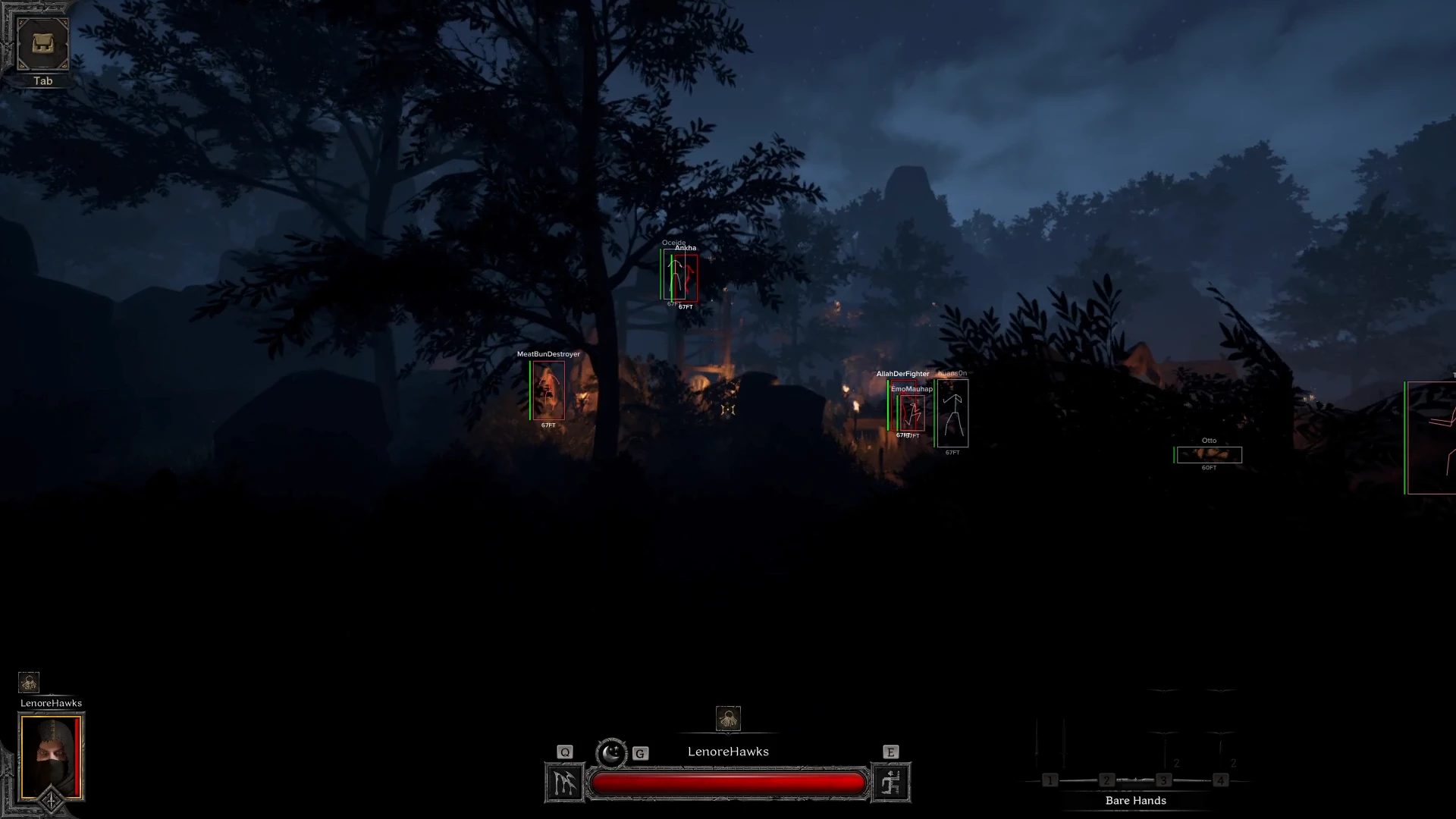
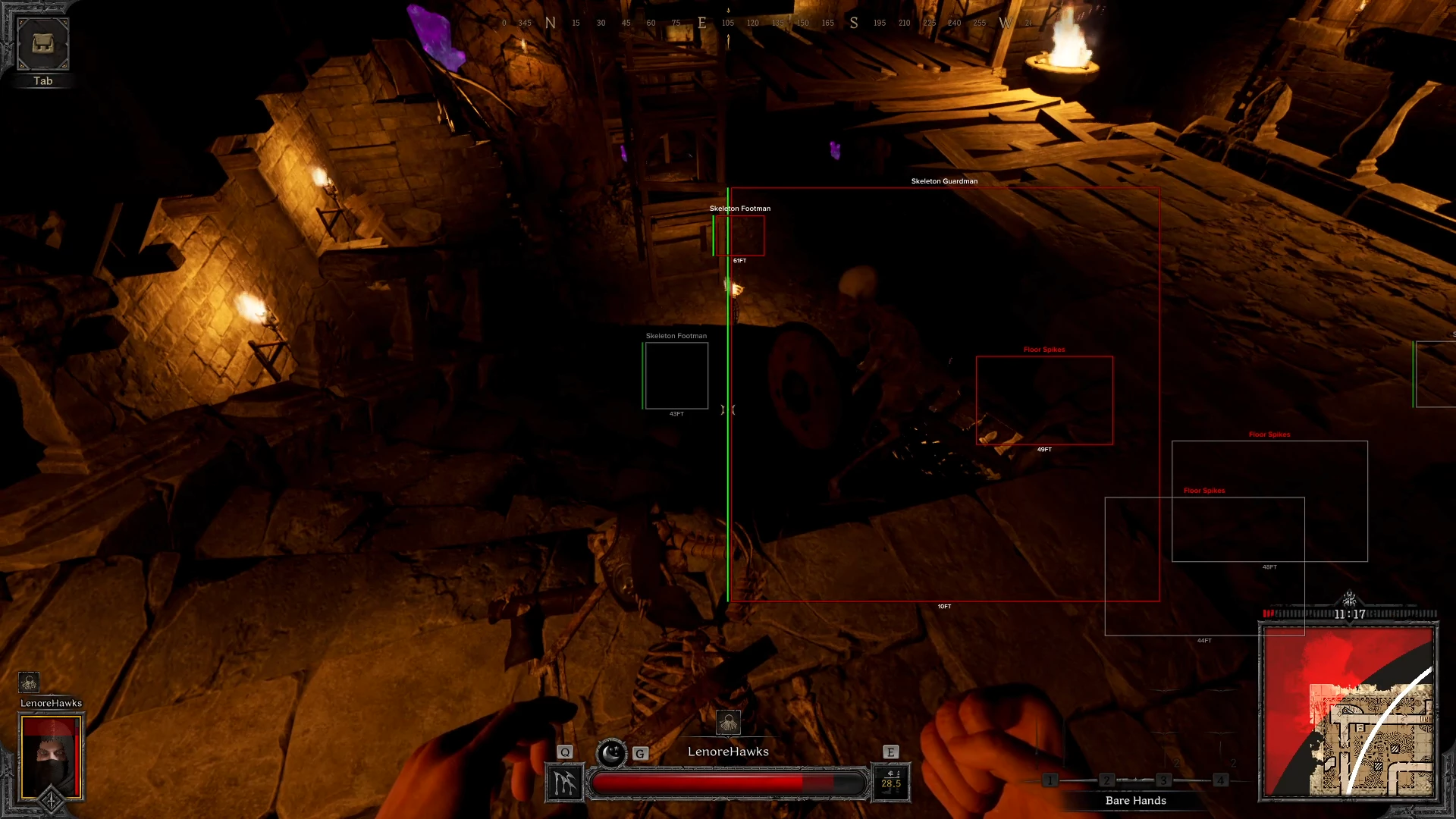
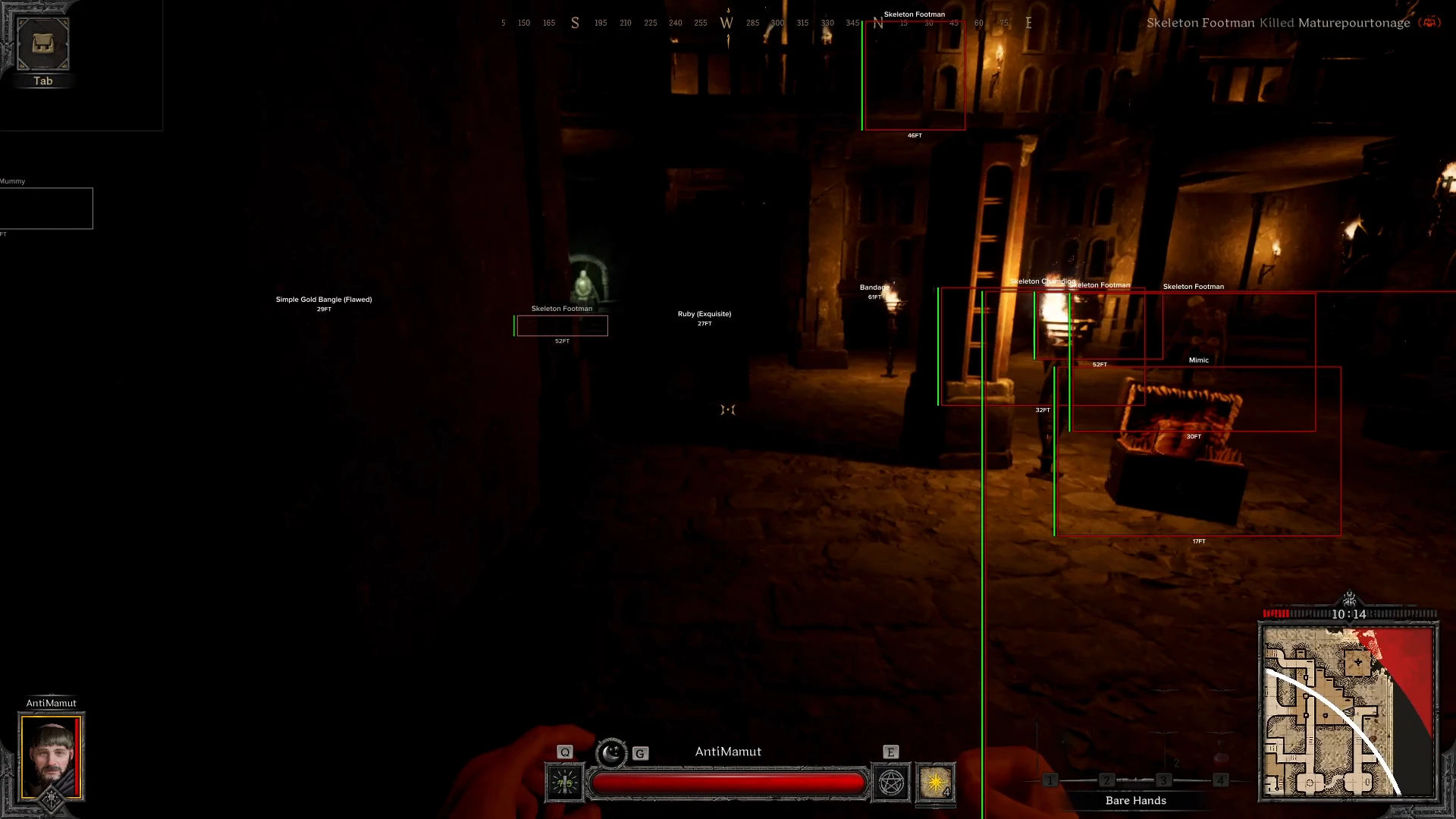
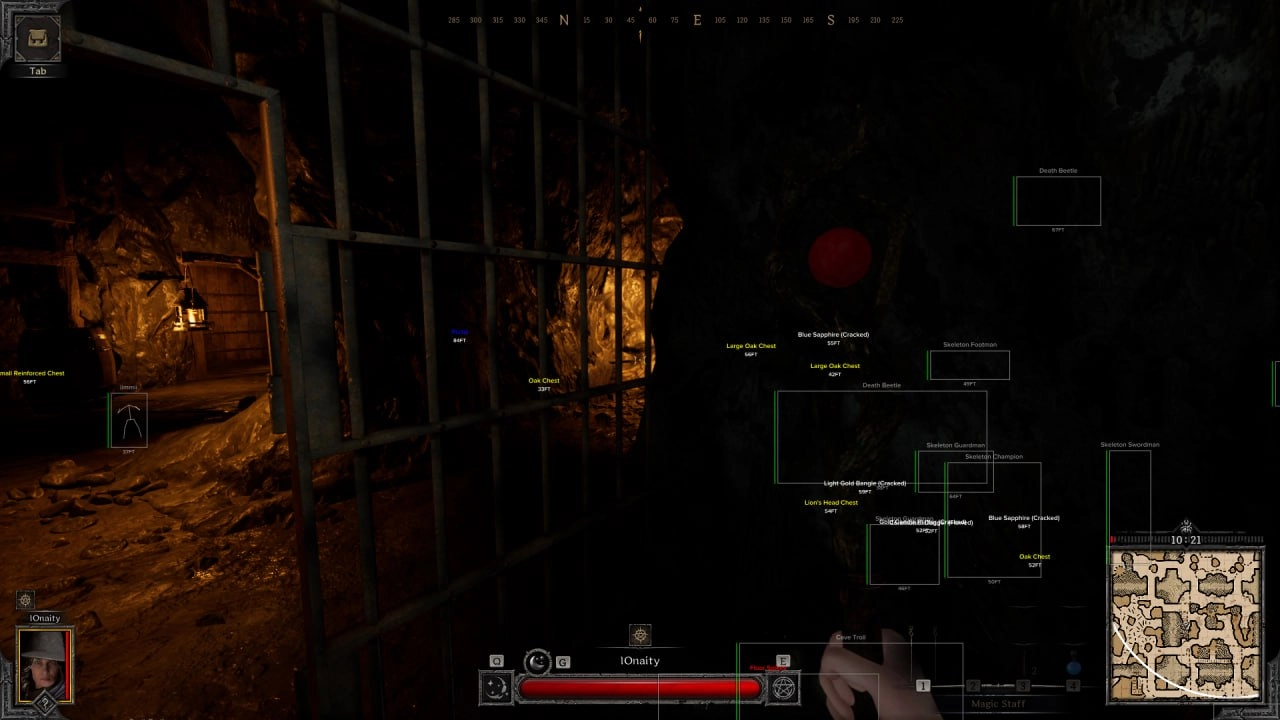
ESP in Dark and Darker renders real-time overlays showing player positions, class identities, health values, equipped gear rarity, and distance through dungeon walls across all vertical dungeon layers. The overlay distinguishes between player targets, AI monsters, treasure chests, extraction portals, and interactive objects like altars and traps. What separates this from ESP in a flat-map shooter is the vertical dimension — the Forgotten Castle stacks the Ruins above the Howling Crypts above Inferno. Without vertical layer filtering, your overlay floods with entity tags from two floors below you. Proper configuration isolates your current floor while flagging high-value entities (Legendary-geared players, boss monsters, Unique item drops) on adjacent layers.
The PvPvE split creates a second filtering challenge no pure-PvP title has. EFT Arena cheats for competitive PvP only need to track players. In Dark and Darker, every dungeon corridor mixes player combatants with Skeleton archers, Wraiths, Mummies, and floor-specific bosses like the Ghost King or the Lich. A cluttered overlay that tags every Skeleton in the Crypts the same color as a hostile Rogue defeats the purpose of running ESP in the first place. Entity-type color coding — one color for players, another for elites, a third for loot containers, a fourth for extraction points — converts raw data into a decision layer you can process at a glance during a fight.
Dark and Darker ESP Settings — Filtering Entities in a PvPvE Dungeon
Start with player ESP only. Disable mob tracking, chest highlights, and trap overlays until you're comfortable reading the player-tag layer without visual overload. In Normal mode's lower gear score bracket, lobbies hold fewer players but higher monster density — flipping on full entity ESP in a Goblin Caves run with 40 AI mobs on screen turns your overlay into noise. Once the player layer is clean, add extraction point markers. Knowing where blue portals and staircases spawn is the single highest-value ESP data point in any extraction game. Every decision you make — push deeper, loop around, fight or flee — depends on how far you are from an exit.
In High-Roller, the calculation shifts. HR disables gear score brackets and enables Fog of War, which limits your natural view distance. ESP cuts through that fog completely. The player density is lower but the gear quality is higher — one red tag carrying a Legendary Longsword and full plate armor represents a threat that three Normal-mode Fighters combined wouldn't match. Prioritize gear-rarity display on ESP tags in HR. You don't need to know there's a player 30 meters away. You need to know that player is wearing Legendary armor with high PDR before you commit to an ambush with a Rapier that deals mostly physical damage.
Seeing Through the Dark — How Wallhack Changes Dungeon Navigation
The number one complaint on every Dark and Darker discussion board isn't class balance or server lag. It's extract camping. A Rogue activates Hide, crouches behind a sarcophagus in the Howling Crypts, and waits for you to walk past with a full inventory. You never see the attack. Your loot vanishes into someone else's stash. The darkness mechanic makes this worse — torches illuminate a narrow cone, and dungeon modules are built with blind corners, dead-end alcoves, and multi-level rooms designed to obscure line of sight. The game rewards patience and ambush positioning by default.
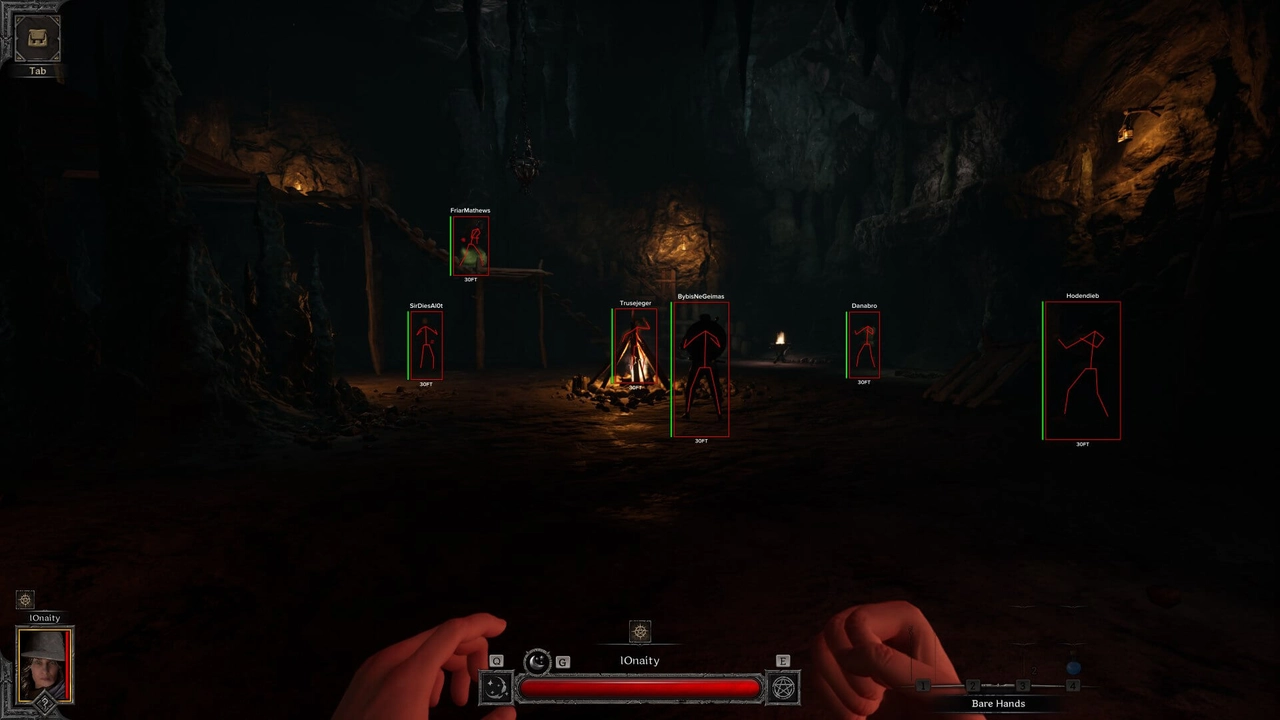
Wallhack in Dark and Darker removes visual obstructions from dungeon geometry — stone walls, wooden doors, floor tiles between vertical layers — revealing player and entity positions as rendered models or skeletal wireframes. This differs from ESP's data overlays by showing actual character models through solid surfaces, which means you see the Rogue's crouched animation, the Fighter's shield raised in a doorway, the Wizard mid-cast behind a pillar. Where ESP gives you tagged positions on a flat plane, wallhack gives you posture, stance, and intent.
The darkness mechanic is where wallhack creates the widest gap between default play and augmented awareness. Without a torch, the game renders rooms as near-black voids. Your monitor shows nothing. Wallhack ignores the rendering darkness layer entirely — wireframe or full-model display treats every room at full visibility regardless of torch state. You don't carry a torch anymore. You don't broadcast your position. And every player still relying on torchlight becomes a glowing target moving through corridors you can already see through the stone.
Wireframe vs Full-Model Rendering in Module Layouts
Full-model rendering through walls shows complete character animations but adds significant visual clutter in tight Goblin Caves modules where six or more AI mobs patrol adjacent rooms. Wireframe mode reduces each entity to a skeletal outline — lighter on screen, easier to process at speed, and enough to distinguish between a Barbarian's hulking frame and a Rogue's narrow silhouette from 30 meters through two stone walls. For the Firedeep's lava-lit corridors where natural visibility is already higher than other dungeons, wireframe prevents overlapping wireframes from obscuring your actual first-person view during melee fights. Switch to full-model only when you're pre-clearing a room before entry and need to read weapon types and casting animations.
Dungeon Radar Overlay — Mapping Modules You Haven't Entered Yet
A radar hack in Dark and Darker projects a real-time minimap overlay showing the positions of all players, monsters, loot containers, traps, and extraction points within detection range. The game deliberately has no minimap — dungeon navigation depends on memorizing module layouts, tracking your own movement direction, and recognizing visual landmarks in repeated room segments. Radar removes that entire skill layer and replaces it with a persistent spatial readout that reveals the full dungeon layout as assembled from the module system, including rooms and corridors you haven't physically entered.
You're on Inferno — the third floor of the Forgotten Castle, the deepest and most dangerous layer in the game. The Lich boss room is somewhere in this floor, and so are two extraction staircases that lead back to the surface. The module system assembled the layout at the start of the match, and without radar, you're navigating blind through a labyrinth of identical stone hallways, trap plates, and Skeleton Mage patrols. Three hostile player tags pulse on the radar 40 meters southwest, moving toward the same staircase you're targeting. You cut northeast through an unexplored module corridor, hit the second staircase, and extract clean. Without the overlay, you would have walked directly into that trio.
Entity Filtering and Range Settings for Dungeon Scale
Dungeon modules in Dark and Darker are compact. The Forgotten Castle's Ruins floor spans roughly 120 by 120 meters with irregular module boundaries and vertical overlaps. Setting radar range beyond 80 meters in this space pulls in entity data from adjacent floors — the Crypts below the Ruins generate tags that appear as same-floor dots unless you've enabled vertical layer separation. Keep radar range at 50–60 meters for floor-level accuracy. In Goblin Caves — the smallest map — drop to 30–40 meters. Inferno needs the full 60–80 meter range because its corridors stretch longer and its extraction points sit at the map edges.
Entity filtering on radar follows the same priority as ESP: players first, extraction points second, everything else optional. Trap markers add real defensive value in Inferno where spike plates and dart traps line corridors that look identical to safe passages. If you're running a Rogue with the trap detection perk, radar trap markers overlap with your class ability — turn them off to reduce noise. For any other class, keep trap markers active. Stepping on a spike plate mid-fight in a Crypts corridor costs 80 HP and staggers you long enough for a chasing Fighter to land a free overhead swing.
How Ironshield Anti-Cheat Scans Your System
You create a new free account after your last one caught a ban. Fresh email, fresh username, zero progression. You load into the lobby, select a Fighter, equip a gray Arming Sword from the default inventory. Before you finish the first dungeon module, the game disconnects. Ironshield matched your hardware fingerprint against its ban database. The account was free. The ban followed your motherboard. That's the enforcement model IRONMACE chose for a free-to-play extraction game where new accounts cost nothing — hardware identification replaces the financial deterrent that paid titles rely on.
Ironshield is IRONMACE's proprietary anti-cheat system, executed through Tavern.exe and TavernWorker.exe processes. Unlike industry-standard solutions like EAC or BattlEye that protect dozens of titles and have years of accumulated signature databases, Ironshield is custom-built for a single game. The core executable is protected with VMProtect code obfuscation, which wraps the scanning logic inside virtualized code segments that resist static analysis. TavernWorker.exe launches as a background process during game startup and actively scans connected storage drives, cross-referencing file signatures against IRONMACE's internal detection database. The combination of proprietary code, VMProtect obfuscation, and drive-level scanning creates a detection surface that differs fundamentally from anything EAC or BattlEye deploys.
Why Custom Anti-Cheat Cuts Both Ways
The Ironshield system's strength and weakness stem from the same source — isolation. EAC and BattlEye share detection telemetry across every title in their network. A cheat signature flagged in Rust feeds into EAC's database and protects Apex Legends, Fortnite, and every other EAC-integrated title within hours. Ironshield has no network. Its detection database updates only when IRONMACE's team manually identifies and catalogs new signatures. That makes Ironshield harder to predict — its scanning patterns aren't documented across dozens of reverse-engineering communities the way EAC's kernel driver is — but it also means known cheat techniques that EAC patched months ago may still work against a smaller team maintaining a single-game solution. For context, Hunt Showdown cheats for PvPvE extraction operate against EAC's shared network — a fundamentally different detection environment than Ironshield's standalone model.
HWID Bans and the Free-to-Play Problem
Account bans in Dark and Darker carry zero cost. Creating a free account takes thirty seconds. Legendary Status costs money, but the base game — including Normal mode, Adventure mode, and Squire to Riches — requires no purchase. IRONMACE's response to this economic reality is HWID-level enforcement. Ironshield fingerprints hardware identifiers across CPU, motherboard, GPU, and storage volumes, then persists that fingerprint server-side. A new free account on the same machine matches instantly. A new Legendary Status purchase on the same machine matches identically. Hardware-level spoofing becomes the real countermeasure — not account rotation, not email swapping, not clearing local data. The entire ban-evasion hierarchy inverts compared to paid titles where buying a new copy is the primary path back.
Speed and Movement Manipulation in Dungeon Corridors
Every class in Dark and Darker has a different base movement speed, and every fight in the game is decided partly by who can close distance or create it. The Barbarian carries the highest HP pool and the hardest-hitting two-handed weapons but moves slower than a Rogue, a Ranger, or a Bard until activating Rage. The Rogue is the fastest class by default but can't take more than two Longsword swings before dying. Speed determines whether you catch the Ranger kiting you through Ruins hallways, whether you reach the blue portal before the trio rounding the corner, whether a Barbarian's charge reaches your Wizard before your Fireball finishes casting.
Speed hacks modify character movement velocity beyond the class-defined base speed stat, allowing faster dungeon traversal, chase escapes, and positional advantages in melee combat. Movement speed in this game directly affects swing-dodge timing — a Fighter moving 15% faster than expected throws off an opponent's read on attack range and parry windows. The opponent expects your Longsword to reach them in a specific timeframe based on your class speed. You arrive early. Their parry triggers too late.
Subtle Increases vs Obvious Acceleration
In Squire to Riches — the mode that still uses the Dark Swarm closing circle — speed manipulation separates extraction from death in the final 30 seconds of a match. The Swarm deals escalating damage that kills even plate-armored Fighters in seconds. A 10–15% speed increase doesn't look visibly wrong to another player watching you sprint, but it puts you three to four meters ahead of where they'd expect you to be after a ten-second run. That gap is the difference between reaching the safe zone and dying to the Swarm with a full inventory. Keep multipliers below 20%. Anything above that produces observable rubber-banding on other players' clients and draws reports. In Normal mode, where the Swarm no longer exists, speed value drops slightly — but portal races to contested blue portals still reward subtle movement advantages.
Crossbow Recoil and Ranged Weapon Stabilization
No recoil hacks in Dark and Darker eliminate weapon sway and recovery delays on ranged weapons — primarily crossbows, bows, and throwable items. Because melee weapons have no recoil mechanic in this game, this feature applies exclusively to the Ranger's Survival Bow and Crossbow, the Fighter's Crossbow secondary, and the Wizard's Crossbow backup. That makes the functional scope roughly 80% narrower than no recoil in any FPS title, where every weapon in the arsenal benefits.
Where it matters is rapid follow-up shots. The Crossbow has a bolt-loading animation between shots that introduces sway when you re-acquire a target. The Survival Bow adds draw-speed wobble at full pull. Both mechanics punish fast shooting — you either wait for the sway to settle or fire inaccurately and waste limited ammunition. No recoil removes that sway entirely. Your second crossbow bolt hits the same pixel as the first. Your fully-drawn Survival Bow holds dead still for as long as you hold the draw. For a Ranger rapid-firing three bolts at a closing Fighter in Goblin Caves, the difference between default sway and zero sway is the difference between landing two out of three and landing all three — roughly 120 extra damage that determines whether the Fighter reaches melee range at half health or full.
Dark and Darker Hacks — Staying Undetected While Ironshield Watches
You're streaming a High-Roller trio run to 2,400 viewers. Your Cleric is running full ESP with extraction markers, your Fighter has aimbot tuned to 30° FOV for melee, and the Warlock is using radar to call out enemy positions from the back line. Ironshield's TavernWorker.exe is running its drive scan in the background. Your OBS scene capture is broadcasting your monitor to Twitch. One misconfigured overlay layer and every viewer — including anyone who decides to clip and report — sees the ESP tags on screen. Stream proof isn't optional in Dark and Darker. The game pulled 19 million Twitch watch hours during its breakout playtest, and its streaming community remains active enough that recognizable players get reported from VOD clips.
Staying undetected in Dark and Darker requires understanding Ironshield's specific scanning patterns — its VMProtect-packed executables, TavernWorker.exe drive monitoring, and hardware fingerprinting system. Because the game is free-to-play with instant account creation, IRONMACE relies on HWID bans as the primary deterrent rather than account-level enforcement. That means the detection stakes operate on a different axis than paid extraction titles. In DayZ hacks with survival ESP, getting banned costs you a game purchase. In Dark and Darker, getting account-banned costs nothing — but getting HWID-banned locks your physical hardware out of the game across every account you create on that machine.
Feature Tuning for Detection Plausibility
Ironshield's behavioral analysis — if it runs any — is harder to profile than EAC or BattlEye because no reverse-engineering community has published the volume of documentation that exists for those industry-standard solutions. What's observable is this: players report bans correlated with extreme parameter values more than with feature activation itself. An aimbot locking 180° behind you onto a Rogue you couldn't possibly see is reportable by any player watching the killcam. An aimbot at 25° FOV that catches a target already centered in your first-person view looks indistinguishable from a well-timed manual swing.
The same principle applies across every feature. Speed hack above 20% produces visible rubber-banding. ESP with full entity display and no distance cap creates behavior patterns — you avoid every player, path perfectly to every chest, extract at the exact moment a threat approaches — that server-side telemetry could theoretically flag as statistically improbable. In High-Roller, where lobbies hold fewer players and individual performances are more scrutinized, conservative settings matter more. In Normal mode's lower gear score bracket, where lobbies rotate faster and player attention is split across learning the game, the detection window is wider. Adjust per mode. Adjust per lobby density.
Stream Proof in a Dungeon Crawler Context
Stream proof renders cheat overlays invisible to screen capture software by drawing on a hardware-accelerated layer that OBS, Streamlabs, and Discord screen share cannot access. In Dark and Darker, where dungeon lighting is intentionally dark and overlays stand out sharply against black backgrounds, an uncaptured ESP tag is visually obvious on a stream even at low opacity. Stream proof removes that risk entirely. Your monitor shows the overlay. Your stream shows the vanilla game. The feature is relevant for anyone using Discord screen share in group play as well — your duo partner doesn't see your ESP layer during a shared Forgotten Castle run.
Dark and Darker Cheats — Frequently Asked Questions
My Longsword headshot deals 240 damage but the aimbot keeps locking center mass — can I force head bone targeting on specific weapon types?
Head bone targeting works on all melee and ranged weapons, including the Longsword. Switch the bone priority from default (center mass) to head in the aimbot settings panel. Keep in mind that headshot multipliers on melee weapons are lower than ranged — the Longsword's 240 head damage versus its 180 chest damage is a meaningful gap, but missing a head swing entirely because the target ducked costs you the full attack window. For Crossbow and Survival Bow shots, head targeting is higher-reward because ranged headshot multipliers scale more aggressively.
Does the ESP overlay distinguish between players and AI mobs in the Howling Crypts where both spawn in the same corridors?
The ESP uses separate color coding for players and AI entities. Players display as one color with class identity, gear rarity, and health data. AI mobs — Skeletons, Wraiths, Mummies, the Ghost King — display as a distinct color with health only. This separation is critical in the Howling Crypts and Inferno where elite AI monsters occupy the same corridors as player combatants. You can toggle AI display off entirely to isolate human threats during PvP-heavy phases of a run.
I play solo Rogue in Normal mode with 15 gear score — will Ironshield flag me differently than a trio in High-Roller?
Ironshield does not differentiate its scanning between Normal and High-Roller lobbies or between solo and trio queue. The anti-cheat runs the same processes — TavernWorker.exe drive scanning, hardware fingerprinting, signature matching — regardless of mode or party size. What changes is human scrutiny. High-Roller lobbies have fewer, higher-skilled players who are more likely to notice and report unusual behavior. Normal's lower gear score bracket has higher player turnover and lower average awareness, making suspicious plays less likely to generate manual reports.
The radar shows entity positions, but Goblin Caves modules randomize every run — does the radar update in real time as new modules load?
The radar updates in real time as the game assembles and loads dungeon modules. Dark and Darker's module system pre-generates the full dungeon layout at match start, so the radar reveals the complete map structure from the moment you load in — including rooms and corridors your character hasn't physically entered. Module randomization means the layout differs every run, but the radar reads the assembled structure as a static map once generated. You get full spatial awareness from the lobby loading screen onward.
Can I use speed hack to outrun the Dark Swarm in Squire to Riches without getting flagged by other players?
Subtle speed increases of 10–15% are difficult for other players to visually confirm, especially during the chaotic final moments of a Squire to Riches match when the Swarm is closing and everyone is sprinting. Stay below 20% — values above that threshold produce client-side desync that other players observe as jittering or teleportation. The Swarm's damage ramp is steep enough that even a 10% speed advantage puts you three to four meters ahead of an equally-geared player over a ten-second sprint, which can mean reaching the safe zone while they die to Swarm ticks.
If I get HWID banned on my free account, does the ban carry over when I buy Legendary Status on a new account with the same hardware?
HWID bans target your hardware fingerprint, not your account type or purchase status. Buying Legendary Status on a new account using the same CPU, motherboard, and storage devices will result in the same ban triggering during the connection handshake. Ironshield fingerprints hardware components server-side, and that fingerprint persists regardless of which account logs in. Addressing the hardware fingerprint directly — through spoofing the identifiers that Ironshield reads — is the only path to re-entry on banned hardware.
The next time you're three floors deep with a Legendary in your inventory and seven seconds between you and the blue portal, you'll want every overlay on this page running clean. Browse Dark and Darker products or check detection status before you descend.
-
-
Total Members 5,000
-
Most Online 39
-
Newest Member johseff.johseff

-
-
Reviews
-

By Discord Review · Posted
+rep @admin really fast support and noce cutom service the delivery speed was fast he helped me with the settings you need to change an do and that in 10 min thats crazy. -

-

By 3ttuu · Posted
My firmware is working perfectly thanks to the kind explanations and help from the Burger Cheat admin. They were always very friendly and responded quickly to customers. If you're considering a purchase, I highly recommend it -
By Discord Review · Posted
+REP. The response was fast, the explanations were kind, and they answered my questions sincerely and thoroughly. It was excellent. -

-