
-
Bloodhunt Cheats & Hacks — Aimbot, ESP & Wallhack for Prague’s Rooftops
Bloodhunt hacks and cheats with aimbot that tracks wall-climbing vampires, ESP filtering blood resonance, and wallhack through Prague’s rooftops. Undetected past EAC with full status page monitoring.
-
Featured Products
-
-
Five Clans, One Prague Night, Zero Second Chances
Forty-five vampires drop into a single Prague map every match, and the first decision is already unique to Bloodhunt: feed on a civilian to stack blood resonance buffs, or avoid the Masquerade violation that outlines your position in red through every wall for nearby enemies. No other battle royale punishes power progression with involuntary wallhack on yourself.
Five vampire clans — Brujah, Nosferatu, Toreador, Ventrue, and Tremere — each bring abilities that rewrite standard BR engagements. A Brujah launches off a rooftop with Soaring Leap and crosses forty meters of airspace in two seconds. A Nosferatu activates Vanish and disappears entirely from visual detection mid-fight.
The map itself operates on two layers. Prague’s streets hold loot caches, blood resonance NPCs in four colors (Sanguine, Choleric, Phlegmatic, Melancholic), and Entity soldiers from the Second Inquisition. The rooftops above form a second battlefield where vampires wall-climb any surface with zero fall damage, chain wall-jumps for momentum, and take mid-air ADS shots while gravity slows their descent. Every engagement is three-dimensional — threats come from above, below, and through the building between you and the next squad.
Bloodhunt runs Easy Anti-Cheat at kernel level, a switch Sharkmob made after community backlash against the original Tencent ACE system during Early Access. EAC monitors the game’s memory space, cross-references loaded modules against a server-side signature database, and feeds data into Sharkmob’s proprietary statistical anomaly detection. The sections below break down how Bloodhunt hacks interact with mechanics that exist nowhere else in the BR genre, and how they operate beneath EAC’s detection layer. If you’ve run Apex Legends hacks with EAC bypass, the anti-cheat foundation is familiar — but the vampire mechanics on top of it are not.
Bloodhunt Aimbot — Locking Targets Mid-Wall-Climb Over Prague
You’re wall-climbing the Abandoned Mall’s east face when a Brujah launches off the Shopping Arcade roof with Soaring Leap. The arc covers forty meters of vertical airspace in under two seconds, and your crosshair needs to track a target whose elevation changes ninety degrees while your own character is mid-climb on a perpendicular surface. Manually tracking that vector — a moving target on a parabolic arc while you’re scaling a wall — demands spatial processing that no flat-map BR ever asks for.
An aimbot in Bloodhunt automatically acquires and tracks enemy vampires through the game’s three-dimensional combat space — locking aim onto targets during wall-climbs, aerial dashes, Soaring Leaps, and rooftop-to-street transitions where manual tracking demands reaction times and spatial awareness that exceed what most players can sustain across a full Trios match.
The vertical dimension changes how every aimbot parameter behaves. FOV in a flat-plane BR like Warzone operates on a two-dimensional cone. In Bloodhunt, that cone becomes a sphere — targets appear directly above during wall-climb pursuits, directly below during rooftop-to-street drops, and at every angle between. A Toreador using Projection to teleport across a gap creates a target that blinks out of existence and reappears fifteen meters laterally in under a second. The aimbot reacquires on the post-teleport position without the 200-400ms human reaction gap that separates a kill from a whiffed Burst Rifle burst. Players running undetected Fortnite cheats on EAC will recognize the anti-cheat layer, but Bloodhunt’s three-axis tracking requirement is a fundamentally different targeting problem.
Bloodhunt Aimbot Settings — Matching Aim Mode to Clan Ability
Aim bone selection interacts directly with clan health pools and damage resistance. Ventrue Enforcers activate Unyielding Charge and gain damage resistance — headshot bone lock burns through the resistance fastest by maximizing damage-per-hit. Against a Brujah Brute whose health passively regenerates to fifty percent, sustained body shots from a Tommy Gun with smooth aim often outdamage precision headshots from a Burst Rifle because the regeneration ticks between burst intervals. A Nosferatu Prowler deploying Scouting Famulus bats while wall-running presents a narrow, fast-moving silhouette where chest bone lock offers the most consistent hit registration.
FOV and Aim Bone for Aerial Targets
Solo BR rewards aggressive FOV settings — sixty degrees or wider — because one-on-one rooftop duels demand snap acquisition on targets appearing from any elevation. Trios requires tighter discipline. Three squads converging on the Burning Church creates ten to fifteen potential targets across three vertical layers, and a wide FOV locks onto the wrong vampire mid-Soaring Leap while the actual threat is the Ventrue using Flesh of Marble on the landing below. Keeping FOV between twenty-five and thirty-five degrees in Trios ensures lock-on stays on the target you’re already tracking rather than snapping to a Brujah passing through your peripheral arc. The full parameter list and current Bloodhunt compatibility are on the feature breakdown page.

Why Standard Radar Fails When Everyone Climbs — Bloodhunt ESP
Bloodhunt’s minimap radar was designed for a flat battlefield that the game never delivers. Combat spans five vertical stories between Prague’s underground passages and the Sky Bar rooftop, and the in-game compass provides no elevation data. A red dot “nearby” could be the Nosferatu Saboteur planting a Sewer Bomb in the tunnel directly beneath your feet or the Toreador Siren on the construction crane forty meters above. The radar treats both as identical blips at identical distances.
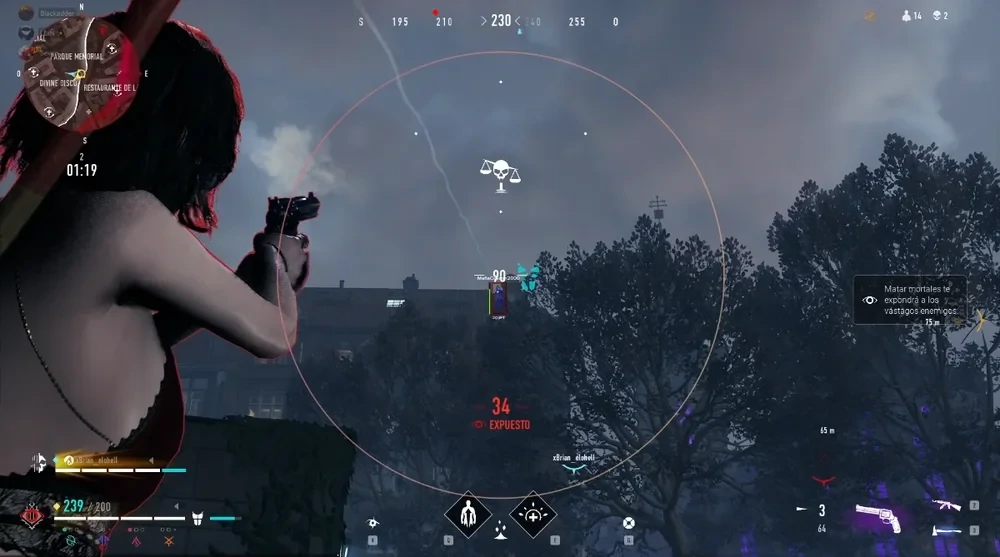
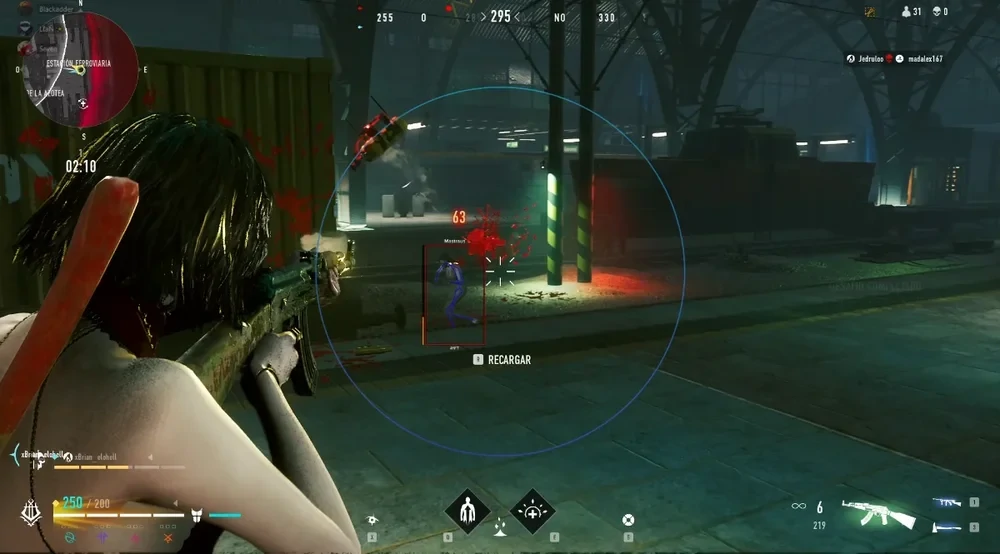
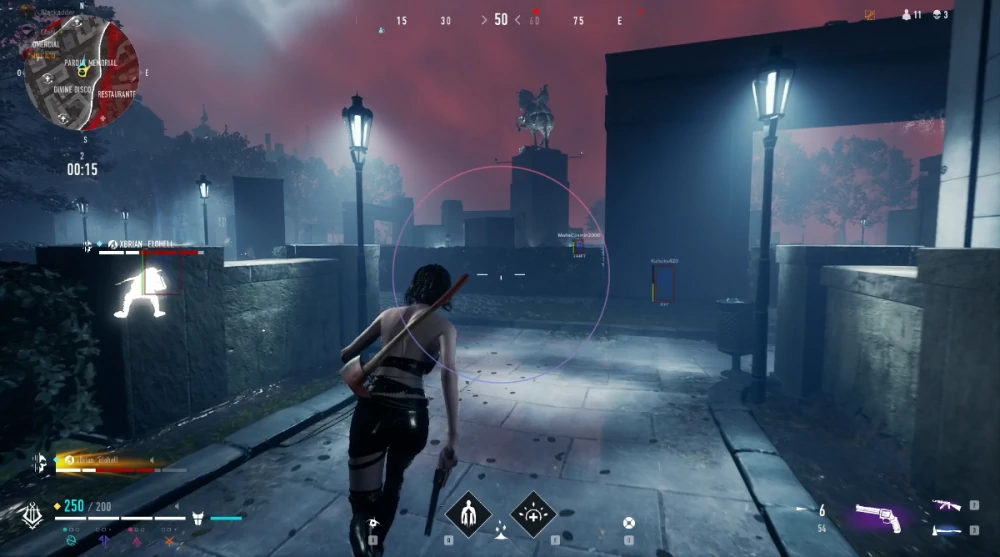
ESP overlays solve the vertical awareness gap by rendering enemy vampires, NPCs, items, and blood resonance data as colored markers visible through all surfaces — including Prague’s multi-story buildings and underground passages — with health bars, distance counters, clan archetype labels, and equipped weapon identifiers updating in real time across the full three-dimensional play space.
The feature that separates Bloodhunt ESP from every other BR application is resonance filtering. Prague’s streets are populated with civilian NPCs carrying visible aura colors — Sanguine pink for health regeneration, Choleric orange for up to fifty percent melee damage bonus, Phlegmatic blue for reduced archetype cooldowns, and Melancholic purple for faster clan ability resets. Stacking three of one type unlocks maximum buffs. Without ESP, identifying resonance colors requires activating Heightened Senses (a cooldown-gated ability) and physically approaching each NPC. With resonance filtering active, every Choleric civilian within render distance lights up through walls, letting you plot a feeding route from the Graveyard to the Harbor without ever activating Heightened Senses or risking a Masquerade violation near the wrong cluster of witnesses.
Bloodhunt ESP Settings — Filtering Blood Resonance Colors
Melee-focused Brujah builds hunting Choleric resonance can filter ESP to highlight only orange-aura NPCs, stripping the visual noise of Sanguine and Phlegmatic civilians from the overlay. A Tremere Scholar stacking Melancholic resonance for faster Levitation resets needs purple-only filtering to locate the comparatively rare Melancholic civilians scattered across specific Prague districts. Entity soldiers — the Second Inquisition NPCs that carry weapons and can be killed without triggering Masquerade — deserve their own ESP layer, because their patrol routes overlap high-traffic feeding zones near the Burning Church and Prince’s Haven where civilian witnesses cluster.
Enemy Clan Identification and Threat Assessment
ESP displaying archetype labels transforms engagement decisions. Spotting a Nosferatu Prowler through a wall means their Scouting Famulus bats are the immediate counter-threat — those bats reveal your position through walls to the Prowler’s entire squad, so the engagement timer is three seconds from bat deployment to full squad awareness. Identifying a Ventrue Warden before the fight starts tells you their Shackles ability will leash your movement to an anchor point if you get within range, dictating a ranged Burst Rifle approach rather than a shotgun push. Seeing a Toreador Muse in the squad means area healing is incoming — focus fire on the Muse first or the squad regenerates through your damage output.
Wallhack Through Prague’s Rooftops and Underground
You’re holding the Sky Bar rooftop with a Burst Rifle, watching the Rudolfinum plaza below. A Nosferatu Saboteur drops a Sewer Bomb behind the stone wall of the Burning Church — invisible from your angle — then activates Vanish and disappears from your screen entirely. Thirty seconds later, your squad rotates through that alley. The gas cloud detonates. Two teammates go down before anyone identifies the source. The Saboteur uncloaks, diablerises both downed players in sequence, and gains four resonance slots and full health. That entire sequence — trap placement, invisibility approach, ambush execution — happens behind geometry that the game’s camera never penetrates.
Wallhack renders all player models visible through solid geometry — walls, floors, rooftops, and terrain — stripping away Prague’s layered architecture to expose vampires hiding behind cover, clinging to vertical surfaces mid-wall-climb, crouching inside buildings, or moving through the underground passages that connect several districts beneath street level.
The interaction between wallhack and Nosferatu clan abilities creates the most game-specific use case in the entire feature set. Vanish grants complete visual invisibility for several seconds — the Nosferatu disappears from screens, from crosshairs, from every visual cue the game provides. Wallhack overrides that mechanic entirely, rendering the “invisible” Nosferatu as a fully visible model moving through walls and surfaces. A Saboteur planting traps behind cover loses the element of surprise. A Prowler flanking through Vanish while Scouting Famulus bats distract the target becomes visible the moment the ability activates. Players running The Finals hacks bypassing EAC will recognize the wall-penetrating overlay, but no other EAC title has a full-invisibility clan ability for wallhack to counter.
Spotting Nosferatu Before They Uncloak
The Nosferatu Saboteur’s passive grants semi-invisibility while crouching and stationary — a weaker version of full Vanish that persists indefinitely. In Prague’s Graveyard district, where tombstones and mausoleum walls create dozens of crouch-height cover positions, a patient Saboteur can sit invisible for an entire match phase waiting for a squad to rotate through. Wallhack transforms the Graveyard from a death trap into a readable map — every crouching Saboteur renders through the stone, their position and facing direction visible before you enter the kill zone.
Tracking Feeding Routes and Diablerie Targets — Bloodhunt Radar
Bloodhunt’s built-in awareness tools are clan-locked and cooldown-gated. Only the Nosferatu Prowler has persistent enemy tracking through Scouting Famulus bats — and that ability reveals enemies to the Prowler’s squad for a limited duration before going on cooldown. Every other clan relies on audio cues, Heightened Senses (which only reveals NPC resonance, not enemy players), and visual line-of-sight across Prague’s obstructed rooftop terrain. The game provides no universal, always-on enemy position data for any archetype.
A radar hack overlays a real-time minimap showing all player positions, movement directions, and distances — replacing Bloodhunt’s limited compass with a comprehensive tactical display that tracks enemies across Prague’s vertical layers regardless of which clan you chose.
Feeding Route Optimization and Third-Party Timing
Radar unlocks a tactical layer that connects directly to Bloodhunt’s blood resonance economy. Enemy players follow predictable feeding routes — Choleric NPCs cluster near Entity soldier camps around the Harbor and Prince’s Haven, so melee-focused Brujah squads gravitate toward those districts in the first three minutes. Radar reveals those movement patterns in real time, letting you either avoid the feeding zones entirely or position for a third-party attack the moment the feeding squad triggers a Masquerade violation near civilian witnesses. The Masquerade outline that punishes them becomes a free target marker for your squad.
The diablerie timing application is Bloodhunt’s most radar-specific use case. When a player diablerises a downed vampire, the animation locks them in place for over three seconds — no movement, no ability activation, no cancellation. Radar tracking two squads fighting on the Construction rooftop shows the moment one squad wins and the surviving players begin diablerie animations. Your squad rotates from the Graveyard, arriving as the animations end. The squad that just won a fight — abilities on cooldown, ammo depleted, mid-diablerie — faces a fresh team before they can loot a single weapon. Current radar availability and detection status for Bloodhunt are tracked on the status and feature page.
How EAC Detects Bloodhunt Cheats — From Tencent ACE to Ban Katana
Bloodhunt runs Easy Anti-Cheat at kernel level, loading a Ring 0 driver before the game executable initializes. The driver monitors the process memory space for unauthorized reads and writes, scans loaded modules against a server-side signature database that updates independently of game patches, and flags statistical anomalies in aim patterns and movement velocity that suggest automated input rather than human control.
The generic description above applies to every EAC-protected title. What makes Bloodhunt’s anti-cheat history unique is the system it replaced and the reason the switch happened.
From ACE Kernel Drivers to EAC — Why Sharkmob Switched
During Bloodhunt’s Early Access period, the game used Tencent’s proprietary Anti-Cheat Expert (ACE) system. ACE deployed three services on every player’s machine: a user-mode component called “Expert Anti Cheat,” plus two kernel-level drivers — ACE-BASE and ACE-GAME. A community member discovered that ACE continued running for up to ninety seconds after closing Bloodhunt and persisted through game uninstallation, remaining active on the system with no game running. Sharkmob classified both behaviors as implementation bugs rather than intentional telemetry, patched the persistence issues, and no actual spyware functionality was identified in the drivers. The damage to community trust, however, was immediate. Sharkmob announced the switch to EAC for Bloodhunt’s full launch, citing direct community feedback as the primary motivation.
Ban Katana Waves and Statistical Anomaly Detection
Sharkmob layered proprietary detection systems on top of EAC’s base protection. A dedicated anti-cheat team reviewed manual reports around the clock. A statistical anomaly engine flagged accounts exhibiting what Sharkmob described as “impossible values and patterns” — aim deviation rates below human thresholds, headshot consistency during aerial engagements where manual tracking is hardest, and movement velocity anomalies during wall-climb transitions. The system operated on a delayed enforcement model rather than real-time bans — aggregating match data across weeks, then dropping periodic “Ban Katana” waves that retroactively flagged accounts exceeding statistical thresholds. Over the game’s lifespan, Sharkmob reported banning approximately eleven thousand accounts total, with roughly seventy-five hundred processed through manual review and the remainder caught by automated detection.
The compounding problem that the anti-cheat team openly acknowledged is mathematical. As the player base contracted, the density of cheaters per lobby increased even as absolute cheater numbers decreased. A forty-five-player lobby drawing from a pool of ten thousand concurrent players produces different odds than one drawing from three hundred. The Dead by Daylight cheats on EAC ecosystem faces a similar concentration dynamic in smaller server regions — but Bloodhunt experienced it globally, across every queue, every mode.
Undetected Bloodhunt Hacks — What the Status Page Actually Tracks
You load Bloodhunt. EAC’s kernel driver initializes before the main menu renders, scanning every loaded module against the current signature database. A cheat that operated cleanly yesterday triggers a detection flag today because EAC pushed a silent signature update overnight — no game patch, no client download, just a server-side database refresh that reclassified a previously unknown DLL hash as a known threat. The Ban Katana system doesn’t act immediately. The flag enters the statistical pipeline. Two weeks later, the ban wave drops. By then, you’ve played forty matches on a flagged account without knowing it.
An undetected cheat operates below EAC’s detection threshold by avoiding known signature patterns, randomizing memory access timing to evade behavioral heuristics, and mimicking legitimate process behavior — confirmed not by a one-time bypass but through continuous monitoring against EAC’s evolving detection database via a live status page that tracks the current detection state in real time.
HWID Spoofer Protection for EAC Hardware Bans
EAC’s hardware fingerprinting in Bloodhunt captures drive serial numbers, motherboard identifiers, MAC addresses, and BIOS UUIDs, building a composite device profile that persists through account creation and operating system reinstalls. A hardware ban in Bloodhunt doesn’t target the account — it targets the machine. Creating a new free-to-play account on the same hardware triggers an immediate re-ban because the device fingerprint matches the flagged profile. HWID spoofing generates randomized hardware identifiers that EAC reads as a clean machine, decoupling the physical hardware from the banned fingerprint and allowing new account creation without triggering the device-level block. Because Bloodhunt is free-to-play, account replacement carries zero cost — but without HWID spoofing, the replacement account inherits the hardware ban before the first match loads.
Stream Proof for Bloodhunt Content Creators
Bloodhunt’s visual identity — the dark Prague skyline, the blood resonance aura colors, the red Masquerade violation outlines — makes any cheat overlay immediately conspicuous on a broadcast. Stream proof rendering routes the overlay to a display layer that OBS and similar capture software cannot access, keeping ESP markers and aimbot indicators invisible to viewers while remaining fully visible on the player’s primary monitor. The game’s distinctive visual palette means generic “hide overlay” solutions that work in muted-color military shooters need calibration for Bloodhunt’s saturated reds and blues.
DMA hardware offers an alternative detection-avoidance path for players prioritizing ESP and radar over aimbot. A DMA card installed in a second PC reads Bloodhunt’s memory externally via PCIe, rendering player positions, resonance data, and item locations on the second machine’s monitor. Because the read operation never touches the game process on the primary PC, EAC’s driver-level scanning has no injected module or modified memory page to detect. The trade-off is functional: DMA provides read-only data — ESP, radar, item tracking — but cannot inject aimbot or no recoil inputs into the game client.
Bloodhunt launches through Steam with EAC initializing automatically during the loading sequence — no separate anti-cheat launcher or manual EAC install required. Verify the status page before each session to confirm the current detection state. If EAC throws a “Failed to Initialize Game Launcher” error — a known Bloodhunt-specific issue — revalidating game files through Steam’s properties menu resolves it without reinstallation.
Bloodhunt Cheats — Frequently Asked Questions
Does aimbot track targets during Soaring Leap and wall-climb aerial transitions, or only on flat ground?
Aimbot tracks targets through full three-dimensional movement — including vertical wall-climbs, Soaring Leap parabolic arcs, and Toreador Projection teleport repositions. The lock follows the target model through elevation changes, surface transitions, and mid-air ADS windows. Bloodhunt’s combat rarely happens on flat ground, so tracking operates across the vertical axis as a baseline rather than an exception. Aim bone selection and FOV settings apply identically whether the target is on a rooftop, mid-climb, or falling from the Sky Bar.
Can ESP filter blood resonance colors to show only Choleric NPCs for melee builds?
ESP includes resonance filtering that highlights specific NPC aura types independently. Setting the filter to Choleric-only strips Sanguine, Phlegmatic, and Melancholic civilians from the overlay, leaving only the orange-aura NPCs that grant melee damage bonuses up to fifty percent when stacked to three. This lets Brujah melee builds plot feeding routes across Prague without visual clutter from hundreds of irrelevant NPCs. The filter applies to Entity soldier tracking separately, so Second Inquisition patrols near Prince’s Haven and the Harbor remain visible regardless of resonance settings.
Does wallhack reveal Nosferatu players during Vanish invisibility?
Wallhack renders all player models regardless of in-game visibility state. A Nosferatu activating Vanish disappears from normal visual detection but remains fully visible through walls and surfaces with wallhack active. This applies to both full Vanish (the clan ability with limited duration) and the Saboteur’s passive semi-invisibility while crouching. Sewer Bomb traps placed behind cover also become visible through geometry, eliminating the ambush potential that defines the Saboteur archetype in standard play.
Will Bloodhunt’s EAC ban my hardware ID if I get detected, or just the account?
EAC in Bloodhunt issues both account bans and hardware ID bans. The hardware fingerprint captures drive serial numbers, motherboard identifiers, MAC addresses, and BIOS UUIDs. Because Bloodhunt is free-to-play, account bans alone would be meaningless — a new account takes seconds to create. The HWID ban prevents the flagged machine from running any Bloodhunt account, making hardware spoofing necessary before creating a replacement. The status page tracks current detection states so you can verify safety before each session.
Do hacks work in Team Deathmatch or only Battle Royale modes?
All features operate across every Bloodhunt mode — Solo, Duos, and Trios Battle Royale plus Team Deathmatch on all seven sub-maps (Slaughterhouse, Disco, Hotel, Construction, Harbor, Rudolfinum, and Railway Station). TDM runs eight-versus-eight with respawns on smaller map sections carved from Prague, so ESP render distances and radar scale adjust automatically to the reduced play area. Blood resonance NPCs do not spawn in TDM arenas, so resonance filtering is relevant only in BR modes.
That Masquerade violation doesn’t have to outline your squad through every wall in Prague. Every feature above — from aimbot that tracks Brujah mid-Soaring-Leap to ESP filtering Choleric resonance through five vertical stories — runs beneath EAC’s kernel driver with real-time status monitoring and HWID protection against hardware bans.
-
-
Total Members 5,011
-
Most Online 39
-
Newest Member xjaevinx_22790

-
-
Reviews
-

By Discord Review · Posted
+rep @admin really fast support and noce cutom service the delivery speed was fast he helped me with the settings you need to change an do and that in 10 min thats crazy. -

-

By 3ttuu · Posted
My firmware is working perfectly thanks to the kind explanations and help from the Burger Cheat admin. They were always very friendly and responded quickly to customers. If you're considering a purchase, I highly recommend it -
By Discord Review · Posted
+REP. The response was fast, the explanations were kind, and they answered my questions sincerely and thoroughly. It was excellent. -

-