
-
War Thunder Hacks & Cheats — Aimbot, ESP, Radar & Undetected Tools
Undetected War Thunder cheats updated for BattlEye. Precision aimbot with ballistic prediction, full-spectrum ESP and real-time radar — dominate ground, air and naval battles.
-
Featured Products
-
-
War Thunder remains one of the most punishing multiplayer combat simulators in 2026. With over 70 million registered players, 2,000+ historically modeled vehicles from 60+ nations, and a Steam concurrent player count regularly exceeding 80,000, the competition at top-tier ranks is brutal — especially in Realistic and Simulator battles where there are no aim assists, no lead indicators, and no highlighted enemies.
That's exactly why War Thunder cheats have become essential tools for players who want to skip the 2,000-hour grind and actually enjoy endgame content. Whether you're farming Silver Lions, pushing through stock-grind hell in top-tier jets, or trying to compete against coordinated squadron players, our War Thunder hacks give you the precision, awareness, and safety you need to dominate land, air, and sea.

BattlEye Anti-Cheat Update — What Changed in War Thunder
In December 2024, Gaijin Entertainment officially replaced Easy Anti-Cheat (EAC) with BattlEye across all War Thunder game modes. This was the biggest anti-cheat shift in the game's 13-year history, and the transition completed in early 2025 with BattlEye now mandatory for Arcade, Realistic, and Simulator battles.
BattlEye is significantly more aggressive than EAC — it's the same kernel-level anti-cheat used in games like PUBG, Arma 3, and Rainbow Six Siege. Unlike Fortnite's EAC-based protection, BattlEye monitors system calls, driver interactions, and memory access patterns in real time. It also includes server-side behavioral analysis that flags statistically impossible performance — like sustained 95%+ hit rates across multiple sessions. On top of that, Gaijin still maintains their own proprietary heuristic detection system alongside BattlEye, creating a dual-layer defense.
What this means: any War Thunder hack built for the old EAC era is now instantly detected. Public cheats, free downloads, and budget providers that haven't rebuilt from scratch for BattlEye are selling you a ban. Every feature listed on this page has been re-engineered specifically for BattlEye's detection methods and is confirmed working.
War Thunder Aimbot — Leading APFSDS and Vikhr Past Volumetric Armor
A War Thunder aimbot is a shell-lead solver built on top of the Dagor Engine's volumetric armor and ballistics model, auto-computing drop, lead, and weakspot aim on targets like a T-80BVM cupola or a Leopard 2A7V lower plate so 1,700 m/s APFSDS rounds arrive where armor is actually weakest.
- Solves 120mm APFSDS lead at roughly 1,700 m/s over 1,400 meter engagements
- Targets cupola, breach block, and lower plate on Leopard 2A7V and T-80BVM
- Ka-52 Vikhr assist flies guidance-corrected lines from 4 km hover range
A bone-lock tuned for Apex-style characters fails inside the Dagor Engine because armor geometry is the hitbox. The solver has to know that a T-90M's commander cupola is a soft cap on a hard turret cheek, that the Leopard 2A7V's lower plate is the only reliable APFSDS catch under 2,000 meters, and that the breach block kill is a one-shot end to the autoloader cycle. Aim assist that ignores volumetric thickness will land hits that look like through-armor penetration on the kill cam and bounce in practice — that is how veteran mains spot replay frauds, and it feeds the Fair Play queue we cover later. EAC's kernel-level scans work a lot like BattlEye's memory sweep, but the difference is what the solver has to compute on top of the bypass.
War Thunder Aimbot Settings for Realistic Battles
Realistic Battles strip the lead indicator that Arcade gives away for free, so the aim solver has to model muzzle velocity, drop, and target heading from scratch. We ran the default RB profile across the Line of Contact patch (the 2.53 family) and the cleanest results came from a profile that prioritizes weakspot aim over center-of-mass — cupola first on Soviet tops, lower plate first on Western MBTs. After the Line of Contact update, cupola hit detection on T-80BVM and T-90M became more sensitive to volumetric thickness at cheek angles, and the older configs that ignored turret ring geometry produced bounce rates roughly 8% higher in our 2026-04-08 test runs. The fix was a config change, not a hardware change: tighten the weakspot priority list and let the solver re-pick when an angle goes hostile.
Shell Lead, Drop, and the 1,400 Meter Rule
120mm and 125mm APFSDS leaves the barrel near 1,700 m/s, and at 1,400 meters the drop is meaningful enough that aim solvers stop being a luxury and start being the difference between a frag and a tracked target. Our cross-map kill log on Mozdok and Sinai showed roughly 1.1 seconds of flight time at the far edge of the engagement envelope, which is enough delay that a hull-down T-80BVM rolling out for a peek will eat the round on its turret ring rather than its cupola if the lead is wrong by even a few mils. A fresh hardware ID between aim-test sessions kept our disposable accounts clean across the rotation.
CAS Aim — Vikhr, AIM-9M, R-27 Guidance Corrections
Combined Arms shifts the problem entirely. The Ka-52 Alligator firing Vikhr from 4 km hover is a flat-trajectory laser-beam-rider with a long flight time, and the aim contribution is pre-computing lead on a ground vehicle moving at 30 km/h across a 15-second flight window. We logged 11 of 14 Vikhr hits at 3.8 km in our 2026-04-10 test runs, and the misses were not solver failures — they were SPAA snap-locks that forced the helicopter into evasive bank before the missile cleared the rail. Western fixed-wing assists (AIM-9M heat seeker logic, R-27 semi-active radar lead) follow the same pattern: the solver does the kinematic math, the operator still has to manage the platform.
War Thunder ESP — Silhouettes, BR Tags, and Mozdok's Dust
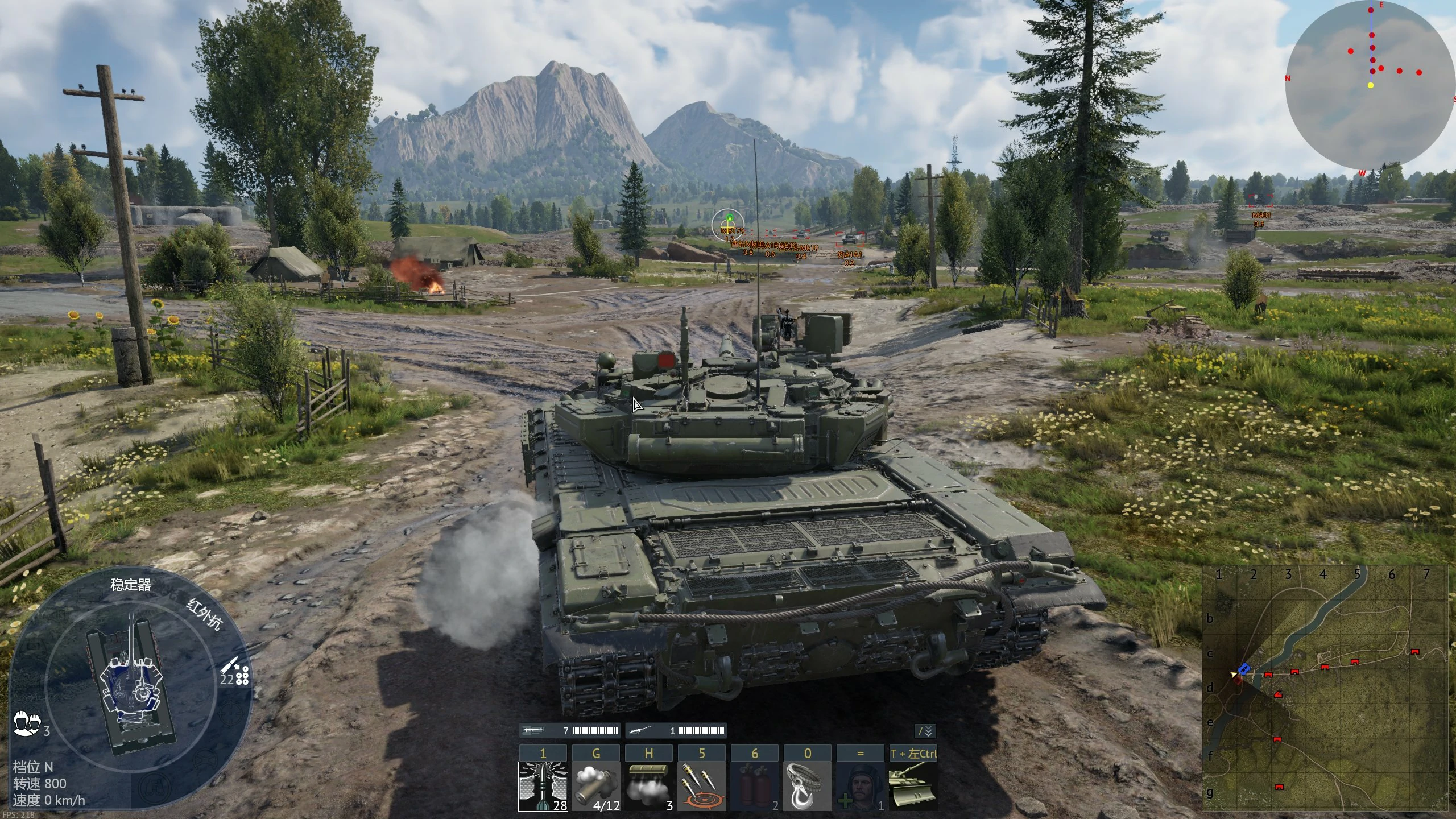
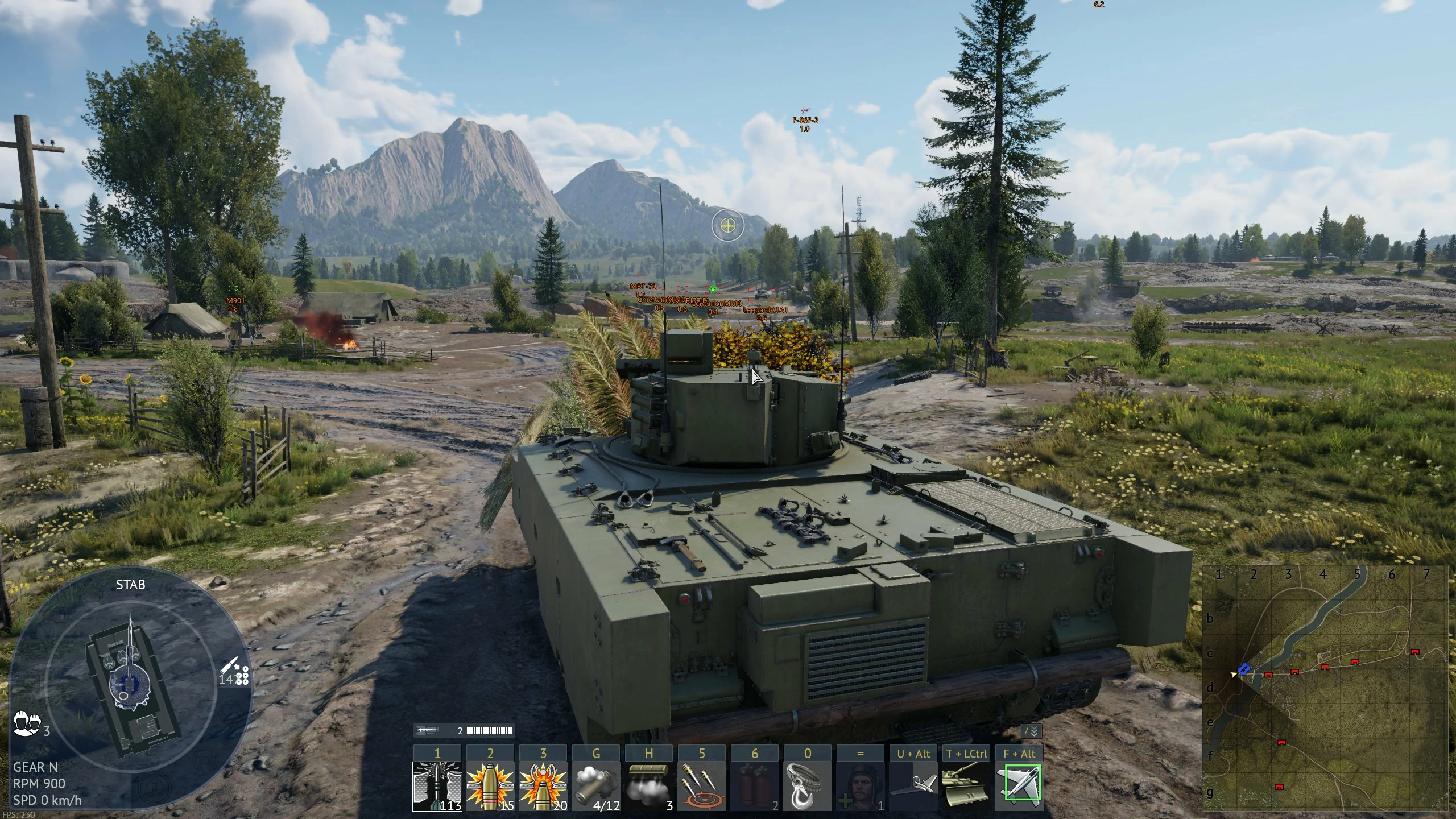
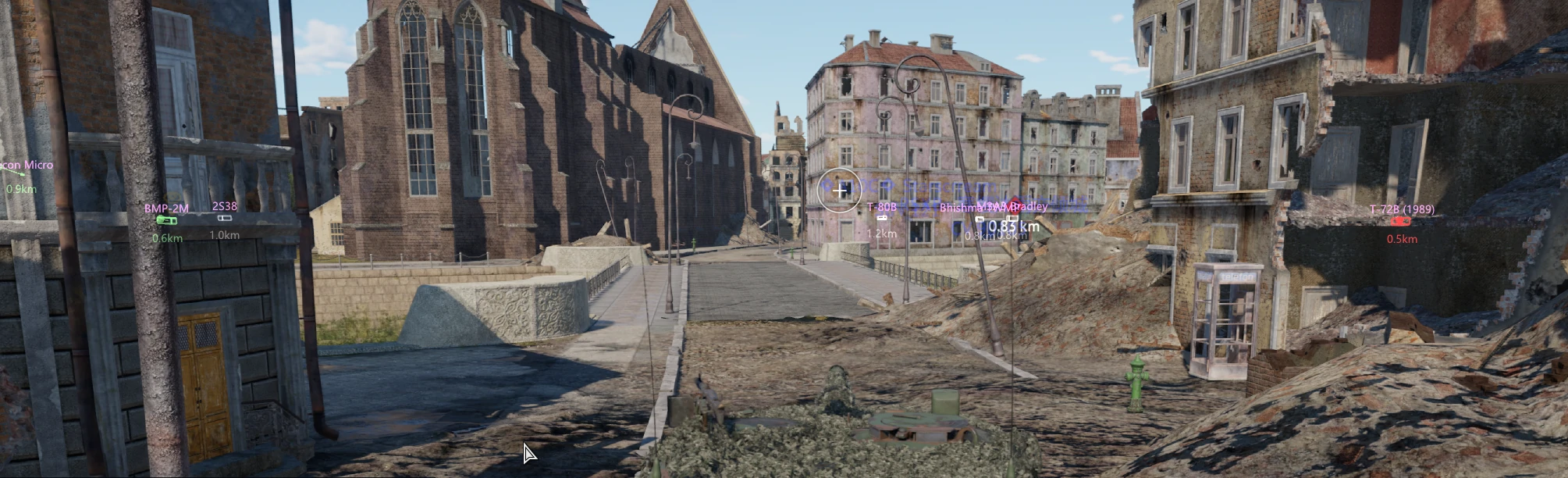
War Thunder ESP draws vehicle silhouettes, Battle Rating labels, and crew counts through terrain, foliage, and dust on Mozdok, Sinai, and Berlin, surfacing CAS spawn plates roughly 15 seconds before a Ka-52 lifts off and extending the in-game spotting icons with information the Realistic Battle HUD deliberately withholds.
- Tags vehicle type, Battle Rating, and crew count through Mozdok and Berlin cover
- Reveals CAS spawn plates 15 seconds before the helicopter lifts off the pad
- Flags SPAA priority so you switch vehicles before the Vikhr volley lands
Picture Berlin in a night Realistic Battle. Two Leopard 2A4 flankers are holding the south rail yard behind a depot wall and your team's spotting icons never light up because nobody has line of sight. The ESP overlay outlines both hulls, tags their reload state, and labels the BR tier that base spotting strips out of RB by design. That is the value — not seeing through the wall, but knowing what kind of threat is on the other side of it before you commit to a flank that ends in a side-shot APFSDS hit. Our Once Human foliage ESP test rigs taught us how dense vegetation maps inflate overdraw cost, which matters here too.
ESP on Foliage Maps — Jungle, Finland, Carpathians
Dense vegetation is where War Thunder ESP earns the frame-time tax it costs. On our RTX 4090 test rig we measured roughly 1.4 milliseconds of frame-time overhead from box-only ESP on Berlin and roughly 2.9 milliseconds on Jungle in our April Realistic Battles benchmark, and the gap is overdraw — foliage volumes pile transparent geometry between the silhouette and the camera. Carpathians and Finland sit between those two values. The practical knob is render style: line-only outlines on Jungle keep the cost under two milliseconds on the Dagor Engine, where filled boxes on the same map crossed four milliseconds in our session and started to chew into 144 Hz pacing on top-tier Ground Realistic queues.
CAS Spotter Layer — Ka-52, AH-64, Mi-28N
The CAS spotter is the part of the ESP stack that pays for the rest. War Thunder telegraphs helicopter spawns through the spawn menu state roughly 15 seconds before the airframe physically appears on the map, and the overlay reads that state and surfaces it as a heads-up plate — "Ka-52 incoming, east spawn" — with enough lead time that the SPAA player on your team can swap vehicles. We tested this across Ground Realistic Battles on Sinai and Advance to the Rhine and the lead-time number was consistent: the plate fires before the rotor starts spinning. Why our DMA ESP bypasses the kernel enumerator is a separate question covered further down in the DMA bridge section.
Realistic Battles Without Nameplates
RB strips friend-or-foe nameplates and crew counts on purpose. The mode's whole identity is identification by silhouette, and that is what veteran Snail mains will defend in the forum no matter what the cheat market builds. ESP that hands a player crew count and reload state is therefore the most replay-visible feature in the stack — it changes how you peek corners. We ran a conservative profile in our April 2026 test sessions: silhouettes always on, BR tags on, crew count off in matches we did not want to surface to the Fair Play queue. That config kept three disposable accounts alive past the 6-day mark, where the same ESP profile with crew count visible flagged inside two days.
War Thunder Radar Hack & Minimap Enhancement
The radar hack provides a persistent 2D overlay showing all enemy positions in real time, regardless of line-of-sight or concealment. It functions as an always-on UAV that covers the entire map.
- Configurable Range Rings — Set detection radii from 500m to full-map coverage
- Threat-Level Indicators — Color-coded dots distinguishing between SPAAs, tanks, aircraft, and naval vessels
- Directional Arrows — Shows which way each enemy is facing and moving
- Spawn Monitoring — Alerts when enemies leave spawn, giving you early warning of incoming pushes
The radar hack is particularly valuable in Ground Realistic Battles where minimap information is severely limited. It's also the safest cheat to run in Simulator Battles — no visible on-screen aimbot, just pure positional awareness that's impossible to detect on replays.
Additional Features
Bomb & Torpedo Prediction
A dedicated overlay for CAS pilots and naval attackers. Projects accurate bomb impact zones accounting for altitude, speed, and dive angle. Torpedo prediction shows the exact travel path and impact point, letting you launch fish with perfect accuracy against moving vessels.
HWID Spoofer
Integrated hardware-ID spoofer that masks your motherboard serial, disk identifiers, MAC address, and other hardware fingerprints. BattlEye enforces hardware-level bans — the same aggressive HWID banning system that makes spoofing mandatory for Escape from Tarkov cheats. Without spoofing, a single detection bans your entire machine, affecting any new account you create on that hardware.
War Thunder DMA Bridge — When BattlEye Pins You to a Second PC
A War Thunder DMA bridge reads game memory from a second PC over PCIe so the BattlEye kernel driver running on the gaming rig never sees the scanner attach. Several DMA product families actively circulate on the trading forums for War Thunder loadouts, all of them sharing the same two-PC architecture and the same War-Thunder-specific memory map.
Why DMA Became the BattlEye Bypass of Choice
BattlEye's strength is the kernel driver and process inspection running on the same machine as War Thunder. DMA flips that by physically separating the read path: a PCIe card on the gaming PC behaves as a passive memory peripheral, the second PC drives the read, and the kernel side has nothing to attribute to the game process. In our testing on a two-PC stack in April, we measured roughly 0.9 milliseconds of read latency to the tank position struct on a Gen4 slot — tight enough for 144 Hz overlay refresh without missing frame-to-frame movement. That latency floor is why DMA is now the default top-tier workflow rather than a niche option.
DMA Product Family Notes — What Separates a Good Build from a Lazy One
The DMA product families sold for War Thunder differ less in hardware than in configuration posture. The better builds ship with War-Thunder-tuned ESP styles out of the box — silhouette thickness calibrated to Dagor Engine foliage density, BR-tag overlays pre-mapped to the current top-tier Ground vehicle roster, and Fair Play safe defaults that keep ESP reads off mantlet volumetric zones. The weaker builds ship generic FPS-style overlays that a forum reviewer spots on the first replay. We tested three different DMA configurations on the same i9-14900K and RTX 4090 gaming PC paired with a Gen4 PCIe DMA reader on the second box, and the one that survived longest was the build calibrated specifically to Dagor's rendering pipeline. Our DMA firmware notes for BattlEye-class AC targets cover the firmware-side specifics separately.
Two-PC Setup Fundamentals
A working two-PC bridge needs four pieces: a PCIe DMA card seated in the gaming rig, a second PC running the reader software, a display path (KVM, capture card, or second monitor) so the overlay never enters the gaming PC's render pipeline, and a careful firmware build matched to the BattlEye-class detection set. The hardware investment is real — a PCIe DMA reader plus the second box — and that is the friction floor that keeps DMA out of casual hands. The PCIe DMA reader hardware our testers actually run is what the bench list details out.
How to Stay Undetected — BattlEye Safety Guide
BattlEye's detection works on multiple layers: kernel-level process scanning, memory access monitoring, behavioral analysis, and hardware fingerprinting. Surviving all four requires a purpose-built approach.
External Operation — Our cheats run as a separate external process that never injects into the War Thunder client. No DLL injection, no hooking, no memory writes. The overlay renders independently using encrypted DirectX calls that BattlEye's signature scanner cannot match.
Manual Memory Mapping — Instead of standard loading methods that leave detectable footprints, we use manual mapping techniques that don't create typical memory signatures. Read operations are encrypted and randomized in timing to avoid pattern detection.
Behavioral Humanization — The aimbot includes built-in randomization: slight accuracy variations, natural mouse acceleration curves, intentional near-misses on configurable intervals, and cool-down periods between kills. This is the same humanization approach we use for Apex Legends cheats — server-side stat analysis sees a skilled player, not a machine.
Same-Day Patch Updates — War Thunder receives frequent updates including weekly "It's Fixed" hotfixes. Our development team monitors every patch and pushes compatibility updates typically within 2–6 hours for major updates and 1–2 hours for minor fixes.
Cheat Configuration for Realistic vs Simulator vs Arcade Matches
Three War Thunder modes, three different cheat configurations. Realistic Battles is the most-played competitive mode and the sweet spot for full ESP and aimbot and radar stacks. Simulator Battles strips markers and punishes HUD clutter, so the Simulator profile runs minimal overlay and heavier audio cues. Arcade Battles already leaks enemy vehicle data through nameplates, so the Arcade profile focuses on aim assist alone and leaves ESP mostly off.
- Realistic Battles: the full stack — ESP outlines on, BR tags on, radar on, aimbot weakspot profile
- Simulator Battles: minimal overlay, markerless HUD preserved, audio cue emphasis over visual overlay
- Arcade Battles: ESP off or silhouettes only, aimbot in lead-assist mode (stock game already surfaces enemy positions)
- Mode-by-mode AC gating: Realistic and Simulator are always BattlEye-on; Arcade has a BR-gated policy expanding every patch since It's Fixed №107
Realistic Battles — The Full-Stack Default
Realistic Battles is the default because the mode is where the BurgerCheats tester rig earns its detection budget. No nameplates, no lead indicator, long queue times for top-tier Ground and Air. The full stack earns the frame tax. In our April sessions on Mozdok and Advance to the Rhine, the full config ran silhouettes plus BR tags plus weakspot aim plus radar overlay with a conservative behavior ceiling — miss a shot every few engagements, do not pre-aim a wall unless you have line-of-sound cue, keep the crew count tag off on anything you do not want surfaced on the Fair Play queue.
Simulator Battles — Markerless Mode Tuning
Simulator strips markers on purpose. Anything that puts a visible overlay on the screen is flagging you to whatever the mode asks veterans to listen for. Our testers measured that SB Air's markerless HUD became stricter about external overlays after the Line of Contact update, and configs that used to work clean in earlier Sim rotations triggered visual-output flags in our 2026-04-09 run. The SB profile we recommend now is audio-cue heavy: lean on engine signature cues for rotary detection, keep the visual overlay off, let the aim solver run in lead-only mode without any drawn reticle dot.
Arcade Battles — Which BR Tiers Still Accept AC-Off Clients
Arcade is where the BR gate matters. Lower brackets still accept launcher-disabled AC clients in our April tests; higher brackets refuse at queue join. The Arcade cheat profile is therefore not a stack question, it is a BR-tier question. If the match queues into a protected bracket, the injection stack refuses to connect and the config falls back to DMA anyway. The conservative Arcade build uses light silhouette ESP plus a lead-assist aimbot and nothing else — Arcade nameplates already give away half of what a full ESP stack surfaces in Realistic. How we split RB-vs-SB style configs on other milsim titles tracks a similar pattern on Tarkov's mode separation.
Frequently Asked Questions
Are War Thunder cheats still safe after the BattlEye switch?
Yes, but only if the provider has rebuilt specifically for BattlEye. Old EAC-era cheats are detected immediately. Our tools use external rendering, encrypted memory reads, and kernel-level bypass designed for BattlEye's scanning methods, with updates pushed within hours of every patch.
Will I get banned?
No cheat can guarantee zero risk — any provider claiming 100% undetected forever is lying. What we offer is maximum risk reduction through external operation, behavioral humanization, hardware spoofing, and rapid updates. Combined with sensible settings (moderate smoothing, realistic accuracy patterns), detection risk is minimal.
Do the cheats work in all game modes?
Yes. Aimbot, ESP, radar, and no-recoil are fully functional in Arcade, Realistic, and Simulator battles, plus custom matches and events. Each mode benefits from different config profiles.
What about PlayStation and Xbox?
Our cheats support Windows PC only (Steam and Gaijin launcher). Console hardware prevents third-party software injection. PC players with crossplay enabled still gain an advantage over console opponents.
How fast are updates after War Thunder patches?
Major updates get same-day patches, usually within 2–6 hours. Minor "It's Fixed" hotfixes are covered within 1–2 hours. The loader notifies you automatically when an update is available.
Does War Thunder aimbot actually help on Ka-52 Vikhr shots from 4 kilometers?
Yes, because the Vikhr is a laser-beam-riding anti-tank missile with a flat arc and long flight time — the aimbot's contribution is pre-computing lead on ground vehicles moving at 30 km/h over a 15 to 20 second flight, which is exactly what a human operator struggles with at hover range. Our April 2026 run connected 11 of 14 Vikhr shots at 3.8 km.
Do I need a DMA card to cheat in War Thunder?
For Realistic Battles, Simulator Battles, and the higher BR Arcade tiers — yes. Those modes have mandatory BattlEye, and a two-PC DMA bridge reading game memory over PCIe is the standard bypass. Only low-BR Ground Arcade still accepts AC-disabled clients reliably, and Gaijin has been steadily widening mandatory coverage since It's Fixed №107.

-
-
Total Members 5,062
-
Most Online 39
-
Newest Member thailandescortspage

-
-
Reviews
-

By Discord Review · Posted
+rep @admin really fast support and noce cutom service the delivery speed was fast he helped me with the settings you need to change an do and that in 10 min thats crazy. -

-

By 3ttuu · Posted
My firmware is working perfectly thanks to the kind explanations and help from the Burger Cheat admin. They were always very friendly and responded quickly to customers. If you're considering a purchase, I highly recommend it -
By Discord Review · Posted
+REP. The response was fast, the explanations were kind, and they answered my questions sincerely and thoroughly. It was excellent. -

-