
-
Apex Legends Cheats — Aimbot, ESP, Wallhack & DMA Hacks
Undetected Hacks for APEX : Breach. Updated within hours of every patch. Aimbot, ESP, triggerbot, radar, and DMA hardware
-
Featured Products
-
Season 28 Just Broke Every Building in the Game — and the Meta Broke With It
Respawn put destructible windows in every building across World's Edge, Broken Moon, and E-District. They called it Hardlight Mesh. The community is calling it the biggest mechanical shift since the removal of tap-strafing. Every structure that used to be a safe box now has purple-tinted windows that block bullets and movement — until someone breaks them. Shotguns shred Hardlight at 2.5x damage. Snipers crack it at 3.5x. Explosives obliterate it at 8.5x. And Fuse, who just received the most aggressive legend rework in Apex history, can detonate his new Motherlode through an entire floor of Hardlight panels and push through the wreckage with Knuckle Jumper before defenders reposition. Meanwhile, Controller legends like Catalyst and Wattson can rebuild shattered Hardlight to 1,250 HP — over six times its base strength. Season 28: Breach didn't just change the meta. It split the game into two roles that never existed before: breakers and builders.
This landed on top of a game that was already the most mechanically demanding BR on the market. Apex doesn't just test aim — it tests whether you can slide-jump around a corner, wall-bounce off a building, land a Wingman headshot mid-air, and grapple to a new angle before your opponent finishes their reload animation. That movement system is why Fortnite players, Rust veterans, and even CS2 grinders describe Apex as a different kind of hard. And now Hardlight adds a layer of environmental destruction and timing on top of everything that already existed. The EVA-8 got Double Tap back. The Peacekeeper accepts Disruptor Rounds. The Mastiff received Dual Shell. Marksman rifles were nerfed across the board and the G7 Scout moved to the Care Package. Season 28's message is clear: close-quarters combat is king, and if you're not breaking through walls or defending them, you're already behind.
The numbers confirm that Apex isn't slowing down despite being seven years old. Over 130 million cumulative players since launch. Cross-platform concurrent counts between 600,000 and 700,000 daily in early 2026. Steam peaked at 205,321 on February 11 — the day after Breach dropped. The ALGS Year 6 circuit is running a $7 million prize pool across 2026, with peak tournament viewership exceeding 540,000 concurrent. Lifetime revenue sits above $3.4 billion in net bookings. And Respawn's 2026 roadmap, published just yesterday, promises two new legends, a major World's Edge competitive update, and a continued crackdown on cheating — including two new Wildcard events per season starting in Season 30. The game isn't dying. The skill ceiling is just climbing faster than most players can follow.

How EAC and Respawn's Layered Anti-Cheat Actually Works
Apex Legends runs Easy Anti-Cheat at the kernel level, meaning EAC loads a driver before the game starts and monitors system memory, running processes, driver integrity, and file modifications in real time. But EAC alone isn't the full picture. Respawn has built multiple proprietary detection layers on top of EAC that operate server-side, analyzing gameplay data across millions of matches to identify statistical anomalies. This layered approach — kernel-level client monitoring combined with server-side behavioral analytics — is what makes Apex's anti-cheat more complex than what most players assume. Compared to Valorant's Vanguard, which relies heavily on always-on kernel monitoring, Apex's system distributes detection across both client and server, making it harder to bypass with any single technique.
The numbers are staggering. Respawn has banned over 6 million accounts since launch, with an average exceeding 100,000 bans per month. In Season 23, Respawn banned all Linux devices from Apex entirely, producing an immediate drop in match infection rate. That decision was controversial — Linux represents only about 3% of Steam users — but Respawn's data showed that a disproportionate number of cheat tools were operating through Linux-based environments to avoid kernel-level detection. The June 2025 anti-cheat update revealed that ban waves now target specific categories: automated detection systems handle known cheat signatures, a newer behavioral analysis system launched in Season 23 flags players based on gameplay indicators like impossible gamesense and anti-recoil patterns, and a dedicated teaming/botting detection model has reduced Reports Per User by 62% for teaming and 58% for botting year-over-year from 2024 to 2025.
HWID (Hardware ID) bans represent Respawn's most aggressive enforcement layer. When an account is flagged and banned, EAC creates a hardware fingerprint from the player's CPU, GPU, motherboard, storage drives, and network interfaces. If the system detects repeated violations from the same hardware — even with new accounts, new emails, and different IPs — it issues a hardware-level ban that blocks the entire machine from running Apex. The only ways around an HWID ban are a full hardware swap or an HWID spoofer that changes the identifiers EAC reads. Respawn has also expanded its anti-cheat team with 24/7 monitoring and dedicated staff in Asia-Pacific, where cheating activity has historically been most concentrated. The 2026 roadmap explicitly names anti-cheat as a top priority, with ongoing updates to EAC client-integrity checks designed to detect manipulated game clients before cheaters even enter a match.
APEX Aimbot — Configured for the Season 28 Weapon Meta
Season 28 shifted the weapon meta hard toward close-quarters combat. The EVA-8 got Double Tap Trigger back, producing devastating burst damage at close range. The Mastiff received the Dual Shell hop-up for faster reloads. The Peacekeeper now accepts Disruptor Rounds, which shred shields before pellet damage kicks in. Meanwhile, marksman rifles got nerfed across the board — the G7 Scout, the second most popular weapon by kills in Season 27, moved to the Care Package. The Bocek Bow, 30-30 Repeater, and Triple Take all received damage or handling reductions. Shotguns and pistols are the stars of Season 28, and aimbot configuration needs to match.
FOV (Field of View) settings determine how large a detection cone the aimbot scans for targets. For shotgun fights — which now dominate building engagements thanks to Hardlight Mesh breaching — a wide FOV between 120 and 180 degrees ensures the lock catches targets even when they appear suddenly from destroyed windows or flanking angles. For the R-301 or Flatline at mid-range, a tighter FOV between 60 and 90 degrees prevents the aimbot from pulling toward unintended targets in multi-squad fights. Smoothing controls the speed of crosshair movement toward the target. High smoothing values produce gradual, human-looking aim transitions — critical for Apex, where spectators and kill-cam viewers can watch your crosshair movement in real time.
Bone targeting varies by weapon and engagement type. Headshot targeting maximizes damage per shot with the Wingman and Peacekeeper, where a single well-placed shot can deal over 100 damage. Body targeting with the R-99 and Flatline produces more consistent damage output during spray fights where head hitboxes bounce rapidly due to Apex's movement speed. Prediction systems compensate for the projectile travel time that most Apex weapons have — unlike hitscan-heavy games like Counter-Strike 2, nearly every Apex weapon fires projectiles with travel time and bullet drop, meaning a stationary lock-on point isn't enough. The aimbot must predict where the target will be when the projectile arrives, and that calculation changes with distance, weapon type, and barrel attachment.
APEX ESP — Map Awareness Across World's Edge, Broken Moon, and E-District
Season 28 rotates three maps: World's Edge, Broken Moon, and E-District. Each has distinct layouts that create different information problems. World's Edge is defined by Fragment East and West — the most contested landing zone in Apex history — where multi-story buildings, narrow ziplines, and tight corridors create chaotic multi-squad fights where knowing who's on which floor decides whether you survive. Skyhook and Lava Siphon offer longer sightlines but require awareness of teams rotating through choke points. Broken Moon features wide-open terrain connected by gondola systems, with POIs like Eternal Gardens and Production Yard creating predictable rotation paths. E-District is the newest map, redesigned with a daytime skybox in Season 26 for improved visual clarity — dense urban environments with stacked buildings, neon signage, and multiple vertical levels.
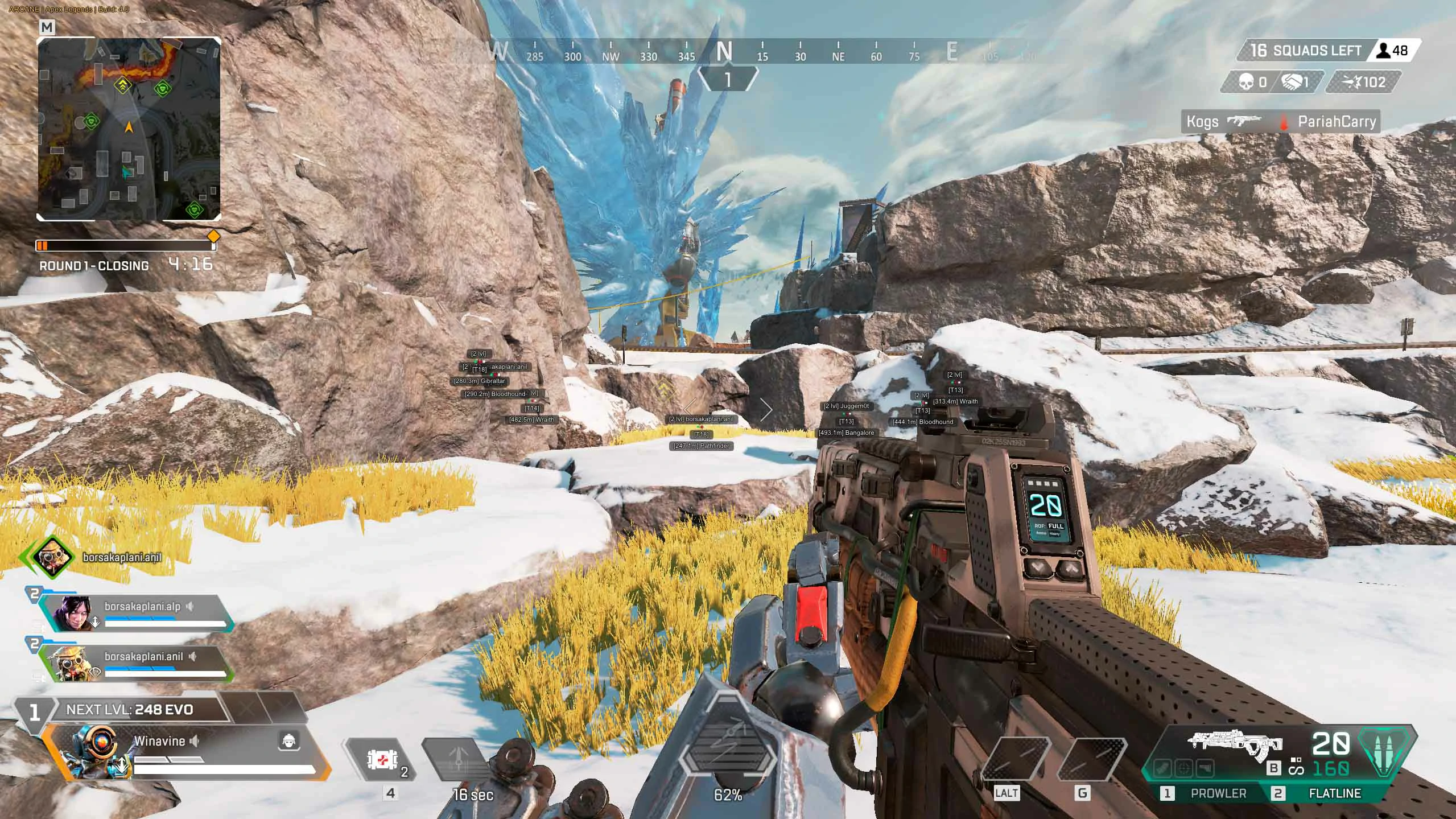
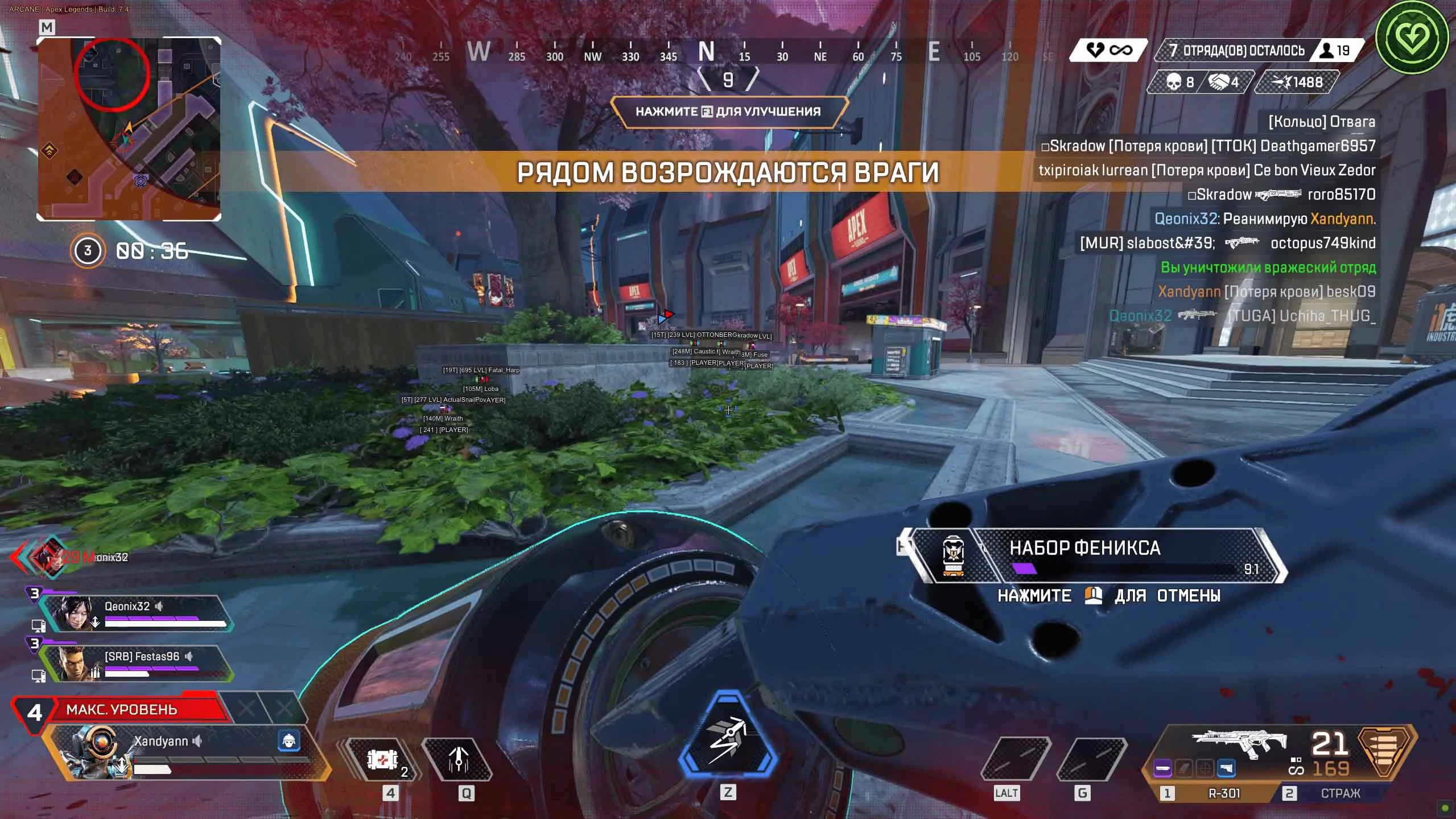
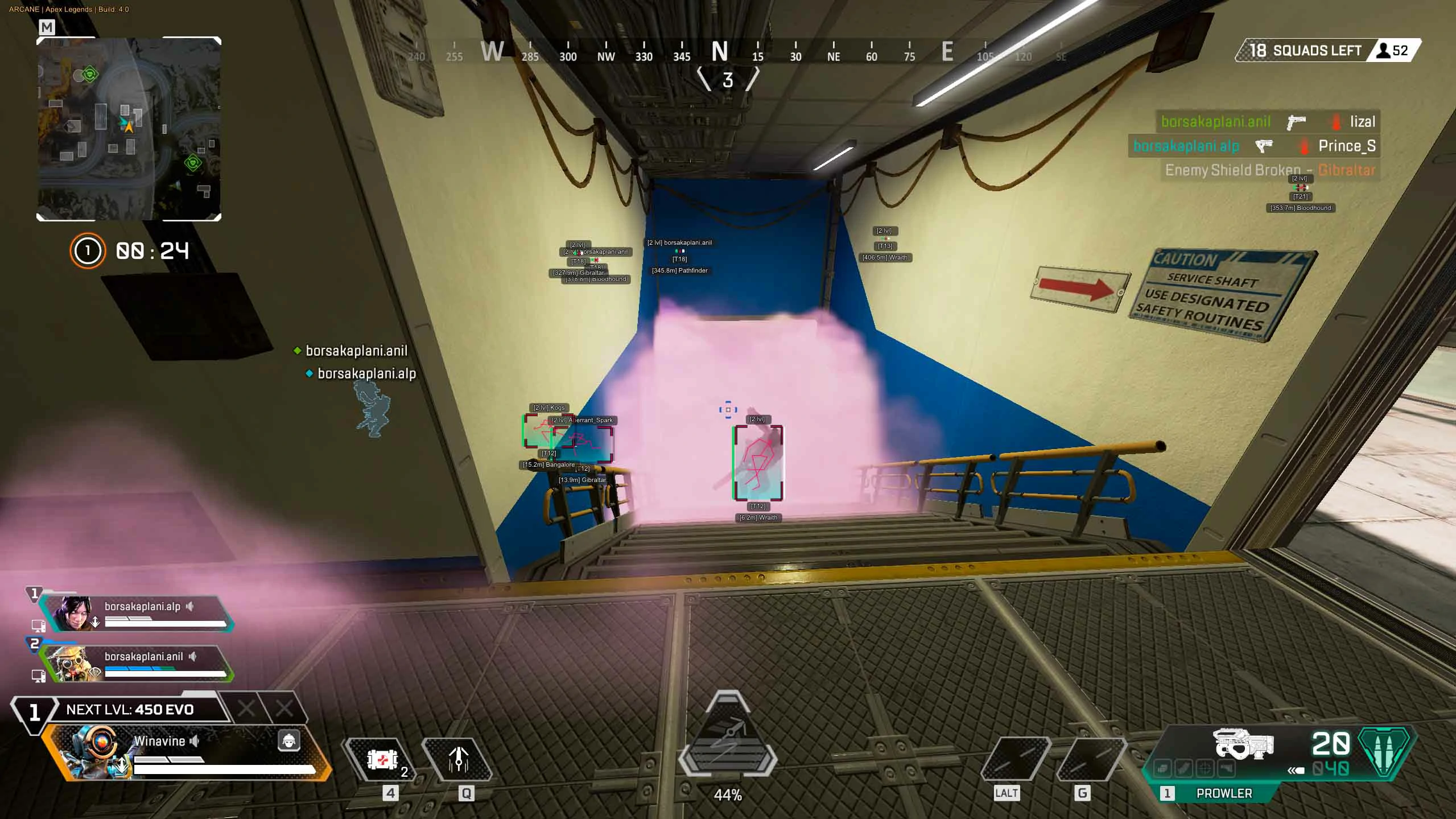
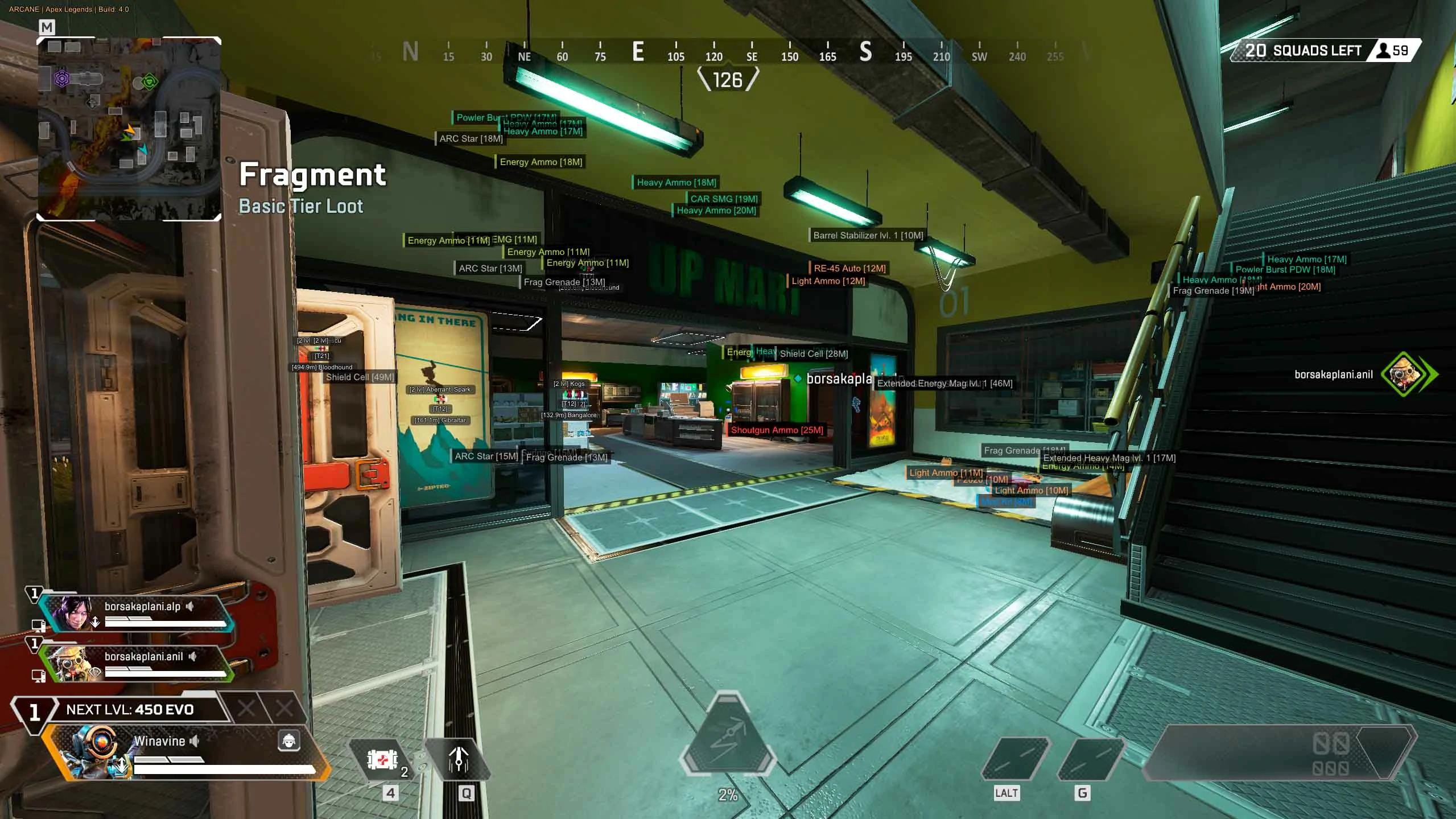
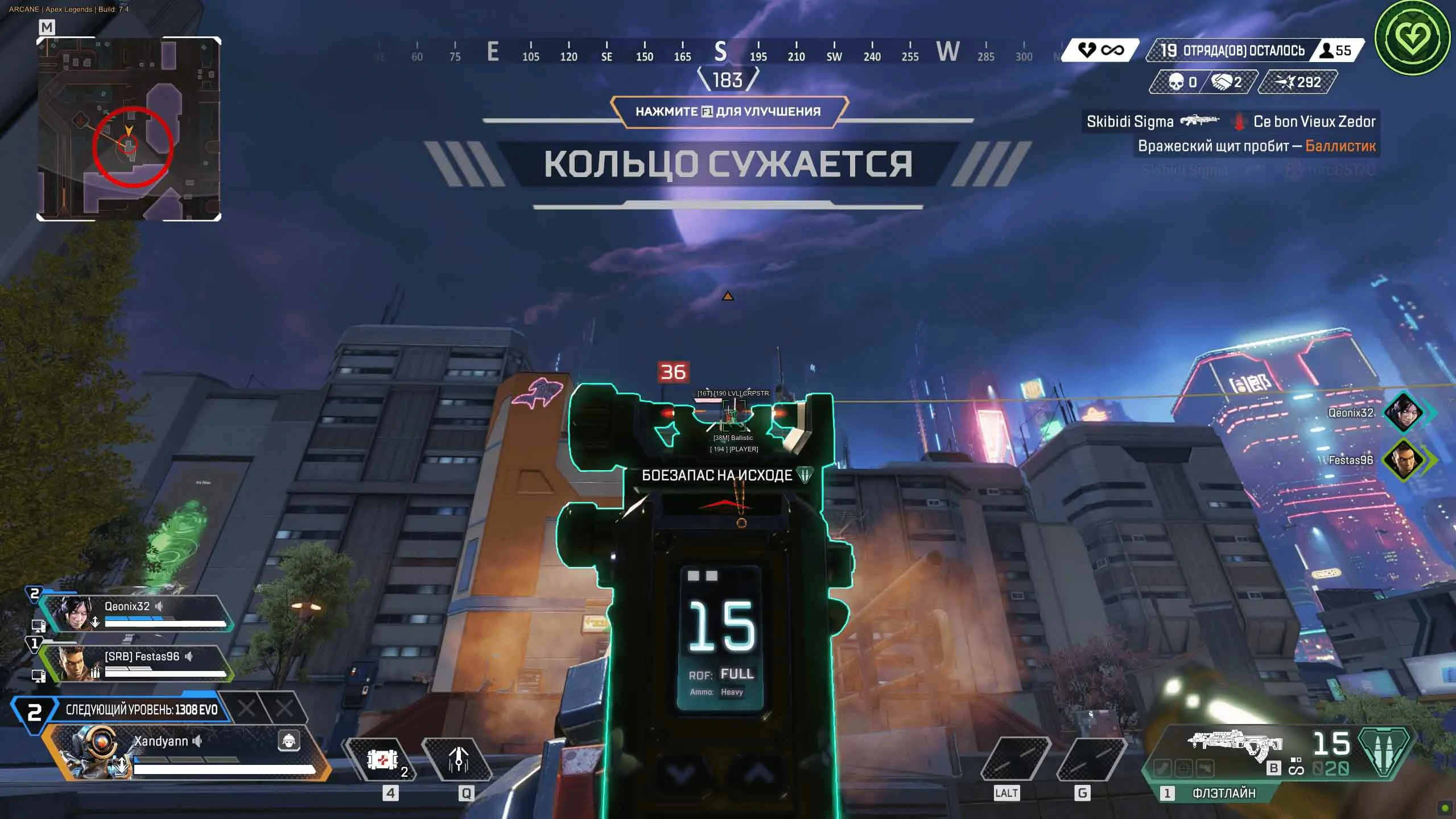
Player ESP renders every enemy through walls, buildings, and terrain with configurable visual overlays. Box ESP draws rectangular outlines around enemy players, making them visible at any range through any surface. Skeleton ESP displays the exact bone structure and body posture — critical for knowing whether an enemy is crouching, healing, aiming down sights, or mid-slide. Health and shield bars show exact damage states, letting you prioritize cracked opponents for easy finishes over full-health squads. Distance tags calculate exact meters to every visible player, helping you decide engagement range. Weapon display shows what each enemy is carrying — essential information when you're deciding whether to push a team holding Peacekeepers at point blank versus a squad running Triple Takes at distance.
Loot and item ESP is especially relevant in Season 28 because of the inventory changes. Knockdown shields have been removed from floor loot entirely — they now scale with your Evo level. White backpacks were also removed, with every player spawning with one. These changes simplify early looting, but the remaining loot pool means finding Evo shields, weapons, and attachments quickly is more competitive. Loot ESP highlights every item through walls and floors, letting you drop on the exact building that has the weapon you want. On World's Edge, this means knowing which building in Fragment has the purple shield before you land. On E-District, it means seeing the high-tier gear inside stacked buildings without clearing every floor. The store offers multiple products with different ESP configurations, from streamlined player-only overlays to comprehensive displays with item, health, weapon, and movement data.
APEX Triggerbot — Frame-Perfect Timing as TTK Drops
In Season 24, Respawn made a deliberate decision to reduce Time to Kill across the entire game. Helmets were removed from the loot pool and integrated into the Evo system, weapon damage was buffed across most categories, and the overall result is that fights resolve faster than at any point in Apex's history. Season 28 accelerated this further by buffing shotguns and adding Hardlight Mesh — a mechanic that literally creates new peek windows where they didn't exist before. When you break a Hardlight panel, you have a brief window to fire through the gap before the enemy repositions or a Controller legend rebuilds it. That window might be 300 to 500 milliseconds. Miss it, and the Hardlight starts rebuilding.
A triggerbot fires automatically when your crosshair passes over an enemy hitbox. Unlike an aimbot, which moves your crosshair to the target, a triggerbot relies on your own aim placement but ensures the shot fires at the exact frame your crosshair touches the enemy. In the Hardlight Mesh meta, this is devastatingly effective. You peek through a breached window, your crosshair crosses an enemy's body, and the triggerbot fires the Peacekeeper before you could manually react. The reaction time advantage — typically 50 to 150 milliseconds over human reaction — doesn't sound like much until you realize that Apex fights at close range last roughly 1 to 2 seconds. Saving 100 milliseconds on every peek means getting one extra shot off, which in a game where shotguns can deal 100+ damage per shot, is often the difference between a knock and getting knocked.
Triggerbot delay settings add randomized millisecond pauses between crosshair contact and shot firing to prevent perfectly consistent reaction times that trigger statistical detection. A delay range of 30 to 80 milliseconds simulates fast human reaction while still being significantly quicker than the average player's 180 to 250 millisecond reaction time. The triggerbot also pairs naturally with recoil compensation — when automatic fire holds perfectly on target, the triggerbot ensures every burst starts at the exact moment the crosshair is on the hitbox, producing maximum damage efficiency. Check the status page for current feature availability and update timings across all products.
APEX Radar — Real-Time Squad Tracking in 60-Player Lobbies
Apex Legends drops 60 players — 20 squads of three — into each match. By mid-game, surviving squads are rotating through predictable paths toward the next ring, and third-partying is the dominant strategy at every rank from Gold to Predator. Knowing where other squads are before they know where you are is the single most impactful piece of information in any Apex match. Sound design improvements in Season 28 — including split enemy and geo bullet impact audio — help somewhat, but audio only works at close range and can be masked by ability effects, ring damage, and gunfire from other fights.
Radar overlays display all enemy positions on a real-time minimap, updated continuously. You see not just where enemies are, but which direction they're moving and at what speed — enough to predict rotation paths and third-party timing. On World's Edge, radar reveals squads rotating through Harvester before they appear at your building in Fragment. On Broken Moon, it shows teams taking gondolas between POIs, giving you time to set up an ambush at the destination. On E-District, where vertical layering creates complex three-dimensional positioning, radar flattens the information problem — you always know if a squad is above, below, or on your level.
In endgame circles — typically the last 3 to 5 squads in a shrinking ring — radar becomes decisive. ALGS professionals spend hundreds of hours studying final ring positions and rotation options. With radar, every player gets that information in real time. You know exactly which squads are alive, where they're positioned relative to the ring, and whether they're fighting each other or holding position. This lets you decide whether to push an ongoing fight for easy kills, hold position and let other squads eliminate each other, or rotate early to claim the strongest position for the final ring. The status page shows which products currently include radar functionality and their real-time operational status.
APEX DMA Hardware — Operating Below EAC's Kernel Layer
Easy Anti-Cheat operates at the kernel level, which means it monitors everything that runs within the Windows operating system. DMA (Direct Memory Access) hardware operates below that layer entirely. A DMA setup uses an external device — typically a PCIe capture card with custom firmware — to read the game's memory directly from the system's PCIe bus without any software presence on the target machine. Because the DMA device communicates at the hardware level, EAC's kernel driver has no visibility into what the device is doing. It's functionally invisible to any software-based anti-cheat system.
A standard DMA configuration uses two machines: the target PC running Apex Legends with EAC, and a second PC connected to the DMA card that processes the memory data and renders the ESP overlay on its own screen. The target PC shows a completely clean game — no overlays, no injected code, no modified memory, nothing for anti-cheat to detect. The second screen displays player positions, health, weapons, and all ESP data independently. Some setups use a single PC with the DMA card configured in a virtual machine pass-through arrangement, but the two-PC method remains the cleanest approach for avoiding detection.
The firmware on the DMA card matters significantly. Stock firmware from manufacturers like Squirrel or LambdaConcept is recognized by some anti-cheat systems that scan for known DMA device signatures on the PCIe bus. Custom firmware changes the device's PCI vendor and device IDs, making it appear as a generic or legitimate PCIe device. Apex's February 2026 roadmap mentions continued improvements to anti-cheat integrity checks, but as of Season 28, DMA hardware with properly configured custom firmware remains outside EAC's detection scope. The DMA hardware page covers compatible devices, firmware requirements, and configuration guides for Apex-specific setups.
Season 28: Breach — Five Scenarios Where Tools Change the Outcome
Scenario 1 — Fragment Hot Drop, Three Squads on Your Building. You land Fragment East on World's Edge. Two other squads dropped on the same building. Without ESP, you're running blind through hallways listening for footsteps that blend with ability sounds and other squad fights. With player ESP, you see exactly how many enemies are on each floor, their health states, and what weapons they've found. You push the squad that landed poorly — one player still has a P2020 and another is unarmed. Meanwhile, radar shows the third squad is fighting across the street, giving you time to loot before the rotation.
Scenario 2 — Hardlight Mesh Breach on Broken Moon. Your squad approaches a building where a team has fortified with Catalyst's reinforced Hardlight windows. Without tools, you commit explosives and time to break the mesh, then enter blind. With ESP, you see exactly where all three defenders are positioned behind the Hardlight — one is healing behind the far wall, one is ADS aimed at the breach point, one is on the second floor. You break the Hardlight from an angle that avoids the ADS player, triggerbot lands the first Peacekeeper shot through the new opening, and your team pushes while the third player is still upstairs.
Scenario 3 — Ranked Endgame, Final Three Squads. Ring 5 closing on E-District. Three squads alive. You're in a building, but you don't know where the other two squads are. Radar shows one squad is 40 meters east, holding inside a stacked building. The other is 60 meters south, already fighting the ring. You hold position, let the southern squad take ring damage and rotate into the eastern squad's line of fire. They fight. You push the survivors. That sequence — reading positions, predicting rotations, timing your engagement — is exactly what ALGS teams practice for weeks. Radar delivers it instantly.
Scenario 4 — Third-Party Read on World's Edge. You hear gunfire at Harvester while rotating from Lava Siphon. Without information, pushing is a coinflip — the fight might be almost over with one squad cracked and easy to clean up, or both squads might be healthy and you're walking into a 3v3v3. Radar shows both squads' positions and ESP shows their health states. One squad is at full health, dominating the fight. The other has two players knocked. You rush the knocked squad for quick finishes, then use their deathboxes for heals before the healthy squad rotates to you.
Scenario 5 — Climbing Ranked Through Platinum. Platinum is where most Apex players stall. The lobbies contain a mix of legitimate Diamond-level players grinding back up and hardstuck Platinum players making desperate pushes. With aimbot configured conservatively — moderate smoothing, body targeting, 80-degree FOV — your gun skill matches the lobby. ESP removes information gaps that cause bad rotations. Radar prevents third-party ambushes. The result isn't rage-level domination; it's consistent top-5 finishes with positive kill participation, which is exactly the profile that climbs through Platinum without triggering behavioral detection flags.
Choosing the Right Product for Your Playstyle
BurgerCheats offers multiple products for Apex Legends, each designed for different use cases. Software-based solutions run on your gaming PC and provide the full feature set — aimbot, ESP, triggerbot, radar, and recoil control — through an overlay that renders on your main display. These are the most cost-effective option and offer the fastest configuration changes between features. The tradeoff is that any software running on the target machine exists within EAC's detection scope, which means ongoing updates are essential to stay ahead of detection waves.
DMA hardware solutions move all detection-relevant processing to an external device, eliminating software presence entirely on the gaming PC. The upfront cost is higher — the DMA hardware setup requires a compatible capture card and either a second monitor or a second PC. But the detection profile is fundamentally different because there's nothing for EAC to scan on the target system. For ranked grinders who plan to invest significant time in a single account, DMA provides the strongest long-term safety profile.
For aggressive players who want maximum impact — aimbot, triggerbot, and full ESP running simultaneously — a software product with daily status monitoring through the status page offers the best combination of power and convenience. For passive players who primarily want information advantages — radar positioning, player health data, and loot locations without aim assistance — a lightweight ESP-only configuration draws less attention from both spectators and behavioral detection systems. The store lists all available products with current feature matrices and compatibility information.
Account Safety — Behavioral Detection Thresholds and Configuration Rules
Respawn's anti-cheat doesn't just look for software signatures — it analyzes gameplay patterns across thousands of matches to identify statistically impossible performance. Understanding these thresholds is what separates users who get flagged in days from users who operate for months without detection.
Headshot percentage is the most closely monitored metric. Professional ALGS players — the best aimers in the world — typically maintain headshot rates between 20% and 30% depending on their weapon preferences. Headshot rates above 35% with automatic weapons consistently trigger manual review flags. Rates above 45% almost always result in automated flagging. The safe zone for aimbot users is configuring bone targeting to mix head and chest shots, keeping the overall headshot rate between 25% and 35% — high enough to perform well, low enough to stay within the range that legitimate skilled players occupy.
K/D ratio spikes are another major flag. If your historical K/D is 1.2 and it suddenly jumps to 4.0 after one session, that anomaly gets logged. Gradual increases — moving from 1.2 to 1.5 over a week, then to 1.8 over the next two weeks — mirror the pattern of a legitimately improving player. Accuracy consistency across weapon categories is also monitored. A player who hits 60% of shots with the R-301, 60% with the Flatline, 60% with the Wingman, and 60% with the EVA-8 doesn't exist in nature — different weapons at different ranges produce naturally varying accuracy stats. Configure different aimbot presets for different weapon types to produce organic-looking accuracy variation.
Report volume matters more than most users realize. Respawn's behavioral detection models use player reports as input signals — three or more reports on a single player within 28 days triggers elevated monitoring. The "Wallhacking/Impossible Gamesense" report option added from community feedback specifically targets ESP users who make plays that don't make sense without wall information. The countermeasure is discipline: don't pre-aim through walls, don't track players you "shouldn't" know about, and don't make rotations that only make sense with radar information unless you can justify them through sound cues or natural game sense. An HWID spoofer is essential as a baseline safety layer — if an account does get flagged, the spoofer prevents the ban from extending to your hardware and blocking future accounts.
Frequently Asked Questions
Are these tools compatible with Season 28: Breach?
Yes. All products are updated within hours of every patch. Season 28 launched on February 10, 2026, and all available tools were operational on day one. The status page shows real-time update progress and current operational status for every product.Does Hardlight Mesh affect ESP visibility?
No. ESP renders through all surfaces regardless of game state — Hardlight Mesh, standard walls, terrain, and structures are all transparent to the ESP overlay. You see every player and item through Hardlight the same way you see through any other surface.What's the difference between software and DMA solutions?
Software runs on your gaming PC and provides the full feature set with an on-screen overlay. DMA uses external hardware to read game memory without any software on your system, making it invisible to kernel-level anti-cheat. Software is cheaper and easier to set up. DMA offers stronger long-term detection resistance at a higher price point.Can I use these in Ranked without getting banned?
Yes, with proper configuration. Conservative aimbot settings (moderate smoothing, body targeting, narrow FOV), natural-looking ESP usage (don't pre-aim through walls), and gradual stat progression all reduce detection risk. The Account Safety section above covers specific thresholds.Does the aimbot work with all weapons in Season 28?
Yes. The aimbot supports every weapon in the current loot pool, including the new hop-up configurations — EVA-8 with Double Tap, Mastiff with Dual Shell, and Peacekeeper with Disruptor Rounds. Prediction systems account for projectile speed and bullet drop per weapon type.How fast are updates after a new patch?
Typically within hours for minor patches and within 24 hours for major seasonal updates. During update windows, the status page displays real-time progress. You receive automated notifications through the store dashboard when your product is back online.Do I need an HWID spoofer?
Strongly recommended for all software users. Apex's anti-cheat issues HWID bans that persist across accounts and IP changes. An HWID spoofer prevents hardware-level bans from blocking your entire system. DMA users typically don't need a spoofer because the hardware approach doesn't trigger software-level detection.What maps does ESP cover?
All maps in the current rotation — World's Edge, Broken Moon, and E-District — plus any map that enters rotation through future updates. ESP operates independently of map geometry and works identically across all environments, including the Firing Range and Wildcard modes.Start Winning in the Apex Games
Seven years in, Apex Legends is still the most mechanically demanding battle royale in the world. The movement ceiling keeps rising, the weapon meta shifts every season, and Season 28's Hardlight Mesh has added an entirely new dimension to building fights. Whether you're grinding through Platinum, pushing for Diamond, or trying to compete in lobbies that play like mini ALGS tournaments, the tools you need are available now — updated for Breach, configured for the current weapon meta, and backed by 24/7 support.
Browse available products in the store, check real-time operational status on the status page, and start playing Apex the way it's meant to be played — with every advantage on your side.



-
-
Total Members 5,011
-
Most Online 39
-
Newest Member xjaevinx_22790

-
-
Reviews
-

By Discord Review · Posted
+rep @admin really fast support and noce cutom service the delivery speed was fast he helped me with the settings you need to change an do and that in 10 min thats crazy. -

-

By 3ttuu · Posted
My firmware is working perfectly thanks to the kind explanations and help from the Burger Cheat admin. They were always very friendly and responded quickly to customers. If you're considering a purchase, I highly recommend it -
By Discord Review · Posted
+REP. The response was fast, the explanations were kind, and they answered my questions sincerely and thoroughly. It was excellent. -

-