
-
Valorant Cheats — Aimbot, ESP, Wallhack & DMA Hack
Built for the only tactical shooter where anti-cheat runs before you open the game. Daily updates. 24/7 support.
-
Featured Products
-
Vanguard Is Why This Page Exists — and Why Most Valorant Cheats Don't Survive a Week
Every other tactical shooter on the market runs anti-cheat as a background process that starts when the game launches and stops when it closes. Valorant's Vanguard loads a kernel-mode driver the second your PC boots. It monitors system memory, scans running processes, validates driver signatures, blocks known vulnerable drivers from loading, and fingerprints your hardware — all before you even open the Riot client. Vanguard doesn't wait for you to cheat. It assumes someone will try and builds a fortress before the first round starts. This is why free Valorant cheats from GitHub repos and Discord servers survive an average of three to seven days before mass bans. This is why the same aimbot that works undetected in Counter-Strike 2 for months gets flagged in Valorant within hours. And this is exactly why developing cheats for Valorant costs more, takes longer, and demands a fundamentally different engineering approach than any other FPS.
Riot's anti-cheat team — led by Phillip Koskinas, who built Vanguard from the ground up — bans thousands of cheaters every day. Their own data confirms that less than 1% of ranked matches globally contain a detected cheater as of early 2025. The system operates on multiple layers simultaneously: kernel-level integrity monitoring scans for injected code, memory manipulation, and unauthorized drivers. Server-side behavioral analytics track statistical anomalies across millions of matches — headshot percentages, reaction times, pre-fire accuracy, crosshair placement patterns. HWID fingerprinting creates a permanent hardware profile from your CPU, GPU, motherboard, storage, and network adapters, meaning a banned machine stays banned even with new accounts and fresh Windows installs. In Season 2025, Riot added mandatory multi-factor authentication for Ascendant+ ranks. In Season 2026 Act 1, MFA enforcement expanded to all EU ranked accounts and shared account detection. The anti-cheat infrastructure isn't slowing down — it's accelerating. And that acceleration is precisely why the tools that survive Vanguard are worth understanding in detail.
Meanwhile, the game itself has never been more active or more competitive. Estimates place daily active players between 2.5 and 4 million, with monthly counts exceeding 20 million across all regions. Season 2026 launched on January 8 with a completely reworked Breeze map returning to the competitive pool, a new 600-credit sidearm called the Bandit that rewards headshot precision on eco rounds, agent buffs to Breach, Sage, Harbor, Tejo, and Vyse, and the first All Random One Site limited-time mode. The VCT 2026 circuit features Masters Santiago ($1 million prize pool), Masters London, and Champions Shanghai ($2.25 million) — the largest prize pool in Valorant esports history. Twenty-eight agents. Ten maps in total rotation. A ranked system that resets twice yearly and requires 20 to 40 games to stabilize your visible rank near your hidden MMR. Valorant is the most mechanically demanding tactical shooter in competitive gaming, protected by the most aggressive anti-cheat in the industry, and played by millions of people who have been grinding for five years. That's the environment these tools are built for.

How Vanguard's Kernel-Level Architecture Actually Detects Cheats
Understanding how Vanguard works is non-negotiable if you want to understand how Valorant hacks survive — or why most don't. Vanguard consists of two components: a kernel-mode driver (vgk.sys) that loads at system boot, and a user-mode client that runs alongside the game. The kernel driver operates at Ring 0 — the highest privilege level in the Windows operating system — which gives it visibility into every process, driver, and memory region on your machine. This is the same privilege level used by hardware drivers and operating system components, and it's why Vanguard can detect cheats that hide themselves from user-mode anti-cheat systems like BattlEye or EasyAntiCheat.
The boot-time loading is Vanguard's most important design decision. By initializing before any other user-installed software, Vanguard establishes a trusted baseline of your system state. Any cheat that tries to load after Vanguard is already being monitored. Any cheat that tries to load before Vanguard — through a pre-boot rootkit or vulnerable driver — gets blocked because Vanguard validates the driver chain during initialization. Riot's 2025 Vanguard security update specifically addressed a motherboard-level vulnerability that allowed pre-boot code injection on certain hardware, proving they actively close even hardware-level attack vectors. If you disable Vanguard's tray icon, you can't play Valorant until you restart your PC, because the kernel driver needs to load from boot to establish its integrity baseline.
Beyond local detection, Vanguard feeds gameplay data to Riot's server-side analysis pipeline. This is where behavioral detection happens. The server doesn't need to see your cheat software — it only needs to see your performance data. Headshot percentages above statistical norms for your rank. Reaction times consistently faster than human physiological limits. Crosshair placement that tracks enemies through walls before visual contact. Pre-aim adjustments that correlate with hidden enemy positions. These patterns are analyzed across thousands of matches, and when the statistical confidence exceeds Riot's threshold, accounts get flagged for manual review or automatic banning. The Ranked Rollback system — introduced in late 2025 and expanded in Season 2026 — automatically refunds RR to players who lost matches against confirmed cheaters, creating an additional incentive for fast detection. Compared to Apex Legends' EAC or Fortnite's EAC, Vanguard is architecturally more invasive, statistically more comprehensive, and operationally more aggressive. Everything discussed on this page accounts for that reality.
Valorant Aimbot — How It Works, What It Does, and How to Configure It
An aimbot overrides your manual mouse input to automatically align your crosshair with enemy player models. In Valorant — where a single Vandal headshot deals 160 damage and kills any full-health target regardless of armor — aimbot is the most impactful mechanical advantage available. But Valorant's one-tap potential also means aimbot configuration matters more here than in any other game. An aimbot that locks to heads with zero smoothing and instant snapping looks inhuman in killcam replays, triggers spectator reports within rounds, and generates the exact statistical anomalies Vanguard's behavioral detection is designed to flag. The goal isn't to headshot every opponent instantly. The goal is to headshot more consistently than your current rank can, at a speed that looks like you've been practicing.
FOV (Field of View) determines the detection cone around your crosshair. When an enemy enters this cone, the aimbot activates. A small FOV — 20 to 40 degrees — only corrects aim when your crosshair is already close to the target, producing subtle adjustments that look like good crosshair placement. This is ideal for the Vandal and Guardian, where pre-aiming head level and making micro-corrections is exactly how high-ranked players shoot. A larger FOV — 60 to 100 degrees — catches targets further from your crosshair, useful during chaotic retakes where multiple enemies appear from different angles. Smoothing controls how fast the crosshair moves to the lock-on point. High smoothing produces gradual, human-like cursor travel. Low smoothing produces the instant snaps that get people banned. For Valorant ranked, a smoothing value that takes 80 to 150 milliseconds to reach the target mimics the reaction speed of Diamond to Immortal players — fast enough to win most duels, natural enough to survive spectator review.
Bone targeting lets you choose which body part the aimbot locks onto. Head targeting maximizes one-tap potential with the Vandal, Sheriff, and the new Bandit pistol — all weapons designed around headshot damage. Body targeting with the Phantom, which deals 156 damage at close range with four body shots, offers more forgiving spray patterns and is harder to distinguish from skilled body-spray players in kill replays. Visibility checks ensure the aimbot only fires at targets with clear line of sight, preventing the obvious tell of tracking enemies through walls before they're visible. Recoil compensation automatically counteracts weapon spray patterns — the Vandal's 25-round spray pulls up and to the right in a predictable pattern that skilled players memorize, but recoil control eliminates the need to learn. This is especially relevant on the new Breeze rework, where long sightlines at A-Hall and B-Site demand spray control at ranges where the Vandal's recoil becomes punishing.
Valorant ESP and Wallhack — Complete Battlefield Awareness Through Every Surface
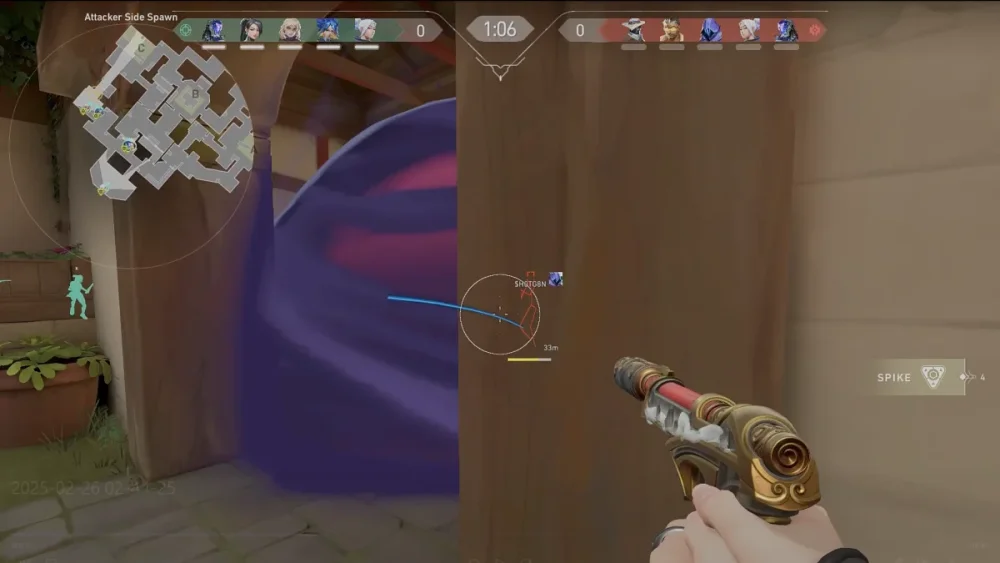
ESP (Extra Sensory Perception) renders game information that's normally hidden from view. In Valorant, where every round is decided by information — who holds what angle, where the spike carrier is, whether the enemy Jett has her Blade Storm ready — ESP transforms you from a player reacting to what you see into a player acting on what you know. Valorant wallhack specifically refers to the visual component: seeing enemy player models through walls, boxes, and map geometry. ESP is the broader category that includes wallhack plus additional data overlays like health bars, agent names, weapons, distances, and ability status.
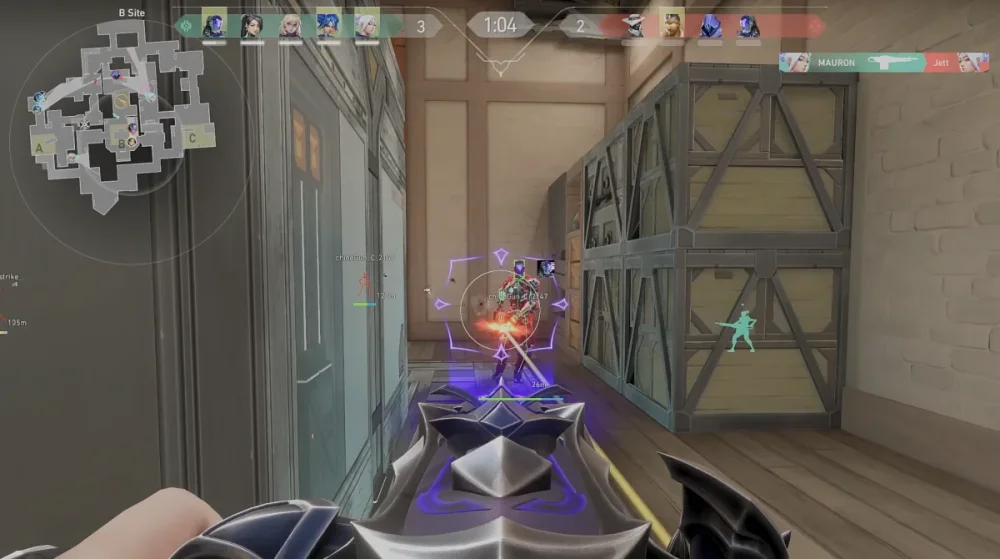
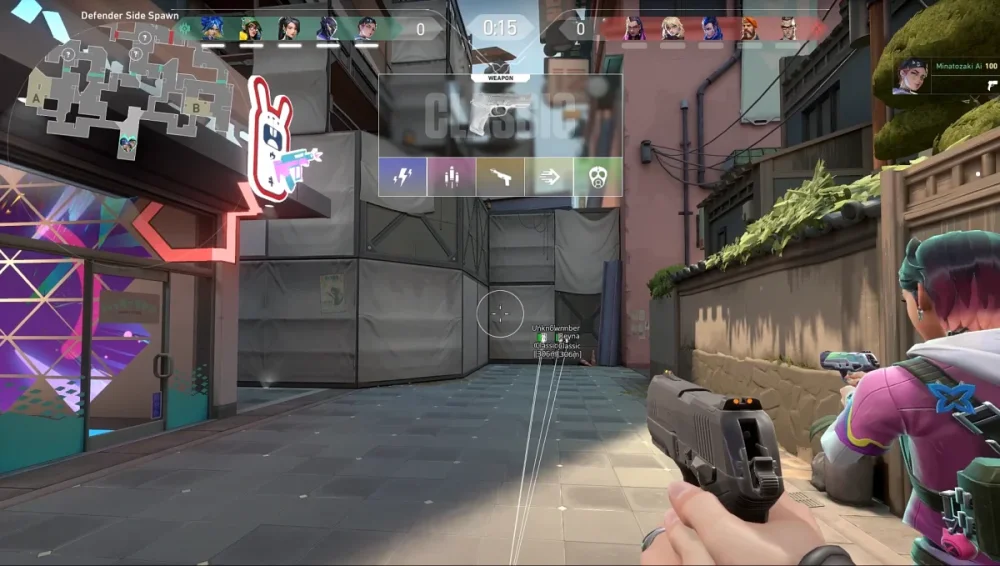
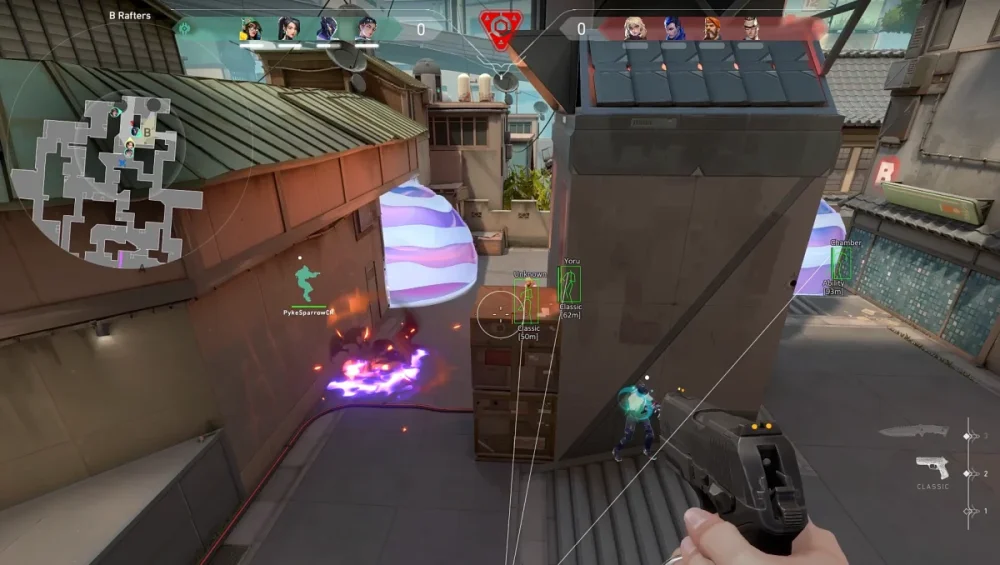
Player ESP draws visual indicators over every enemy on the map, regardless of walls or obstacles between you. Box ESP surrounds each enemy with a colored rectangle. Skeleton ESP renders the enemy's bone structure, showing their exact body posture — standing, crouching, peeking, planting, defusing. This matters enormously in Valorant because body posture reveals intent. A crouching skeleton behind a box on B-Site Ascent is probably holding an angle. A moving skeleton running toward A-Site Split is rotating. A stationary skeleton in a corner with the spike might be planting. Health bar displays show exact HP and shield values, telling you whether to commit to a wide peek for the kill or wait because the enemy has full shields. Distance tags show exact meters between you and every enemy — critical on maps like Breeze where engagement distances determine whether the Phantom or Vandal is the correct weapon choice.
Agent and ability ESP shows what agent each enemy is playing and, depending on the product, the status of their abilities. Knowing the enemy Cypher placed a Tripwire at B-Link on Bind before you rotate there prevents a free kill for the defender. Seeing that the enemy Killjoy's turret is watching Garage on Haven lets your team push A instead without burning utility. Weapon ESP shows exactly what each enemy is carrying — a Jett holding an Operator demands a completely different approach than a Jett with a Spectre. In eco rounds, seeing that the enemy team is force-buying Sheriffs and Shorties lets you play passive and trade safely instead of dry-peeking into one-shot headshot weapons.
Season 2026 Act 1's current competitive map pool — Bind, Haven, Split, Ascent, Icebox, Lotus, Abyss, Breeze, and Corrode — each presents unique information problems that ESP solves differently. Breeze's long sightlines mean ESP identifies Operator positions across 50+ meter distances before you walk into them. Ascent's mid-control battles depend on knowing if the enemy is watching Catwalk or holding Market. Split's vertical gameplay across Heaven, Screens, and Ramps creates multi-level information gaps that ESP flattens completely. The store lists current ESP feature availability across all Valorant products.
Valorant Triggerbot — Automated Firing with Human-Like Timing
A triggerbot fires your weapon automatically when your crosshair passes over an enemy hitbox. Unlike an aimbot, which moves your crosshair to the target, a triggerbot relies entirely on your own crosshair placement — it just eliminates the delay between seeing the target and clicking the mouse. In Valorant, where the difference between winning and losing a duel is often 50 to 100 milliseconds of reaction time, triggerbot provides a mechanical edge that's extremely difficult to detect through spectator review because your crosshair movement looks entirely natural.
The technical advantage is significant. Average human reaction time in competitive FPS is 180 to 250 milliseconds. Professional Valorant players at the VCT level average 150 to 180 milliseconds in controlled tests. A triggerbot fires in 1 to 5 milliseconds from the moment the crosshair contacts the hitbox — effectively zero delay. But running zero delay produces statistically impossible consistency that behavioral detection catches over hundreds of rounds. The solution is randomized delay injection: configuring the triggerbot to fire after a random delay between 40 and 120 milliseconds, simulating fast but human reaction speeds. This puts your effective reaction time in the Diamond-to-Immortal range without producing the inhuman consistency that triggers automated flags.
Triggerbot is particularly devastating on eco rounds with the new Bandit pistol. The Bandit costs 600 credits — half the price of a Ghost — and is designed as a headshot machine. Its first-bullet accuracy is exceptional, but its body damage is low. Triggerbot guarantees that every time your crosshair crosses an enemy head while holding the Bandit, the shot fires instantly. On force-buy rounds with the Sheriff ($800), triggerbot turns every peek into a potential one-tap. On rifle rounds with the Vandal, triggerbot combined with precise crosshair placement means holding an angle becomes nearly automatic — the enemy peeks, your crosshair is already head-level, and triggerbot fires before your opponent can react. This technique, called pre-aim triggering, is exactly how professional players hold angles, except triggerbot removes the human delay that occasionally causes missed shots. The status page confirms current triggerbot availability and compatibility with Season 2026 patches.
Valorant Radar Hack — Full Map Awareness in Real Time
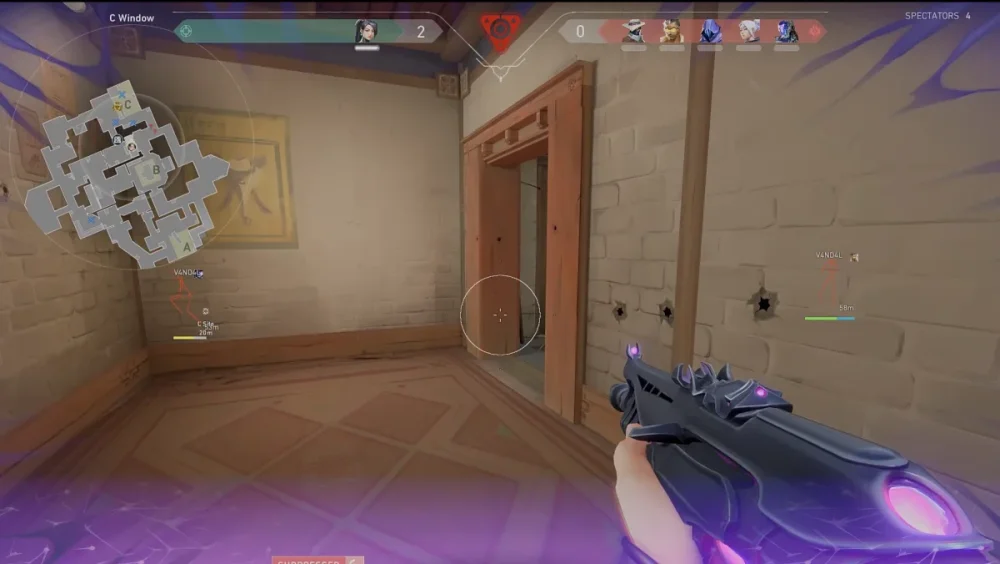
Valorant's minimap only shows information your team has gathered — teammate positions, tagged enemies from abilities like Sova's Recon Bolt or Fade's Haunt, and sound indicators. Everything else is fog of war. A radar hack replaces that limited minimap with a complete real-time display of every player's position on the map, updated continuously. You see all five enemies at all times, regardless of abilities, walls, or distance.
In a game built around information warfare — where Initiator agents exist specifically to reveal enemy positions temporarily — permanent radar awareness is arguably the most strategically powerful tool available. Consider how rounds actually play out in competitive Valorant: attackers use utility to gain information about site defenders, then decide where to execute based on that information. Defenders use utility to delay pushes and gather information about attacker positions. Both sides spend significant portions of each round probing, faking, and gathering intelligence. Radar eliminates all of that complexity for the user. You know exactly where every defender is holding. You know if the site is stacked or if they're playing retake. You know if the lurking Cypher is flanking through mid or holding passive. Every decision you make is based on complete information while your opponents are playing with fragments.
Map-specific radar advantages are massive in Season 2026's pool. Lotus has three sites and multiple rotation paths through A-Link, B-Main, and C-Link — radar shows exactly which sites are underdefended. Haven also has three sites where fast rotations through Garage and Mid create constant uncertainty — radar removes that uncertainty entirely. Breeze's reworked layout reduces angle complexity but maintains long rotation times for defenders, meaning radar shows you exactly when to push a site because you can see the rotation starting from across the map. On Icebox, where B-Site fights from Kitchen and Snowman angles are notoriously chaotic, radar shows exactly how many enemies are on-site versus rotating through Mid.
Valorant No Recoil and No Spread — Perfect Weapon Control Without Practice
Every weapon in Valorant has a unique recoil pattern that activates after the first few bullets. The Vandal pulls up-right. The Phantom pulls up-left initially. The Spectre has a diamond pattern. Professional players memorize these patterns through thousands of hours of practice in The Range and Deathmatch. No recoil hacks eliminate these patterns entirely, keeping your crosshair perfectly stable during sustained fire. No spread removes the random bullet deviation that occurs during movement or sustained spray, ensuring every bullet travels exactly where your crosshair points.
The practical impact varies by weapon. For the Vandal, no recoil transforms a 25-round magazine into a laser at any distance — something that's physically impossible even for professional players who can only maintain precise spray control for the first 8 to 10 bullets. For the Phantom — which has a silenced profile and no bullet tracers through smoke — no recoil plus smoke-spray is a combination that produces kills opponents literally cannot trace back to your position. For the Spectre on eco rounds, no recoil eliminates the weapon's primary weakness and makes it competitive at ranges where it normally loses to rifles. For the Stinger, no spread at close range makes the burst-fire mode devastatingly accurate.
Movement accuracy penalties in Valorant mean that running and shooting produces enormous spread. No spread negates this penalty, allowing run-and-gun tactics that are normally impossible. Combined with agents like Neon — whose Sprint ability already improves movement accuracy — or Jett's Tailwind dash, no spread creates aggressive playstyles that shouldn't be physically possible within the game's mechanics. However, this is also one of the most visible advantages to spectators. A player consistently killing while moving at full speed will generate reports quickly. Conservative use — enabling no recoil for spray control while keeping movement-accuracy penalties active — is the safer configuration for ranked play. Products with recoil compensation are listed in the store with current feature details.
DMA Hardware Cheats — Operating Outside Vanguard's Entire Detection Layer
Vanguard's kernel-level driver monitors everything within the Windows operating system. DMA (Direct Memory Access) hardware operates below that layer entirely, on the PCIe bus — the physical data highway connecting your CPU, GPU, storage, and expansion cards. A DMA device reads the game's memory directly from the PCIe bus without any software footprint on the target machine. Because no code is injected, no process is running, and no memory is modified on the gaming PC, Vanguard has zero visibility into DMA operations. It's the only approach that fundamentally bypasses kernel-level anti-cheat rather than trying to hide from it.
A typical DMA setup uses two computers. The gaming PC runs Valorant with Vanguard — completely clean, no modifications, no suspicious processes. A DMA capture card installed in the gaming PC's PCIe slot reads game memory and transmits it to a second PC over a high-speed connection. The second PC processes the memory data and renders ESP overlays, radar, and other visual information on its own monitor. The gaming PC's screen shows a completely normal game. The second screen shows everything — all enemy positions, health, weapons, agent abilities. Some users run both screens side by side. Others use an HDMI combiner that overlays the second PC's output onto the gaming PC's display, creating a seamless single-monitor experience.
Firmware is the critical variable. DMA devices from manufacturers like Squirrel, LambdaConcept, and ZDMA use PCIe device IDs that anti-cheat systems are beginning to catalog. Custom firmware changes these identifiers to mimic standard PCIe devices — network cards, audio controllers, USB hubs — that Vanguard wouldn't flag. Emulated firmware goes further by replicating the full initialization handshake and configuration space of a legitimate device, making the DMA card indistinguishable from real hardware on a PCIe scan. Riot's Vanguard team has acknowledged DMA cheating in public statements and TechCrunch reporting, specifically noting that DMA devices paired with HDMI fusers represent the most sophisticated current threat. The DMA hardware page covers compatible devices, firmware configurations, and setup guides specifically tested against Vanguard.
HWID Spoofer — Resetting Your Hardware Identity After a Ban
When Vanguard bans an account, it simultaneously creates a hardware fingerprint from multiple system identifiers: CPU serial, GPU device ID, motherboard UUID, storage drive serial numbers, MAC addresses, and Windows machine GUID. This fingerprint is stored server-side and checked every time any Riot account logs in from that machine. If the fingerprint matches a banned profile, the new account gets banned immediately — often before the first match completes. This is Riot's HWID (Hardware ID) ban system, and it's specifically designed to make ban evasion expensive. Without a spoofer, the only way to play on a hardware-banned PC is to physically replace every identified component.
An HWID spoofer generates new, randomized values for every hardware identifier that Vanguard reads. CPU serial, GPU device ID, disk serials, MAC addresses, motherboard UUID, SMBIOS data, monitor EDID — all changed to values that don't match the banned fingerprint. The spoofer must load before Vanguard's kernel driver initializes, because Vanguard reads hardware identifiers during its boot-time scan. If the spoofer loads after Vanguard, the real identifiers are already captured. Timing and load order are what separate functional spoofers from detected ones.
For Valorant specifically, HWID spoofing has additional complexity because Vanguard's hardware fingerprinting is more granular than most anti-cheat systems. Where Rust's EAC might check five to eight hardware identifiers, Vanguard is reported to check significantly more, including peripheral device IDs and firmware version strings. A spoofer that only changes the obvious identifiers — CPU, GPU, disk — might still get flagged because Vanguard recognizes the unchanged peripheral configuration as matching the banned fingerprint. Comprehensive spoofers change everything, including USB device trees, audio device names, and monitor identifiers. The combination of HWID spoofing with fresh Valorant accounts and clean Windows installations provides the strongest foundation for account longevity after a previous ban.
Season 2026 Act 1 — How the Current Meta Shapes Tool Configuration
Season 2026 Act 1 launched on January 8 with patch v12.00 — one of the largest updates in Valorant's history. Understanding the specific changes matters because tool configuration should adapt to the meta, not run on default settings that ignore how the game actually plays right now.
The Bandit is Valorant's newest weapon — a 600-credit sidearm with a 6-round magazine designed exclusively around headshot precision. Its body damage is intentionally low, but headshots deal enough to kill light-buy opponents and strip shields from full-buy enemies. Aimbot with head-only bone targeting on the Bandit turns eco rounds from disadvantaged gambles into consistent kill opportunities. Before the Bandit, eco-round aimbotting meant Sheriff or Ghost play, both requiring accuracy at ranges where pistol spread becomes unreliable. The Bandit's first-shot accuracy is tighter than both, making it the ideal aimbot weapon for economic rounds. Triggerbot on the Bandit is equally powerful — hold an angle, let the enemy peek, and the instant your crosshair crosses their head, the shot fires before conscious reaction time begins.
Breeze returned to competitive rotation after nearly two years with a complete rework. Riot reduced angle complexity, tightened open spaces, and improved defender rotation times. But Breeze remains the most Operator-centric map in the pool. The long A-Hall sightline. The B-Site open ground. The Mid-to-B window. Knowing where the enemy Operator is positioned before peeking — which ESP provides constantly — is the difference between a clean site take and losing your entry fragger instantly. Radar on Breeze is particularly impactful because defender rotations are still the slowest in the map pool, meaning a radar-informed fast execute catches defenders mid-rotate more reliably than on any other map.
Agent changes in Season 2026 Act 1 buffed Breach's Flashpoint cast time, making aggressive entry faster and harder to react to. Sage's healing became more consistent through obstacles. Harbor's Cascade and High Tide received timing improvements for team pushes. Tejo's Special Delivery gained damage for utility disruption, and his Stealth Drone improvements clarified target marking. Vyse's Steel Garden regained area. These aren't meta-breaking changes, but they shift how rounds play at competitive levels — and ESP showing which agents the enemy team picked during the buy phase informs whether to expect faster Breach entries, reinforced Sage holds, or wider Harbor utility coverage. Clove remains the strongest agent in the current tier list, functioning as a controller-duelist hybrid with self-revival capability. Jett, Sage, Phoenix, and Reyna round out the top tier. Knowing the enemy composition through agent ESP lets you prepare counter-strategies before the round starts.
Five Ranked Scenarios Where Tools Change the Outcome
Scenario 1 — Eco Round with the Bandit on Ascent. Your team lost the pistol round and two follow-up rounds. Economy is broken. Everyone buys Bandits at 600 credits. Without tools, you're holding angles with a six-shot pistol hoping for headshots against Vandal-equipped opponents. With aimbot set to head-only targeting and high smoothing, every Bandit shot that connects is a headshot. Triggerbot fires the instant an enemy crosses your crosshair. Your team picks up two kills before dying. Those two kills mean the enemy team banks less money, your team gets better weapons from the ground, and the economic swing starts three rounds earlier than it would without those picks.
Scenario 2 — Retake on B-Site Bind. The enemy plants the spike on B-Site. Your team rotates from A through Hookah and B-Long. Without ESP, you don't know if the post-plant setup has one player Elbow, one Backsite, and one Garden, or if they're all stacking a single angle. ESP shows all three positions instantly. You flash Garden, your teammate peeks Elbow, and the third takes Backsite. The retake is executed with complete information — something that normally requires a Sova dart, a Fade Haunt, or a Skye Dog to partially achieve, all of which can be destroyed or avoided.
Scenario 3 — Mid-Control Battle on Split. Mid on Split is the map's central strategic axis. Controlling it lets attackers access both sites and forces defenders to respect the pressure. Without radar, mid-control requires committing utility and bodies to probe for defenders — risking an Operator pick or a Counter-flash from the Vent defender. Radar shows whether mid is held by one defender or two, whether the rotation from B-Heaven has started, and whether the lurking enemy is pushing Sewers or holding Mail. You take mid for free, your team splits between A-Ramp and Mid-Vent, and the execute happens before defenders can consolidate.
Scenario 4 — Anti-Strat Against a Jett Operator on Breeze. The enemy Jett buys an Operator every round and holds A-Hall. She's good — 70%+ of first duels won. Without ESP, your team either burns three flashes to push through A-Hall or avoids the site entirely, giving up map control. With ESP, you see exactly where the Jett is positioned before the peek. If she's holding close on the right side, you jiggle the left side to bait the shot, then wide-swing after the Operator's rechamber animation. If she's playing deep at A-Site, you push through A-Hall quickly because the Operator's effective zone is behind you once you pass the sightline. ESP turns a 70% first-duel win rate for the enemy into a predictable pattern you counter every round.
Scenario 5 — Final Round, 12-12 Overtime on Haven. Haven is the only competitive map with three bombsites. Overtime means every round is played on full economy. The pressure is maximum. Without information tools, you're relying on calling the right site based on sound cues and default reads. With radar, you see the entire enemy setup immediately. If they're stacking A with three players, you execute C with five and plant before the rotation arrives. If they're playing a 1-3-1 spread, you identify the solo defender's site and execute with two flashes and a smoke. In overtime, where one round decides the match, having complete information is the difference between a coin flip and a calculated win.
How to Use Valorant Cheats — Setup, Configuration, and Best Practices
Using Valorant cheats involves three phases: installation, configuration, and in-game behavior. Each phase matters equally because Vanguard's detection operates across all three domains — software integrity, statistical analysis, and behavioral patterns.
Installation begins before Valorant launches. Software-based cheats must load in a specific order relative to Vanguard's boot-time driver. The loader handles injection timing, memory allocation, and process hooking. Following setup instructions precisely matters because a single misstep — loading the cheat after Vanguard has already scanned, using an outdated version after a patch, or running conflicting software — can trigger detection. Always check the status page before launching. If the status shows "Updating" or "Use at own risk," don't play ranked. Wait for "Undetected" confirmation. DMA hardware installation is more involved — mounting the capture card, connecting the second PC, configuring the firmware, and calibrating the overlay — but the detection risk during gameplay is functionally zero because no software is present on the gaming PC.
Configuration determines both effectiveness and safety. Start with conservative settings: aimbot FOV at 25-35 degrees, smoothing set high (150+ milliseconds to target), body targeting rather than head-only, visibility check enabled. Run ESP with box outlines and distance tags — enough information to make better decisions without the screen clutter that can distract from natural gameplay. Disable recoil control initially and practice your own spray patterns with the benefit of knowing where enemies are. As you become comfortable with the tool overlay and your natural gameplay improves alongside it, gradually adjust settings. Increase FOV slightly. Lower smoothing by 10-20 milliseconds. Switch to head targeting on the Vandal and Sheriff. Add triggerbot with 60-100 millisecond delay. Each adjustment should feel like a natural improvement in your ranked performance, not an overnight transformation from Silver to Immortal.
In-game behavior is where most users get banned — not by detection, but by reports. Don't pre-fire every single angle where an enemy is hiding. Don't stare at walls where enemies are positioned behind them. Don't take fights you'd never normally take because you "know" you'll win. Lose rounds intentionally sometimes. Whiff shots occasionally. Play like someone who is slightly better than their rank, not like an omniscient machine. If your KDA jumps from 0.8 to 3.0 overnight, teammates and opponents will notice. If it climbs from 0.8 to 1.3, then 1.6 over two weeks, that looks like improvement. The best configuration is one that raises your floor — eliminating your worst rounds — rather than raising your ceiling to superhuman levels.
Account Safety — Detection Thresholds, Behavioral Flags, and Long-Term Protection
Vanguard's detection operates across three domains. Software-level detection scans for known cheat signatures, injected code, and unauthorized memory modifications. Hardware-level detection fingerprints your system for ban enforcement. Behavioral-level detection analyzes your performance statistics for anomalies. Surviving all three simultaneously requires understanding what each domain measures and configuring your tools to stay below every threshold.
Headshot percentage is the most commonly cited behavioral flag. The average headshot rate across all Valorant ranks is approximately 15-20%. Diamond players average 22-26%. Immortal players average 25-30%. Radiant players peak around 30-35%. If your headshot rate suddenly jumps to 45% for a sustained period, you've entered territory that triggers automated review. Keep aimbot configured for a mix of head and body shots — or use head targeting with enough smoothing that occasional misses keep your headshot percentage in the upper range of your target rank, not above it. A Gold player climbing to Platinum should look like a 22-25% headshot rate, not 35%.
KDA (Kill/Death/Assist ratio) spikes are equally visible. A sudden jump from 0.9 KDA to 2.5 KDA creates statistical noise that both automated systems and human reviewers notice. Climbing gradually — 0.9 to 1.2 to 1.5 over weeks — mirrors natural improvement patterns. Win rate is another indicator: maintaining 70%+ win rate over 50+ games is statistically improbable for a legitimately improving player and triggers review. Accepting occasional losses and close games maintains a realistic performance profile.
Account age and investment matter. New accounts with no skins, no competitive history, and immediate high-performance ranked games get scrutinized more aggressively than established accounts with three years of history, purchased skins, and gradual rank progression. If you're running tools on a fresh account, expect higher scrutiny from both automated systems and manual reviews. An account with genuine history — even mediocre history — provides better cover than a fresh Level 20 account that immediately starts dominating Immortal lobbies. The store provides product-specific safety guidelines alongside each purchase.
Frequently Asked Questions
Are these Valorant cheats undetected by Vanguard? Detection status changes with every Valorant patch and Vanguard update. The status page shows real-time detection status for every product. Before each session, check the status. If it shows undetected, the product has been tested against the current Vanguard version. If it shows updating, the development team is adapting to a new patch — do not play ranked until the status returns to undetected.
What's the difference between a Valorant aimbot and a triggerbot? An aimbot moves your crosshair to the target automatically. A triggerbot fires your weapon automatically when your crosshair is already on the target but doesn't move your crosshair at all. Aimbot provides mechanical aim correction. Triggerbot provides reaction time elimination. They can be used independently or together — aimbot to align the crosshair, triggerbot to fire the instant it's on target.
Will I get HWID banned for using Valorant hacks? HWID bans are Riot's enforcement mechanism for detected cheaters. If a software-based cheat is detected by Vanguard, the associated account is banned and the hardware fingerprint is recorded. DMA hardware users don't face HWID bans through detection because no software is present on the gaming PC. HWID spoofers reset the hardware fingerprint to bypass existing bans.
Is DMA cheating detectable in Valorant? DMA hardware reads memory at the PCIe bus level, below Vanguard's kernel-level monitoring scope. With properly configured custom firmware that spoofs device identifiers, DMA is currently outside Vanguard's detection capability. Riot has acknowledged DMA cheating publicly and is researching countermeasures, but as of February 2026, no confirmed DMA detection method has been deployed in Vanguard.
Can I use Valorant cheats in ranked competitive matches? Yes, all tools discussed on this page function in Ranked, Unrated, Swiftplay, and custom game modes. Ranked requires more conservative configuration because performance data is tracked more aggressively for ranked players, and the new Ranked Rollback system means confirmed cheaters' impact is retroactively reversed for opponents, increasing Riot's incentive to detect quickly.
How does the Bandit pistol affect aimbot configuration? The Bandit is a 600-credit sidearm with a small magazine and high first-shot accuracy designed for headshots. Aimbot should use head-only bone targeting with the Bandit because body damage is insufficient for consistent kills. Triggerbot is especially effective with the Bandit because its headshot-centric design rewards the fastest possible firing on crosshair contact.
What maps are in Valorant's competitive rotation for Season 2026? Season 2026 Act 1's competitive map pool includes Bind, Haven, Split, Ascent, Icebox, Lotus, Abyss, Breeze (reworked), and Corrode. Sunset was removed from rotation. Each map has distinct sightline lengths, site configurations, and rotation paths that affect ESP utility and aimbot range settings.
How many agents are in Valorant currently? Valorant has 28 playable agents as of Season 2026 Act 1, divided into four roles: 8 Duelists, 7 Initiators, 6 Controllers, and 7 Sentinels. The most recent addition is Veto, released in Season 2025. Agent ESP shows which agent each enemy is playing, enabling counter-strategy before rounds begin.
Dominate Valorant's Hardest Ranked Lobbies — Starting Today
Valorant is five years old, protected by the most aggressive kernel-level anti-cheat in competitive gaming, played by over 20 million monthly players, and entering a Season 2026 that features three international LAN events, a $2.25 million world championship in Shanghai, and a ranked system that resets your visible rank twice per year. The skill ceiling rises with every act, every agent addition, and every map rework. The players who have been grinding since Episode 1 aren't getting worse. Breeze's return, the Bandit's headshot economy, and the continued expansion of Vanguard's behavioral detection create an environment where information and mechanical precision matter more than raw hours played.
BurgerCheats' Valorant tools are engineered specifically for this environment. Every feature — aimbot, ESP, wallhack, triggerbot, radar, no recoil, DMA hardware integration, HWID spoofing — is developed, tested, and maintained against Vanguard's current detection methods. The status page shows real-time operational status. The store provides instant activation. Support is available 24/7 for setup, configuration, and optimization. Whether you're climbing from Iron to Gold or pushing Immortal, the tools exist to close the gap between where you are and where you want to be.
-
-
Total Members 5,037
-
Most Online 39
-
Newest Member alk a

-
-
Reviews
-

By Discord Review · Posted
+rep @admin really fast support and noce cutom service the delivery speed was fast he helped me with the settings you need to change an do and that in 10 min thats crazy. -

-

By 3ttuu · Posted
My firmware is working perfectly thanks to the kind explanations and help from the Burger Cheat admin. They were always very friendly and responded quickly to customers. If you're considering a purchase, I highly recommend it -
By Discord Review · Posted
+REP. The response was fast, the explanations were kind, and they answered my questions sincerely and thoroughly. It was excellent. -

-